Crucial thoughts of one of the fathers of the 1970 UNESCO Convention on cultural property
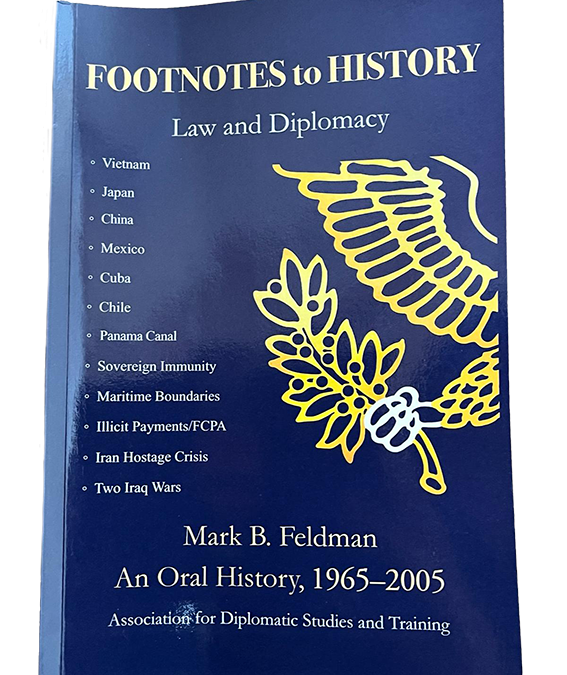
Published last year and highlighted in a recent talk is the fascinating book by Mark B. Feldman, Footnotes to History: Law and Diplomacy.
Feldman has been engaged in U.S. foreign relations law and transnational litigation since 1965, including 16 years at the U.S. Department of State, where he played a pivotal role in developing the concept of the bilateral treaty and the 1970 UNESCO illicit cultural property Convention.
More than 50 years on from his work on the UNESCO Convention, he shares his thoughts on its origins and objectives, as well as what he thinks now.
When the idea of the convention arose, Feldman noted how museums, collectors and dealers feared that a clampdown via UNESCO “would lead to demands for the repatriation of the great collections of ancient art in the United States and Europe”.
He clearly saw his role as balancing interests, describing how he brought together stakeholders across the American art world – archaeologists, art museums, antiquities dealers, and attorneys – later co-authoring a report, which addressed a bilateral treaty with Mexico; an Act of Congress prohibiting the import of Pre-Columbian sculptures from Latin America without the permission of the country of origin; and a multilateral UNESCO Convention based on the principle of non-retroactivity with import controls on archaeological materials threatened by pillage.
Original objectives of the Convention lost over time
Feldman was precise and targeted in his approach. On the pre-Columbian Act of Congress, he writes: “It was the first step by any art importing country to address illicit trade in stolen cultural property, but the reciprocal obligations ‘to recover and return’ were limited to pre-Columbian and colonial objects ‘of outstanding importance’ [and official archives] that had become government property in the other country.”
The bilateral treaty with Mexico was “in practice” a one-off, and has been superseded by “more aggressive actions by U.S. agencies”.
He is enlightening on just how ambitious original plans for the UNESCO Convention were, explaining that the Secretariat “proposed a comprehensive scheme, brutal but coherent, that would have required all parties to refuse import of any cultural property, broadly defined, not accompanied by an export certificate from the country of origin”.
Needless to say, art rich countries blocked measures that they considered would destroy the international art market.
The United States continued to take the lead, drafting a compromise convention.
“The most fundamental points were two: first the convention would not be retroactive – acquisition guidelines would be forward looking – and two, import controls would be limited to cultural property stolen from museums and to specific categories of archaeological interest threatened by pillage to be determined by agreement among the countries concerned.”
Even at that point, however, the antiquities trade was alert to potential abuses. Feldman describes how dealers were “always doubtful about the convention” and “opposed import controls because they feared the State Department would use that authority as a bargaining chip for diplomatic purposes unrelated to protecting the cultural heritage…”. Prescient indeed.
How the concept of bilateral treaties backfired
The U.S. market was also concerned that as it abided by the terms of the convention, others would not, putting it at a competitive disadvantage, leading to Feldman proposing that the State Department “make bilateral agreements for import controls with countries damaged by pillage of their cultural heritage”.
Next came the establishment of the Cultural Property Advisory Committee (CPAC). The idea was for it to be a bulwark in defence of the art market, but, as history, has shown, if anything its role has been the opposite.
“Over the years the State Department has negotiated dozens of bilateral agreements and there have been numerous complaints that State has abused the process for diplomatic reasons as the dealers originally feared,” Feldman accurately observes, as he acknowledges that times have changed, and the behaviour of the trade and wider market “has got a great deal better.”
He also considers that current U.S. policy on cultural heritage protection in relation to foreign patrimony is out of step and “contrary to the U.S. position negotiated in UNESCO in 1970 and adopted by Congress in 1983.”
Many in the market hope that the State Department will take as much notice of what Feldman has to say today on these matters as it did in the late 1960s.
Recent Comments