Countless millions are spent investigating cultural property trafficking to little effect
Preventing trafficking in cultural goods is a major preoccupation of the European Union.
It is one of the key objectives of the constantly updating anti-money laundering regulations; it is the main plank of the import licensing regulation introduced last year; and it led to the creation of Germany’s highly restrictive Cultural Property Protection Act in 2016.
Fears of cultural property trafficking, especially within Europe, have resulted in an ongoing series of co-ordinated law enforcement crackdowns across more than 80 countries since 2014, namely: Operations Odysseus (2014), Aureus (2015) Pandoras I, II, III, IV, V and more (2017-), Sardica (2018), and Achei (2019). These all come under the umbrella of the EMPACT initiative (European Multidisciplinary Platform Against Criminal Threats).
Four current projects running for several years and funded by Europe’s Horizon Project to the tune of €18 million follow on from countless others of the same ilk as they investigate the scourge of trafficking. They are Anchise (€4m), Aurora (€3.5m), Enigma (€4m), and Rithms (€5m) plus another €1.5m being assigned.
Their various remits include:
– Developing methods and digital tools for the protection, identification and traceability of cultural goods.
– Protection, tracing, restitution and safeguarding, as well as provenance research.
– The production of evidence-based research to support the deployment of preventative measures against looting and illicit trade of cultural goods.
– Raising awareness, mobilising and further strengthening cooperation among citizens, stakeholders, experts, policy makers and all actors involved.
Plenty of research but nothing to show for it
In Germany from 2015 to 2019, the €1.2m ILLICID Project analysed over 6,100 ancient objects as it attempted to identify the level and patterns of crime and how they might support money laundering and terrorism financing. At no point did its concluding report identify any trafficked goods or any terrorism financing, the prime goal of the whole project.
Now, a project headlined Culture, Creativity and Inclusive Society will enjoy another €5 million for ‘capacity building’, ‘evidence and intelligence gathering’, ‘cross domain co-operation’ and ‘consolidated tools and platforms’ – for which read more of the same.
So, with all this time and money spent on assessing the scope, methods and other characteristics of the trafficking of cultural goods in Europe and beyond, how big is the problem and what is this illicit trade worth?
The answer so far is that no one has a clue.
Organisations like UNESCO have tried to get round this in the past by quoting substantial figures (in UNESCO’s case $10 billion annually, first quoted in October 2020) that do not stand up to the slightest scrutiny, and which they have since stopped using, admitting that they had no basis in fact.
It detailed the outcomes of Operations Odysseus, Aureus, Pandora and the rest (costs unknown but certainly in the tens of millions of euros based on minimal available data).
Arrest and seizures but no record of outcomes
Of the operations from 2015-2023, it reported: “These operations seized over 234,000 cultural objects (including small items such as coins), with at least 1,255 investigations initiated and 534 arrests made.”
However, despite these figures, no attempt has been made to measure the effectiveness of these operations. Europol, which helped co-ordinate the operations, has admitted to having no data on how many arrests have led to convictions, nor about how many seized items later had to be returned as licit.
The Commission report also reveals that in at least five of the operations, no data is available relating to the number of investigations launched as a result, and in at least three of them no record is available relating to the number of arrests.
The Commission’s publication of the report in March 2025 coincided with the Antiquities Forum’s launch of a survey of a dozen leading bodies concerned with the issue of cultural heritage crime across the world, from the European Commission itself to the FBI, UNESCO, Europol, Interpol and others. What independently verifiable data did any of them have to demonstrate the level and extent of trafficking, money laundering and terrorism financing using cultural property? Not all of them answered, but those that did provided no data at all.
After so many years of investigations and enforcement operations, what is the problem? Why are Europol and Interpol not tracking outcomes from their operations? With so little hard data to go on, one must ask what the point of these exercises are beyond propaganda and to justify the funding for law enforcement bodies.
Art market risk downgraded by the authorities
Art market representatives at the January 2026 meeting of experts with the European Commission to discuss progress with the import licensing regulation put the question again: what data does the European Union have to show the size and scope of trafficking, as well as the actual value of the illicit market in such objects? This is important bearing in mind the enormous level of resources – including public money – being spent on researching this issue. We await an answer.
After countless investigations, operations and reports over the past 15 years, none of the leading bodies among government, law enforcement and the NGOs can provide any idea whatsoever of the scale of the problem, nor any reliable data beyond the extremely occasional case, which almost never involves the art market. Even where it supposedly does – for example with The Louvre scandal – years after the arrests and claims are made, we still await any concrete result. So what does that tell us?
The European Union continues to fund multiple projects and initiatives to prevent the trafficking and looting of cultural property, primarily through Horizon Europe, the Internal Security Fund (ISF), and direct cooperation with UNESCO. While there is no single, isolated budget line for this, the EU Action Plan (2022–2025) provides a comprehensive framework, with millions allocated to specific research, technological, and law enforcement projects.
Among other recent and current initiatives in addition to those listed above are:
– ARTDETECT, which focuses on cutting-edge technologies like AI and blockchain to detect stolen items. Part of an EU-funded €7.5 million research project via the Horizon programme led by Global technology company Orfium called AIXpert, the ultimate objective is to improve transparency and accountability in artificial intelligence systems across sectors.
– PRISM (2025-2027), which aims to fight trafficking in museums. This is part of a multiple set of distinct EU-funded ‘PRISM’ initiatives, the most recent being a €7.6 million project (PEACEPLUS programme) for manufacturing innovation and another focusing on cultural heritage protection.
– The European Commission has co-delegated €2.8 million to UNESCO for a 36-month project (ending roughly 2025-2026) to fight illicit trafficking of cultural property in the Western Balkans.
In all, current projections account for a total of €22.9 million dedicated to future related initiatives. With the €18 million already accounted for, that’s a total of more than €40 million being funneled into multiple projects essentially doing the same thing. And yet, hard data showing the size, nature and scope of trafficking in cultural property, and its links to terrorism financing, remain all but non-existent.
What are these generous budgets really for?
Is it possible that the funds spent on research into cultural property looting and trafficking are actually greater than the value of the property looted and trafficked globally? Of course we cannot know because despite all the money spent, no one has any idea of what that figure is. What these budgets do ensure, however, is significant funding for academics, technocrats, civil servants and law enforcement as part of the incessant NGO/public policy forum gravy train, with the travelling circus of symposia and forums in plush hotels and conference centres around the globe. Enormous focus is put on process and projects, but precious little on effective outcomes and reliable intelligence. This extraordinarily lavish largesse seems unstoppable. Exactly who is holding those with the purse strings to account as the money disappears over the horizon?
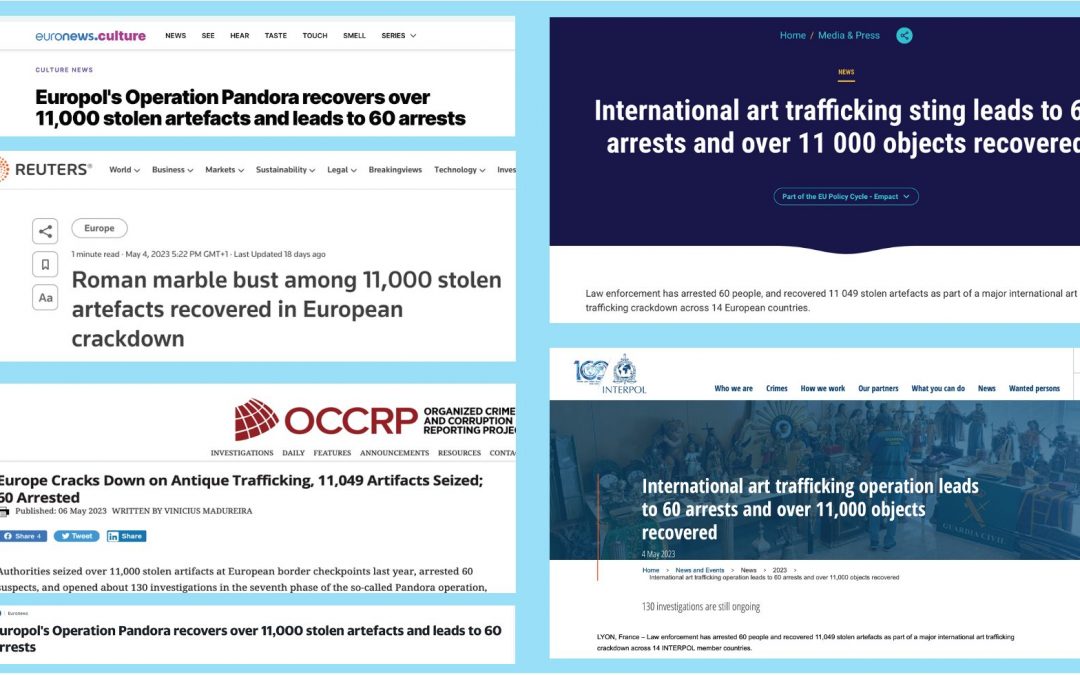
Europol has admitted not having any reliable statistics to support its headline claim over stolen objects in Operation Pandora VII, aimed at tackling cultural property trafficking.
Many media outlets have covered the results of the latest transnational operation co-ordinated by Interpol and Europol with a view to tackling trafficking in cultural property.
Pandora VII, led by the Guardia Civil in Spain, took place over 11 days in September 2022 with two cyber weeks in May and October.
The Europol media release itself stated that the operation led to the arrest of 60 people and the recovery of 11,049 stolen objects across 14 countries.
As the ADA knows well, there is a great deal of difference between seizing items and showing that they are stolen, just as arrests do not equate with convictions.
These operations, along with others named Athena and Odysseus, have been running for almost a decade, and to our knowledge, the authorities have never published either conviction rates or figures confirming how many seizures later proved justified. The ADA and fellow trade association IADAA have sought this information from Europol more than once, but Europol has replied each time that it does not have it, which makes its official release claim this time that 11,049 seized items were stolen all the more surprising.
The twin priorities in carrying out these operations have always been to clamp down on money laundering and terrorism financing, but while there may have been limited evidence of the former across the years, we have heard of no evidence at all of the latter.
Once again we contacted Europol asking the following: a) How many arrests have led to successful convictions? b) How many seizures proved to be valid + how many had to be returned to their owners? c) How many seizures were shown to be linked to money laundering? d) How many seizures proved to be linked to terrorism financing?
As others have also argued, without these accurate clear-up figures, the data serves no purpose beyond propaganda.
Europol’s media office ADMITS IT HAS NO ACCESS TO VITAL DATA
Europol’s media office replied on May 10 as follows: “Unfortunately, we won’t be able to help as we do not have these figures. Europol is not a statistical organisation – Europol’s priority is to support cross-border investigations and the information available is solely based on investigations supported by Europol.”
Confirmation, then, yet again that Europol has no statistics to support the claims it makes, with the further emphasis that Europol is “not a statistical organisation”. If so, what is it doing making statistical claims it admits it cannot support in the introduction to its media release, claims that history tells us will influence policy at a national and international level, as with the introduction to this recent important European Commission document?
Interpol, which has also denied having any reliable statistical information in this field, compounded the error.
Arguably more shameful is the number of media outlets that have reported the unsupported claims Europol has put out in this release without checking them. Newspapers, art market websites and others – all of them experts in their own fields and trained to check their sources – have singly failed to do so in this case.
This is not the first time this has happened; these operations have been going on for a decade and the ADA and IADAA have highlighted the failure of intelligence on numerous occasions. As we showed in this instance, a single email request revealed the truth. So why can’t the experienced journalists working on this story make such a simple check as this to ensure that their reporting is accurate?
One of the worst offenders was Ursula Scheer, a journalist for Frankfurter Allgemeine, who not only swallowed everything she was told without checking, but added even more bogus data to the story unchecked: “According to estimates by the FBI and UNESCO, the annual turnover of the global black market for art and antiques is ten billion dollars, which puts the black market right behind the illegal drug and arms trade.” She also stated: “Selling art and antiques helps mafia activities finance terrorism and war.”
Those who want to know where the bogus data ends and the accurate data begins can check on our Facts & Figures page, which includes independently verifiable data through quoted sources and direct weblink.
The following is the original version of a letter sent by ADA chair Joanna van der Lande and published by the Art Newspaper on page 16 of their July/August 2020 issue
While Europol, Interpol and the World Customs Organisation are very good at grabbing headlines, experience tells us that subsequent requests for more detail on the major international operations cracking down on cultural heritage trafficking tend to fall on deaf ears.
The latest set of seizures and arrests across 103 countries as reported in the Art Newspaper on May 8 (International crackdown on art trafficking leads to 101 arrested and 19,000 artefacts recovered) gives rise to the same set of questions we and other trade associations have been asking for years now:
How much of this material is fake?
How much can be traced back to vulnerable archaeological sites?
Who has been arrested and how many of them are actually part of the art market as opposed to ordinary criminals or gangs?
How much can be traced back to terrorist groups?
How much of it qualifies as cultural property under the terms of the UNESCO Convention?
While the headlines sound impressive, the organisations involved continue in their failure to answer on-going questions about the true effectiveness of these operations. Previous investigations undertaken by the Antiquities Dealers’ Association (ADA) and the International Association of Dealers in Ancient art (IADAA), including direct consultation with the authorities, have exposed worrying gaps in intelligence gathering.
In February 2018, for instance, in responding to an IADAA request for confirmation about the number of countries involved in the original Operation ATHENA, as well as information regarding the volume, value and nature of major items seized during that operation, Europol’s Corporate Affairs Bureau told them: “Unfortunately we do not have such information at hand as we only have a fragmented picture: this operation was coordinated between three partners – us, INTERPOL and the WCO.”
This was a surprising response from one of the main players involved, especially as they had already issued a large number of detailed claims in a press release.
Publicity surrounding this latest operation, conducted in November 2019, focuses chiefly on antiquities and ancient art from around the globe, but does not attempt to distinguish between the genuine and the fake – a key factor in tackling crime, as St John Simpson of the British Museum, an adviser to UK law enforcement, has argued in other recent news reports linked to the seizure at Heathrow last year.
The authenticity of the unique and rare Tumaco gold mask, referred to among the Athena II highlights by Europol, for example, has been called into question by some well placed experts in the field.
Previous operations gave the impression of having a major impact on antiquities trafficking and even the financing of terrorism, although closer inspection showed this not to be the case.
In November 2016, Operation Pandora involved a joint customs, Interpol and Europol operation across 18 European countries. Together they searched 48,588 people (81.6% of them in Bulgaria); 29,340 vehicles and 50 ships. This led to 75 arrests (65 of them in Bulgaria) and the seizure of 3,561 objects in total, comprising:
1000 objects from a single seizure in Poland involving an illegal metal detectorist. These comprised spent bullet cartridges and rusted gun stocks from WW2, which qualify as cultural property under Polish law
500 archaeological objects (mostly coins) in Murcia, Spain
400 coins relating to online adverts
Of the remaining 1600 objects, Europol said that “several” were “of great cultural importance in the archaeological world, such as a marble Ottoman tombstone and a post-Byzantine icon depicting Saint George, along with two Byzantine artefacts”. None of these items was rare, valuable or culturally significant to the extent claimed. All were seized in Greece, another country that is not a war zone, nor did they appear to originate in war zones, although seizing such material was a main objective of the operation. This is not to say the looting of such cultural heritage is not of as much concern to members of the legitimate antiquities trade as it is to an archaeologist.
Notwithstanding this, if these comprised the highlights of the operation, as stated, where were the rare antiquities from war zones, or material associated with terrorism financing, whose intended seizure was the mainspring of this operation?
The tendency to count every coin in a seizure individually rather than as a single seizure also risks inflating the operation’s impact.
A similar pattern of claims accompanied by detailed statistical information released by Europol and the WCO arose for Operation Odysseus in June 2014 and the first Operation Athena in November 2017. However, the ADA and IADAA are not aware of any update on any of these operations, such as confirmation of how many of the arrests and investigations led to successful prosecutions, or whether any seizure at all has led back to trafficking from Syria or Iraq or the financing of terrorism, the twin lynchpins behind these operations. Surely such information constitutes the true measure of these operations’ success and should be made public?
The WCO Illicit Trade report 2017, published in December 2018, did reveal that the largest quantity of items of cultural property seized and reported through their network for that year was a consignment of around 3000 LPs being exported to Turkey from The Netherlands.
While Facebook and other social media platforms present a significant challenge in the fight against crime, it should be noted that Facebook has been proactive in seeking trade help in tackling the issue, having contacted us last year on this matter.
It is disturbing that in her official press release, Catherine de Bolle, Europol’s Executive Director, resurrects the now discredited link between antiquities and trafficking in weapons and drugs. It took years for Interpol to remove misleading claims of a similar nature from its website where, at the same time, it admitted that it had never had any information to show that cultural property trafficking was as significant as that in drugs and weapons, nor was ever likely to have such information. The latest WCO Illicit Trade Report, covering 2018 and seizures reported through its network, showed that while drugs accounted for 32% of all trafficking seizures globally and weapons for 3.6%, cultural heritage – including all art, antiques and collectables, not just antiquities – accounted for 0.08%.
If international law enforcement is so keen to promote its work on these operations, then it should be equally eager to publish their ultimate results in terms of successful prosecutions and evidence clearly demonstrating links to terrorism funding.
Such follow-ups are important because the successes claimed by these operations have been used frequently in the media and by politicians in the EU, as well as elsewhere, to support demands for further restrictive legislation controlling the international art market. If the market is to pay the price, it has a right to know why.
Joanna van der Lande Chair Antiquities Dealer’s Association 15 May 2020

Recent Comments