by ADA | Aug 12, 2026 | Views |
Scotland has published the 2024 review of its treasure trove system. A new scheme that promises a constructive way forward for preservation and record keeping, enthusiasts and the art and antiques industry, is the result.
One of the most important developments for collectors, dealers and auctioneers, concerns the treatment of what are now termed ‘Legacy Finds’.
For the purposes of the new policy, ‘Legacy Finds’ are archaeological objects recovered in Scotland on or before 31 December 1999 that may never have been assessed or recorded under the modern treasure trove system.
Archaeological finds discovered in Scotland are subject to a different system from that operating in England, Wales and Northern Ireland. Under Scots common law, archaeological finds do not automatically belong to either the finder or the landowner. Instead, they fall to the Crown as ownerless property (bona vacantia).
It is essential to remember that under Scottish rules Treasure is not limited to precious metal or stones; it can include a very wide range of artefacts, including wood, glass and textiles, and even worked human and animal bones. Most finds that come under the rules will be over 100 years old, but more modern finds may also qualify.
Ownerless status of finds
In Scotland, finds by metal detectorists and others are not the property of either the finder or the landowner. Instead, they are considered ‘ownerless’ (bona vacantia) pending assessment by the authorities and a possible claim by the Crown.
Responsibility for managing ownerless property in Scotland rests with the King’s and Lord Treasurer’s Remembrancer (KLTR), while archaeological finds are administered specifically through the Treasure Trove Unit (TTU), based at the National Museum of Scotland, which operates on the KLTR’s behalf.
If the Crown does not claim the item, it is disclaimed and returned to the finder with a Certificate of disclaim, which forms part of its provenance.
Where the Crown does claim the find in the public interest, any museum wishing to acquire the object must raise the Finder Reward, from public funds, reserves or private donations.
Where a find is not claimed for a museum collection, it is recorded and returned to the finder together with a disclaim certificate, which confirms that the Crown will not exert its right to claim the find for the nation.
Compensation for finders
The Finder Reward is an ex-gratia compensation payment linked to the market value of the object. That value will be decided by the Treasure Trove Unit (TTU), a panel of experts comprising a team of archaeologists and finds specialists based at the National Museum of Scotland in Edinburgh; it is thought that the panel will include a commercial valuer from the industry. Like the PAS in England, it is thought the value will be based on the hammer price of a similar piece being sold at auction, although this is not expressly stated. Commercial expertise will be of particular importance where similar items have not yet or rarely appeared on the market.
Before the modern reporting regime became widely established, some Scottish archaeological finds entered private collections and the art market without ever being formally assessed or recorded. While there is no statute of limitations on treasure trove in Scotland, the Review has provided a pragmatic way of dealing with these historic finds.
The ‘Legacy Finds’ concept addresses this and covers certain categories of Scottish archaeological finds found before 31 December 1999.
The aim is not simply to determine ownership but also to improve the archaeological record. Collectors, dealers and auctioneers who encounter finds that seem to come under Scottish treasure trove, but are not accompanied by a disclaim certificate, are encouraged to contact the Treasure Trove Unit (TTU) and provide information that will allow the object to be assessed and, where appropriate, recorded.
The TTU will usually require:
- Clear photographs;
- Dimensions and a brief description;
- Known provenance;
- Details of previous ownership, sales or publication history
The Review adopts a pragmatic approach to many older finds. In general, the KLTR will not normally seek to claim finds recovered in Scotland on or before 31 December 1999 where there is evidence that:
- Finds that were bought or sold before 31 December 1999;
- Finds that have demonstrably been outside of Scotland since before 31 December 1999;
- Finds assessed by the Treasure Trove Unit to have been public knowledge before 31 December 1999, whereby the Crown had already had an opportunity to exert its claim.
“Legacy Finds reported to the Treasure Trove Unit are assessed and recorded, with consideration given to their archaeological significance,” the review explains. “In most cases falling within the Legacy Finds policy, the KLTR will not normally seek to claim the object. However, where a find is claimed for a museum collection, the Treasure Trove system provides for the payment of a Finder Reward award, normally reflecting its market value. This helps ensure that significant objects can enter public collections while providing reassurance to collectors, dealers and auctioneers who come forward with previously unassessed material.”
What to do with a Find
Dealers wanting to sell a Legacy Find should first contact the TTU at least a month before the proposed sale to allow for the assessment to be conducted. Having said that, the review also states: “While the treasure trove system is not simply a service for finders, in our judgment the target of 12-month average completion times for straightforward cases, which is referenced as the norm in the Code of Practice, is a reasonable basis for expectation and delivery. It is understood that complex cases require more time.”
Where appropriate, the TTU may issue a Certificate of disclaim confirming the Crown has chosen not to exercise its rights over the finds.
For the trade, this potentially offers a route to obtaining greater certainty regarding provenance while also contributing valuable information to Scotland’s archaeological record.
The Treasure Trove Review, which includes additional investment in the system, hopes that before too long it will be possible to upload all this information via an app.
Currently, the system does not provide a detailed breakdown of reasons either for a claim or a disclaim, but this will be reviewed further.
A balanced system
“While participation in the treasure trove system is not voluntary, the Review recognises that the system benefits from meeting reasonable expectations on the part of those who experience it,” it concludes.
For museums, finders and the trade, the new approach to Legacy Finds seeks to balance protection of Scotland’s archaeological heritage with a practical recognition that many objects have circulated openly for decades. By encouraging their assessment and recording, the reforms should improve the archaeological record while providing greater certainty for collectors, dealers and auctioneers.
“We have come to the clear view that the resources available to the treasure trove system, specifically for operational funding of the Treasure Trove Unit, have not kept pace with the growth of the workload over the last 20 years, and that under-resourcing has had a negative impact on resilience in the system, confidence and participation,” the review explains. “Taken together, all our recommendations for reform rely on, and contribute to, a realistic plan for sustaining the system financially.”
In summary, the proposals are impressive and designed to improve consistency and transparency in rolling out the new regulations, thereby instilling increased confidence in the system among museums, the public and the trade.
More information can be found in the Treasure Trove Scotland: Code of Practice
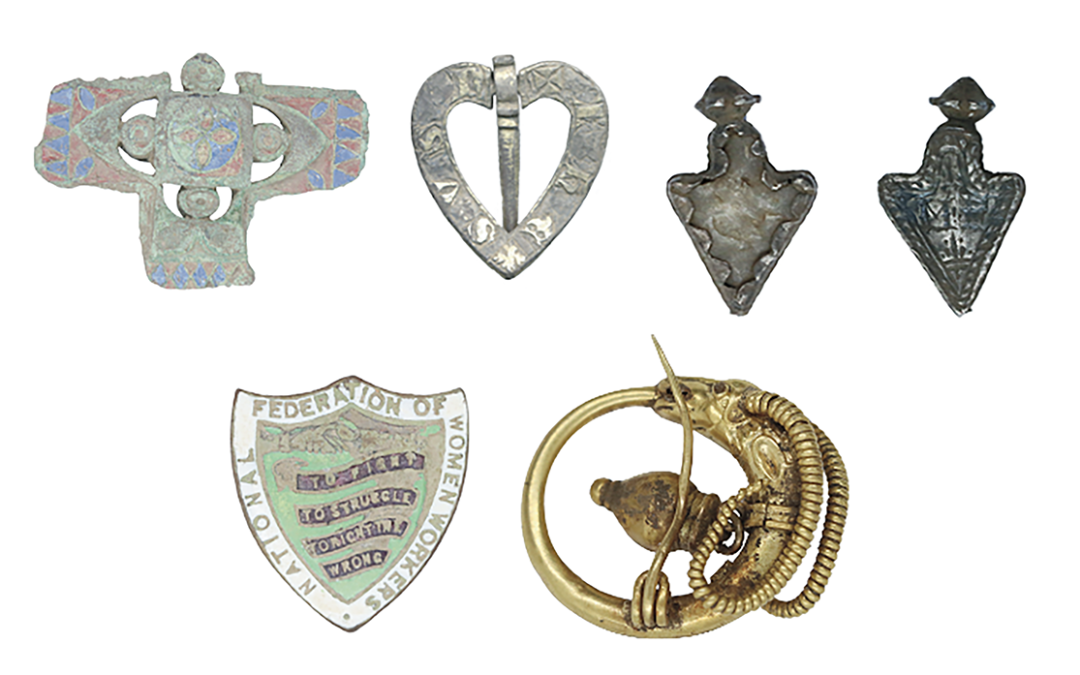
Caption to the image shown above:
Artefacts covered by the new Scottish treasure trove rules can be of any age, from ancient to modern, and almost any material. Here are some examples. Clockwise from top left:
– An enamelled coppery alloy Roman Iron Age harness fitting, 1st or 2nd century AD.
– A late Medieval gilded silver heart-shaped brooch, c.1300-1500 AD.
– A Bronze Age tanged arrowhead of flint, set in a silver bezel, so-called ‘elf shot’ amulet charm, reuse in 17th/18th century.
– A gold zoomorphic annular Castellani brooch in the form a ram’s head, in the archaeological revivalist style, 19th/early 20th century.
– A gilded and enamelled copper alloy National Association of Women Workers badge, early 20th century.

by ADA | Jun 26, 2025 | Views |
Supranational authority’s failure to join the European Convention of Human Rights – despite promising to 15 years ago – protects it from legal action by citizens unfairly suffering under import licensing law
Although every member state is a signatory to the European Convention on Human Rights, the European Union itself is not.
It committed to joining as long ago as 2010, but concerns arose that submitting itself to the ECHR might cause conflicts between the European Court of Justice and the European Court of Human Rights. Joining the ECHR would also lead to fundamental changes to EU powers.
Essentially, as an autonomous body, the EU would be ceding sovereignty to the ECHR, allowing individuals to challenge it legally over human rights in a way that they cannot do now.
While the EU remains committed to joining, 15 years after saying it would, the debate over resolving these conflicts continues.
This is important for those subjected to the EU import licensing regulation for Cultural Goods (2019/880), which comes into full force on June 28.
The fundamental driver for the legislation was the requirement to prevent illicit cultural goods that might have funded terrorism from entering the EU.
Finding evidence of this threat was essential to justifying the regulation under the terms of the European Commission President’s guiding principles for making policy. They stipulated that regulation had to be “targeted, easy to comply with and does not add unnecessary regulatory burdens… we must send a clear signal to citizens that our policies and proposals deliver and make life easier for people and for businesses.”
Ursula von der Leyen also ordered her commissioners to operate a policy of one-in-one-out so that “every legislative proposal creating new burdens” would “relieve people and businesses of an equivalent existing burden at EU level in the same policy area”.
“Proposals must be evidence based, widely consulted upon and subject to an impact assessment reviewed by the independent Regulatory Scrutiny Board. You will ensure that they respect the principles of proportionality and subsidiarity and show the clear benefit of European action.”
So, what happened here?
– No one-in-one-out. In fact, with additional anti-money laundering legislation, it has been at least two in and none out.
– No evidence of terrorism financing could be found, according to the two official reports (Deloitte and Ecorys) ordered by the European Commission.
– Data published by the European Commission to justify the regulation turned out to be wrong.
– The European Parliament concluded that the Impact Assessment conducted to see how the regulation would hit home lacked “sufficient and reliable background evidence” and “robustness and depth” in its analysis, and it dismissed it as “not always entirely convincing”.
– The Regulatory Scrutiny Board was highly critical of the regulation even as it passed it on the second review. Its recommendations were not followed up.
– Few dispute that the regulation will make life for citizens and businesses considerably harder.
Protocol 1. Article 1 of the European Convention on Human Rights (ECHR) protects the right to peaceful enjoyment of possessions, meaning everyone is entitled to own property and have it protected. This right isn’t absolute; it can be limited in certain situations, but any interference must be lawful, serve a legitimate public interest, and be proportionate.
Likewise, Article 17.2 of the Universal Declaration of Human Rights (UDHR) states that “No one shall be arbitrarily deprived of his property”.
So, the ECHR recognises that such interference must be legitimately in the public interest and proportionate. The UDHR says interference must not be arbitrary. ‘Arbitrary’ here means without justification or in a way that is not proportionate.
Now, as the law was introduced to counter the threat of terrorism financing AND no evidence of such terrorism financing was found after extensive official and expert investigation, the measures brought in seem wildly disproportionate.
They:
– Do not make the lives citizens or businesses easier
– Do not honour the one-in-one-out principle
– Arguably breach human rights conventions to which all member states are signatories because they appear to be neither justified nor proportionate, and so could reasonably be termed arbitrary in their interference.
In addition, while they deprive ordinary citizens of fundamental human rights and blight honest business, they are unlikely to have any serious impact on crime, because this crime has not been identified as taking place in the EU, and criminals tend to smuggle illicit material, not submit it to customs. On top of that, other financial crimes such as fraud and money laundering are already addressed through alternative existing legislation.
The next few months will reveal just how damaging the new regulation is. Let’s just hope that dealers, auction houses, collectors and ordinary EU citizens can stay the course while this highly inadvisable experiment continues.

by ADA | Jun 19, 2023 | News |
When the new import licensing regulation for cultural goods (2019/880) comes into force in the EU on June 28, 2025, what goods will be affected from the world of art and antiques?
According to the law, relevant items – all of which must have originated from outside the EU – will be split into two types: those that need a full import licence, and those that can be brought in on the basis of an importer statement.
What those items are is set out in a series of three tables in the Annex to the legislation, Parts A, B and C.
Any attempt to import an item covered by Part A will be prohibited if it is deemed to have been exported illegally from its country of origin, whenever that was.
Items included under Part B are more than 250 years old and seen as being at greater risk of looting and trafficking than those covered by Part C, and so are subject to tighter rules – in other words these are the pieces that need an import licence rather than an importer statement, and no minimum value threshold applies. This means that unless customs tell the importer otherwise, a licence will be required for every individual item, even where they might be identical, low-priced pieces imported together in large groups.
It should be remembered that being issued with an import licence conveys no ownership rights or proof of the item being legitimately acquired.
Applicants for a licence will have to demonstrate that the item in question was exported from the country where it was created or discovered in accordance with the laws and regulations of that country at the time (whenever that was – and it could be centuries ago).
Essential licences and certificates
If that country issued export licences or certificates at the time, the applicant must provide the relevant original licence or certificate (even though there has never been any requirement to keep them once used). Otherwise, they must show that no such laws and regulations existed at the time.
Because many of these items will have left those countries decades or more beforehand, that proof may no longer survive, if it was ever there in the first place. So, the law provides a third way of qualifying for a licence: evidence that the item in question has been exported in accordance with the laws and regulations of the last country where it was located for an unbroken period of more than five years.
There are further conditions to this option. Assuming you can prove that the item has spent an unbroken period of more than five years in a single country, you must also show that it wasn’t there for temporary use, or was just there in transit, for re-export or transhipment. You must also show that it was exported from the country where it was created or discovered before 24 April 1972 – when the 1970 UNESCO Convention on trafficking of cultural goods first came into effect.
One cause for customs rejecting the application will be if it has “reasonable grounds” to believe that the item’s original export from the source country was illicit. But the regulation does not say what “reasonable grounds” means in this context.
Items covered by Part C needing an importer statement are all individually valued at €18,000 or more per item and are more than 200 years old.
by Antiquities Dealers' Association | Jul 27, 2017 | Uncategorized, Views |
COMMENT: A perceived lack of regulation, the rise of art as an alternative asset class and conflict in the Middle East present a triple whammy for an unprepared art market. What has happened to the market? And what must happen now? asks Ivan Macquisten

Antiques Trade Gazette’s current report on how the trade is fighting back against misperceptions and propaganda.
The international trade in antiquities has been the focus of sustained criticism over the past few years as a result of the wars in Syria and Iraq. Anti-trade campaigners – academics, archaeologists, politicians and others – who have been trying to shut down the legitimate trade for years, have seized this opportunity to lobby hard for new regulation, ever-tighter restrictions on trade and more draconian punishments for even slight infringements. There have been calls for the private ownership of antiquities to be made socially unacceptable.
Fake news
The dissemination of biased or badly conducted research and questionable relationships with the media, much of which appears complicit, or at least complacent, has not helped. This is part of the widely recognised ‘fake news’ issue, as 24-hour rolling reporting combined with declining resources within the media – particularly in the press – rob journalists of the opportunity to investigate in any depth or check facts. This makes them increasingly vulnerable to unscrupulous interests that want to present propaganda as news. Outlandish figures relating to the size of the problem of looted material coming out of Syria, for instance, have been widely accepted as utterly unfounded by all sides in the debate for some time now, yet continue to be peddled by a number of quite prominent sources.
This has led to criticism from anti-trade campaigners themselves. Dr Neil Brodie’s article for the European Union National Institutes for Culture, says the propagandists exaggerate the problem to attract government attention and more funding. This leads to inappropriate policy, which in turn damages the very nations and cultural heritage institutions they seek to protect.
Inaccuracies
Even government research and publications, in the US, Germany and elsewhere fall short of the standards that should be expected. Recently, Homeland Security Today, the news and views website for the eponymous US department, published my critique of Homeland Security’s report last October, Cash to Chaos, dismantling ISIS’ financial infrastructure.
The report’s small section on antiquities was riddled with inaccuracies, the footnotes quoting out-of-date and long-discredited media articles as primary sources of evidence to support the claims. In some cases, the reports mentioned in the footnotes did not contain any of the evidence referred to at all. If this can happen with Homeland Security, whose report was leapt on by campaigners as further proof of the antiquities problem, who else can be trusted?
Many of those who want to see an end to any trade, legitimate or not, dedicate most of their working lives to this cause. They tend to be very well funded and organised, and have the ear of governments, law enforcement and NGOs, which do not appear to appreciate the distinction between those who trade lawfully and those who do not.
The effectiveness of these campaigners is not to be underestimated, especially as the antiquities sector in particular and the art market in general have been woefully unprepared to tackle such unrelenting criticism.
All of this is not helped by the perception that the wider art market is fairly lawless. True, it is not directly regulated in the way that finance, health, insurance and the law are, but there is direct regulation, and plenty of it (see the British Art Market Federation’s list of regulation. A dealer’s liability under the new Cultural Property [Armed Conflicts] Bill is a case in point: potentially, they can be jailed for up to seven years for even unintentionally breaking the law.
How it all changed in 2008
What the art market has failed to understand until quite recently is that everything changed in 2008. When the markets crashed and pulled the rug out from under gilts and bonds, those traditional safe havens of wealth, the relative risk of art as a store of value diminished, making it much more attractive as an alternative asset class. The banks and wealth managers started to advise clients to diversify their portfolios.
Where money heads, attention follows – and not just from investors. Regulators, governments and criminals also turned their gaze on the art market as a significant influx of cash created the potential for money laundering, market manipulation and other undesirable activities. Transparency became the buzzword of any discussion about the market, but transparency is just the outward manifestation of the real problem: lack of trust.
The market generally was unused to such scrutiny and ill equipped for what it would mean: media attacks, tighter controls, new laws and wider attempts at regulation. Many continue to bury their heads in the sand, but others have realised they must act now to build confidence with the authorities and public before it is too late.
Despite this, most have still not accepted that such a programme requires a significant investment of money and time, the sort of commitment on which the other side in the debate has long been able to rely.
Against this background, and the emerging Syrian conflict, the antiquities trade found itself in the front line. What makes life even harder for the trade is the role antiquities now play in international diplomacy. Nation states are using cultural property or heritage as a political tool in negotiations, to curry favour with other countries or to burnish their credentials as virtuous campaigners for the greater good.
The trade fights back
Around two years ago, the Antiquities Dealers Association (ADA) in the UK and then the International Association of Dealers in Ancient Art (IADAA) recognised that they needed to fight back. As such, they realised they must revisit their own codes of conduct and improve procedures and methods of communication, whether via their websites, direct mail, PR and media opportunities or their relationships with the various authorities.
They have been very effective in doing so, leading the way in raising wider art market standards – as parliament has recognised – and shaping debate with lawmakers, law enforcement and the media at national and international levels.
Their success can be attributed in part to their thorough research and presentation of arguments supported by independently verifiable evidence, in part to the dedication of their representatives, and in part to the fact that the anti-trade campaigners have not been used to having their propaganda challenged and so are sometimes inattentive when it comes to detail.
Nonetheless, rich and powerful anti-trade interests – supported by countries such as Egypt that wish to reclaim their cultural property, regardless of whether it now rightly belongs to others – have persuaded governments to introduce major changes in the law in Germany, the UK and the United States, laws introduced as a result of mistaken views of where problems lie.
The rather less well-funded antiquities trade is fighting an effective rear-guard action, but very much against the odds. What the trade does have is a network of knowledgeable experts, a sophisticated strategy and a wealth of evidence and data to support its case; it is also getting better organised, with disparate groups in the USA coming together to fight for better understanding and a fairer deal. It needs better financial and strategic support as the trade improves its own relationships with decision-makers further and continues to fight for recognition in national and international debate.
Trade organisations have already tried to engage with their fiercest critics, but the signs so far are that campaigners have no intention of giving any ground. I can understand this: they have had unrivalled success so far and can’t see any reason to compromise. It is clear that many simply believe that any trade whatsoever means providing cover for the crooks. What may surprise them is that legitimate trade is the arch-enemy of the crooks, as criminal activity damages the reputation of those who trade lawfully.
The wider art market needs to wake up fully to its challenges, as demonstrated so clearly already in the microcosm of the antiquities market. That means better self-regulation in the form of codes of conduct, ethical behaviour and transparency, as well as a more effective public charm offensive, with the trade associations taking a prominent role.
This article first appeared in the July/August 2017 issue of the RICS property Journal
See also www.imacq.com

Recent Comments