The real cultural heritage rift that all stakeholders need to heal
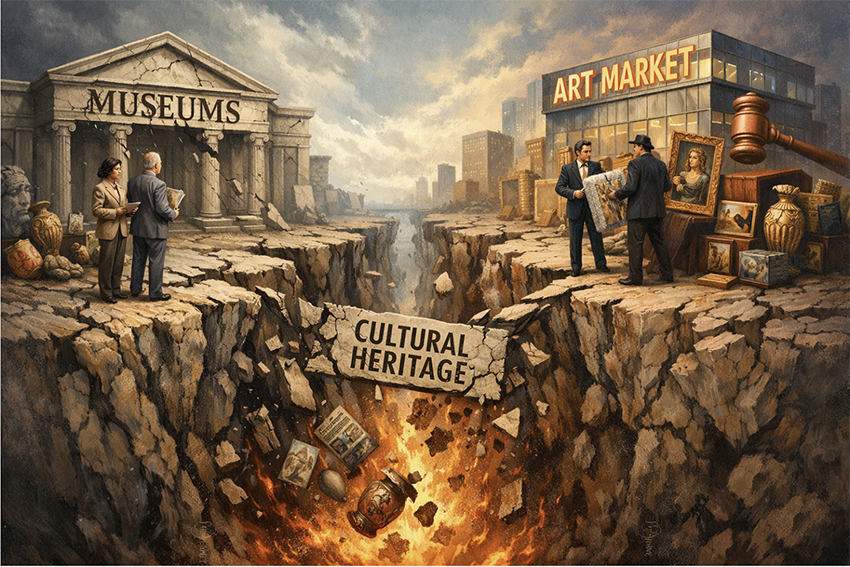
Academic and cultural institutions, as well as governments, continue to look down on the art market – it’s unfair and is in no one’s interest
Provenance and Due Diligence have become the critical factors in assessing cultural goods in recent years. Theft, trafficking, unethical acquisition in colonial times, suspected links to money laundering and terrorism financing have all been presented as arguments for tighter controls and reversing the burden of proof so that items and people are deemed ‘guilty’ unless they can demonstrate their innocence.
The ardent pursuit of this ‘solution’ has brought its own problems: an embarrassing dearth of reliable evidence – hence the reversal of the burden of proof (initially under UNIDROIT 1995) – false data and fake news, failure to check facts and sources, overreach that risks breaching human rights and brings other ethical issues. The exploitation of the cultural sphere for soft power diplomacy includes further exploitation by those who wish to harness it for financial gain or political influence. State-backed programmes and institutional interests are where the real power lies: funding and ‘capacity building’ the self-interests at its core.
This is the environment in which the international art market finds itself the useful whipping boy of those who wish to justify their actions and budgets.
For many on the institutional side of the argument, however, the market really is the problem; they see themselves as being in conflict with – and better than – the trade, while positive actions on the part of the market are deemed merely incidental.
A conversation on…Provenance Research and Due Diligence in the Art and Antiquities World: Distinctions, Connections, Synergies, Challenges, held online on April 8 as part of the International Art Market Studies Association Law & the Arts course 2025–2026, attracted more than 140 attendees.
It addressed the increasing relevance of provenance research and the reasons for this, from the social responsibility of institutions, via the Washington Principles relating to Nazi-looted art to a wider moral responsibility to society and history.
Defining the difference between due diligence and provenance research
Attempts to define the difference between provenance research and due diligence were most usefully summarised as the following: due diligence is the checking of provenance to the extent of what a reasonable person should be expected to carry out related to a specific event, such as a sale or acquisition, whereas provenance research is a wider, ongoing investigation into the history, origins and circumstances of an object.
A higher standard of diligence should be expected from art market professionals as they have more knowledge of objects, it was argued. Presumably such a standard would also apply to museum experts for the same reason, but this was not mentioned.
An overwhelming number of attendees to the session work in the public or academic sphere, as curators, provenance researchers attached to institutions or as officials linked to museum organisations. This resulted in a largely uniform perception and opinion.
Despite this being a course staged by the Art Market Studies Association, art market representatives were extremely thin on the ground. None were included as speakers.
This is a chronic issue with much of the debate over ethics, standards and the law relating to the market. A good example came early on, when Sofia Bollo of the Ethnographic museum at the University of Zurich, who also serves on the Chair of the ICOM Italian section, discussed the working group on provenance research at ICOM. Set up in 2023, it includes more than 100 members: anthropologists, archaeologists, art historians, unemployed people, museum and research interest – but apparently no one from the international art market. This means that we have a body proposing a set of stringent rules for a market that it has not consulted and about which it has a limited understanding. While this may be fine for setting common standards among institutions such as museums, it is unfortunate when it is quite clear that for any measures to be effective in the market, they must address the market from a practical standpoint.
A useful summary of post Second World War initiatives addressing ethics and behaviour covered UNESCO (1970), UNIDROIT (1995), and various EU Directives. As market professionals have found, however, States Parties to the UNESCO Convention tend to cherry pick the articles that suit them, which means that most, if not all, have yet to submit essential lists of goods of national importance, and few are keen to offer the compensation they are committed to when reclaiming items from honest purchasers.
This trampling of a long-established moral right by a new and questionable ‘ethical’ standard is the whole cultural heritage debate in microcosm.
Bilateral agreements and the creeping recognition of domestic laws internationally (not all of them reasonable, notably US vs McClain – 1977) is increasingly creating a situation where honest owners are deprived of the valid title to their belongings. This trampling of a long-established moral right by a new and questionable ‘ethical’ standard is the whole cultural heritage debate in microcosm.
The Australian academic and specialist in cultural heritage law, Lyndel Prott, argued for ‘required diligence’ rather than ‘due diligence’, but that would also require very clear, globally adopted parameters that have yet to be defined. She took a realistic approach to historical norms, acknowledging that provenance standards today could not be applied retroactively to purchases of decades ago.
Alyssa Thiel, of the Penn Cultural Heritage Center, one of several attendees who have worked in the Manhattan District Attorney’s Antiquities Trafficking Unit (ATU), also considered historic norms. She noted the pressure on museums to acquire the best pieces at a time when their context was seen as more important than their history of ownership.
An enlightened approach, it is not shared by the head of the ATU, Assistant District Attorney Matthew Bogdanos, who has seized many such items.
Prott also argued that private sellers were now more of a problem than market professionals because the latter were subject to greater regulation, including anti-money laundering laws, and many have professional compliance departments.
It is almost as though anyone outside the market refuses to believe that market professionals can act with anything other than dishonest or dishonourable intent.
Absent from the debate, however, was any recognition that just as museums and other institutions don’t want to find themselves handling illicit material, neither do auction houses or dealers – and for the same reasons. It is almost as though anyone outside the market refuses to believe that market professionals can act with anything other than dishonest or dishonourable intent.
The webinar also set out the list of checks that should be undertaken when carrying out due diligence, from checking stolen art databases and ICOM red lists to requiring sellers to provide written evidence and supporting paperwork or, in their absence, a notarised statement. While much of this is already the norm, how much would it cost to pursue all the avenues set out and how long would it take? If such checks are essential for all transactions, how much of the market would survive for lesser, cheaper objects?
As Daniel Healey, a Provenance Research specialist at Worcester Art Museum, Massachusetts (and another former ATU staffer) noted, the work of provenance research can become very expensive for museums – sometimes they have to travel to check sources. It is a challenge to museums to fund such provenance research and it requires ongoing support, he advised. They have to rely a lot on colleagues in other institutions.
Again, attendees seemed to apply a double standard here: while Healey complained of the lack of time and resources facing museum curators as they tried to assess items coming up for auction – and blamed auction houses for this – no one considered that auction house specialists themselves, and dealers, faced the same challenges. Why should special consideration be given to one set of professionals but not the other?
Export certificates were another consideration. Now vital under the EU import licensing regulations, the fact that they rarely survive in any useful form continues to be overlooked.
Despite this, the UNIDROIT working group on cultural objects with significant gaps in provenance (usually known as Orphan objects) has been able to make some sensible contributions. Due Diligence is not just about compliance, it’s also about reducing costly mistakes and sustaining public trust.
France is attempting to standardise provenance research
A move in France to nationalise how provenance research is carried out includes a mandatory eight-page provenance form for any public acquisition that is already in place. How would this apply to the market? Who would pay for the compliance? Again, no consideration of the practicalities. Nonetheless, as with every forum of this type, a common complaint was the lack of resources and funding to support their work. Yet no one considers that market professionals face identical issues.
Engaging with the art market is an oft-quoted objective to justify what are usually predictable anti-market outcomes of projects and research. In practice, however, such ‘engagement’ is ignored, ineffectual or simply a fig leaf to cover an ideological approach. Until those in the public sector, together with those in the private institutional sector, recognise that the market faces identical challenges to them, it will be hard to move forward. You cannot expect to apply impossible rules to others while giving a free pass to yourself in the same context.
Recent Comments