by ADA | Nov 2, 2022 | News, Uncategorized, Views |
The World Customs Organisation has finally published a new report following the 2019 report, covering two years from 2019-2021, probably delayed because of the Covid 19 pandemic. Its results once again show that global levels of illicit trade in cultural property are far lower than claimed.
In the press release we read: “This year, the analysis provided in this Report is based on data collected from 138 Member administrations. Previously composed of six sections, the Report now covers seven key areas of risk in the context of Customs enforcement: Anti-money laundering and terrorist financing; Cultural heritage; Drugs; Environment; IPR, health and safety; Revenue; and Security.”
It also states: “The analysis contained in this Report is mainly based on the collection of data from the WCO Customs Enforcement Network (CEN) — a database of worldwide Customs seizures and offences”….
“However, the CEN database relies heavily on voluntary submissions by Members hence the quantity and quality of the data submitted to the system has its limitations”…
“However, as part of this new methodology, the data and information sources used to elaborate this Report has been enlarged to include various open sources.”
While the rest of the report might be “mainly based on the collection of data from the WCO Customs Enforcement Network (CEN)”, in the introduction to the Cultural Heritage chapter on page 57, the WCO goes further, admitting: “Unfortunately, the data received through the WCO’s Customs Enforcement Network (CEN) in 2020-2021 being incomplete, the following analysis will be mostly based on open source information.”
Case studies based on media reports rather than primary research
The result for the Cultural Heritage section is that most of the case studies are based on newspaper articles, sometimes even on events that happened decades ago, and have nothing to do with recent trafficking activities. This is alarming as much of the problem with false data plaguing the cultural property sector stems from misreporting in the media. It is even more alarming when the misleading picture created by a surface reading of the chapter will undoubtedly be used as ‘evidence’ in future campaigns against the art market, as past reports have been.
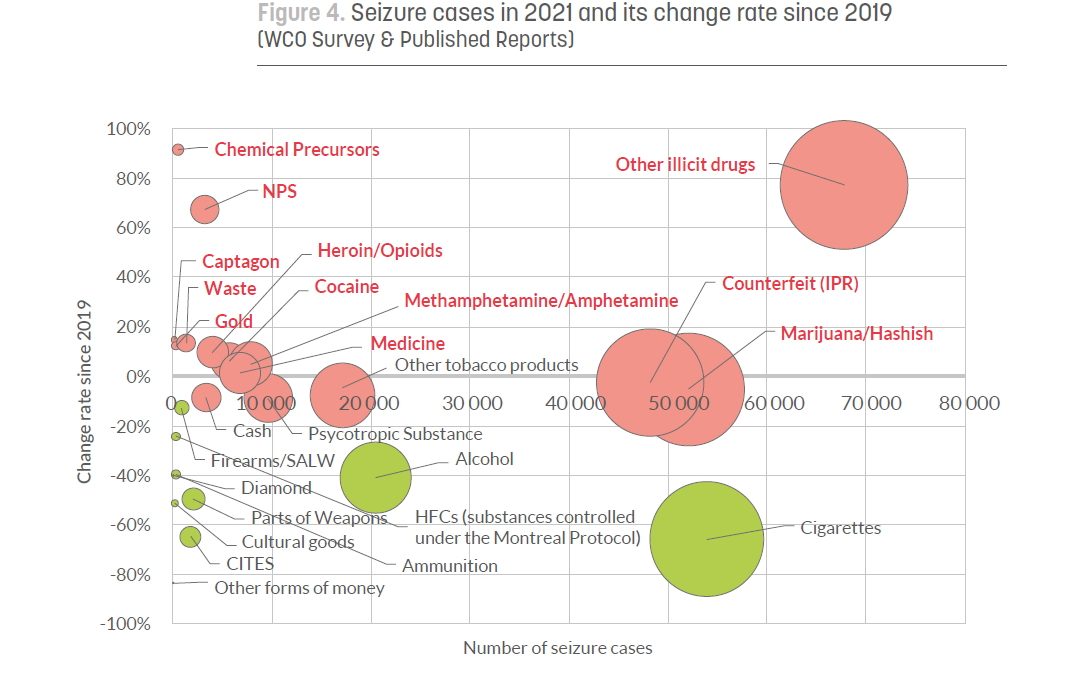
The WCO is supposed to report recent and reliable figures, like figure 3 on page 35, showing that the number of worldwide reported cultural goods cases for 2021 is a mere 156, that is 1.1 case per reporting country….
A newly introduced graph (shown here) in the WCO report (Page 17, Fig. 4) reveals precisely what the ADA and its fellow association IADAA have reported over the past years: the illicit trade in cultural heritage is so small that it barely shows in the statistics. Not only is it the smallest category – so small that you have to look carefully in case you miss it – but the graph also shows that seizures have fallen by around 50% between 2019 and 2021.
Let’s not forget, too, that the Cultural Heritage category is not limited to antiquities, as so many mistakenly believe; it covers 13 distinct sub-categories, including: all forms of art, antiques and collectables, household items, flora and fauna, books and manuscripts. In 2019, the top three categories of recovered item sub-categories were: Fauna, Flora, Minerals, Anatomy & Fossils; Other; and Hand-painted or Hand-drawn articles and works of art. No mention of antiquities, which did not even warrant its own sub-category.
All of this begs the question as to why, in its chapter on Cultural Heritage, the WCO has chosen to focus exclusively on photographs of seized antiquities (at least one of which seems to be a fake) alongside fossils and coins. The choice appears politically charged.Consistent reporting of
The WCO has stated in the past and here that there is under-reporting of crime in the culture sector and that it only counts seizures and cases reported via the Customs Enforcement Network (CEN), the implication being that the problem is much larger.
Figures consistently show low rate of illicit trade in cultural property
However, the miniscule share of illicit trade represented in its reports over the years by cultural property has been consistent, only now augmented by media reports not sourced via the CEN.
It further boosts this chapter of the report with a summary of Pandora VI, the latest in a seven-year campaign of international operations involving mass seizures and arrests. What the WCO, Europol or Interpol have never done, however, is to provide data on how many of their seizures and arrests later prove to be justified and how many were shown to be related to terrorism financing. It is not just the trade asking for these figures, academic investigators want them too to see how effective these operations are.
Previously the WCO has attempted to rebut the ADA and IADAA’s analysis of its reports, stating that the figures cannot be relied on. As our analysis always provides transparent sources for the data emanating from the reports, however, the WCO’s case against our analysis simply does not stand up.
Ultimately, its figures must be indicative of the global state of affairs; if they are misleading, why publish them?
by ADA | Jul 6, 2022 | Views
Věra Jourová, vice-president of the European Commission for values and transparency, has decided to target fake news and disinformation. She calls it “potentially even more dangerous” than conventional weaponry.
Russia’s propaganda campaign surrounding its invasion of Ukraine has prompted this action, but it is also an excellent opportunity to address all of the fake news surrounding antiquities. Those guilty of promoting it include the media, governments, NGOs, campaign groups and even law enforcement.
Cultural property has become an important soft power diplomacy tool in recent years. The incentive for interest groups and individuals to spread false evidence and data as propaganda has grown substantially as a result. Equally corrosive has the been the failure to check the validity of claims. Lack of time and resources is at fault, but so is confirmation bias. If the claim fits your narrative, why bother to check whether it is true or not?
How to begin
Ironically, this applied to the European Commission’s own Fact Sheet, Questions and Answers on the illegal import of cultural goods to finance terrorism. Published on July 13, 2017, it set out the evidence on which the EC relied to press ahead with its import licensing proposals for cultural property and the art market. Researching the sources of its data and claims back to their original sources show clearly that they are groundless.
UNESCO’s 50th anniversary campaign, The Real Price of Art, and its bogus $10 million figure as the annual value of cultural property trafficking, have attracted extensive reporting in the media, but both are bogus and easily checked.
Many other questions arise over claims made by public bodies that should know better. The ADA and IADAA have exposed a large number of them for what they are. It is time that the authorities got a grip on this for the benefit of public confidence as well as better policy.
by ADA | Oct 6, 2021 | Views
Martin Wilson is the former Chief General Counsel for Christie’s, the auction house at the centre of this case. Now as Chief General Counsel for Phillips, who do not trade in antiquities, his interest in the subject is academic. Here he shows a firm grasp of the relevant arguments at hand in a detailed article published on Linked In.
Wilson gives the back story to how Turkey ended up launching a legal claim for the return of the Guennol Stargazer, an Anatolian marble figure dating to around 3,000 BC. It also explains why Turkey lost its claim in the District Court. A lack of evidence to support its claim combined with its failure to act for years when it could have done so weakened Turkey’s case beyond hope here.
Arguably Wilson’s most important observation is as follows: “It is sometimes assumed that, because of the complex ethical, political and historical issues which surround them, cultural restitution claims are not subject to the same evidential requirements and rules of justice which apply to other claims or at least that these rules should be applied less rigidly. This ruling illustrates that this will not be the approach where the parties bring their dispute before the US Courts. It confirms that in common with any ordinary civil ownership dispute, a party claiming restitution must, if it hopes to prevail in a US court of law, be able to satisfy the evidential burden of proving the facts necessary to establish ownership in accordance with the requirements of the law.”
This may also explain why Italy has avoided going to court in its claim against Alan Safani.
Wilson notes the increasingly commonplace arguments used by source countries in their attempts to reclaim artefacts: “It is not uncommon for the parties on either side of the debate in cultural property restitution cases to assume bad faith and wrongdoing. The Turkish government followed a line of argument which is commonly used in cultural restitution cases – that an antiquity outside of its country of origin without evidence of how it came to leave that country should be treated by collectors as a red flag and that there is a presumption of illegal export or excavation which arises in such circumstances.”
Fortunately, although source countries’ attempts to reverse the burden of proof in this way may work under the terms of their Memoranda of Understanding with the United States, it is a different matter when these claims go to court, as this case shows.
Wilson also reminds us that statutes of limitation do count, although they are constantly overlooked.
Crucially, he concludes with some sound advice: “While the judgment does not say so, the outcome of the Stargazer case highlights the shortcomings of the debate over cultural property being expressed as a question of “ownership”.” Certainly, while source countries continue in their attempts to ride roughshod over individuals’ legal rights, no one will be satisfied.
by ADA | Jun 24, 2021 | Uncategorized, Views
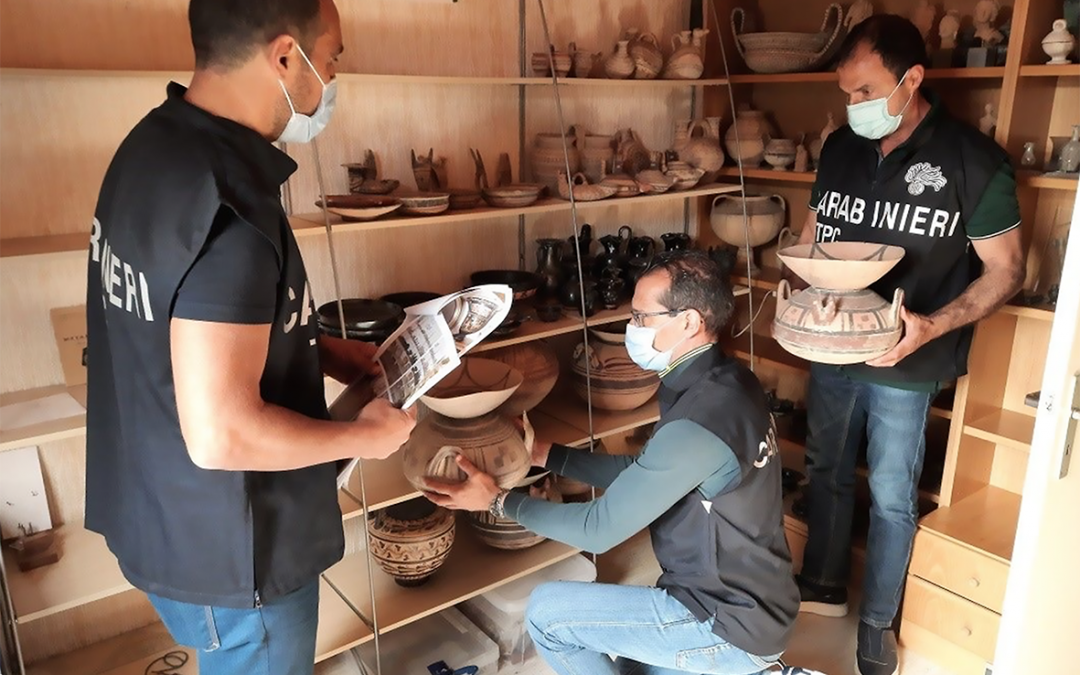
When Eurojust announced that a Belgian collection of nearly 800 Apulian artefacts valued at €11 million had been seized and returned to Italy, it appeared to be a major victory for the Carabinieri and EU law enforcement.
However, dig deeper and all is not what it appears.
At the heart of this case is a stele, which has been part of this collection for decades. It had some missing features that matched fragments on display in a museum in Puglia. The implication? The stele must have been exported illegally: “The missing part enabled authorities to make a link to the artefact displayed during the expositions and led to the Belgian collector,” Eurojust explains.
What came next sounds dramatic: “At his premises, the investigators found the main part of the tombstone and were able to match this to the parts displayed in the Italian museum. During the investigations, a further vast collection of illegally excavated artefacts and pieces of pottery was found, dating to between 600 and 300 B.C..”
Establishing judicial co-operation between the Belgian and Italian authorities led to the entire collection later being shipped to Italy.
However, despite the claims, questions remain over what really happened.
A separate source has told IADAA that far from being shown to be illicit, the collection was shipped to Italy “for further research”, with claims that it was illicit and seized coming only after the shipment had taken place and without any evidence being provided to support the claim. The shipment included artefacts from Turkey, with no explanation as to why they were being seized by Italy.
As CNN reported, “the stele was listed in the catalogue for an exhibition held at the Rath Museum in Geneva, Switzerland, from November 1993 to February 1994, and an exhibition at the Mona-Bismarck Foundation Museum in Paris, France, from March 1 to April 30 1994.”
Applicable laws appear to have been ignored by the authorities
Article 7 of the European Union’s Regulation 93/7, which applied at the time, stipulated that Italy would have one year to file a claim for its return. It did not do so. Even under the updated Regulation 2014/60, which extended the claim period by three years, the current Italian claim is at least 25 years too late.
It is also odd that the authorities state that an investigation helped them identify the collector when the collection had been published and exhibited for decades. The collector had even published his name in association with it in the process.
Regardless of the stele itself, questions remain over other items in the collection. Most notably, the numerous black figure Attic vases have origins that are particularly difficult to establish, making it highly unlikely that any evidence exists to show that they were obtained or exported illegally.
Meanwhile the Art Newspaper’s coverage sheds some more light on what appears to have happened. According to its report, “782 items were identified in the collection that could be considered Italian national heritage, and as such had been exported illegally”.
“Could be considered”? And “as such”?
What this appears to reveal is that the collection – the owner is not a dealer despite the headline – has been deemed illicit because of its quality and importance, not on the grounds of illicit export.
Did the Art Newspaper correspondent ask the authorities what actual evidence they had that the collection was illicit? If so, what was it?
Italy’s first comprehensive cultural heritage law restricting exports (Law No 364/1909) came into force in 1909. Unless the Carabinieri, Eurojust and other law enforcement are in possession of evidence that the items in this collection were exported against the law after that date, the seizure would appear to have been made on no more than supposition. If so, a legitimate collector has been deprived of his long-held collection, valued by the authorities at €11 million, as a result of what would seem to be no more than nationalism and cultural piracy.
At the very least it would seem reasonable for the authorities to publish their evidence in such a significant case.
Due process must be protected: if the collection has been looted, then it has been rightly returned; if not, then significant reparations need to be made and a public investigation launched into how such a miscarriage of justice can not only take place but be promoted by the authorities in such a misleading way.
by ADA | May 20, 2021 | Views
Reflections on cultural goods with no provenance – A review by IADAA chairman Vincent Geerling
On February 4 and 5, the Fondation Gandur pour l’Art, the University of Geneva and UNIDROIT hosted an international conference on the theme of Orphan Works.
The idea was to begin a free dialogue – unconstrained by the usual taboos – between the various protagonists involved in attempts to shape the future of the art market: collectors, gallery owners, lawyers, historians and archaeologists, curators, judiciary, customs and police. The objective is to find a reasonable long-term solution that balances the interests of preservation, conservation and bona fide property ownership.
Orphan Works are archaeological and ethnographic objects – and more broadly works of art – which are present in private and museum collections, but for which there are neither archives nor material proof of their collecting history. What to do with these works, and what to do with them if the owner wishes to move, sell or lend them?
This conference was one of the rare occasions where art dealers had been invited to join the debate – in contrast to most of the numerous institutional meetings about trafficking and illicit cultural property.
The 26 presentations stretched across the full two days of the conference illustrated clearly just how complex this subject is. Five presentations focused on historical aspect, the first by Marc-André Haldiman (Université de Berne). Among other points, he considered a collection of 3,746 Roman glasses in the Musée d’art et d’histoire in Geneva, of which the provenance of only one glass could be established. ‘Provenance’ here was defined under the ICOM’s Code of ethics for museums Art. 2.3: “Due diligence in this regard should establish the full history of the item since discovery or production.” Ideal though this might be, it is obviously an impossible task for most Roman glasses and other objects from antiquity. Originally this ICOM rule was designed to establish the authenticity of paintings from more recent times. Today in the art trade, the meaning of ‘Provenance’ is the collecting history rather than the history of an object from the point of its creation. So one thing the Orphan Works debate needs to settle on is a clear definition of Provenance.
Six presentations looked at the issue of “works without pedigree”. Four of them focused on the challenges for museums. Marcel Marée (British Museum, Ancient Egypt and Sudan Department) spoke on The Circulating Artefacts platform (CircArt) as a tool for provenance research, and from this we learned that 85% of the objects assessed by the sophisticated software involved were found not to have been demonstrably looted. Those identified as probably recently looted could all be pinpointed to just a handful of sites in Egypt. This raises a serious question about how effectively these sites are being protected. Article 5 of the UNESCO 1970 Convention obliges Egypt to protect its vulnerable sites against looting and trafficking. The vulnerability of the sites involved is worrying, but the fact that all of the apparently looted material came from so few sites also raises the exciting possibility that properly targeted action now could have an extremely effective impact.
Provenance in German museum collections
Markus Hilgert (CEO of the Cultural Foundation of the German Federal States) gave a presentation entitled Provenance Research on Orphan Objects in German Museum’s Collections. This also underlined the complexity of the subject, but gave no indication of the results of his research so far. With a €10 million budget, one would expect something in return at this stage.
Six further presentations concentrated on Trade and provenances. Three of them were given by art dealers. Anna Zielinski (Galerie Sycomore, Genève) explained in her talk, A good provenance, how persistent a dealer has to be to get information about previous owners and that on rare occasions this leads to the discovery of important information, enhancing the value and interest of the object concerned. This illustrates that it has always been in the interest of a dealer to find out as much as possible about an object, but that in most cases they are thwarted by the absence of information because of the passage of time. Anthony Meyer (Galerie Meyer Oceanic Art, Paris) gave a splendid presentation, illustrated with old photographs on which objects could be identified, under the title Provenance has to start somewhere. This shed clear light on the dealer experience, and he vividly talked about some rare but lucky moments of discovery of additional provenance information. Jean-Christophe Argilet (Galerie Fürstenberg, Paris) told a story about one object “Un adopté américain devenu orphelin européen“ for which he finally discovered a very good provenance.
Next came Tracks for solutions?, a series of four presentations, including one from Apolline Sans, a legal expert in cultural heritage, who revealed that a definition for “orphan works” already exists in French copyright law (Article L. 113-10 §1 of the intellectual property code): “The orphan work is a protected and disclosed work, of which the holder of the rights cannot be identified or found, despite diligent, proven and serious research.”
What the presentations had in common was the high value of the objects researched; the orphans problem, however, largely concerns lower value items. I estimate that at least 95% of objects in circulation for decades or longer that have no documented collecting history are of a low value. These presentations set this dichotomy in context, showing how time-consuming detailed provenance research is, and therefore how impractical it is from an economic standpoint in the case of low value objects where the chances of success are minimal. We have to keep in mind that these are the sort of objects that attract collectors, thereby helping to maintain a live interest in helping to preserve the vast numbers of legitimate cultural objects in circulation. This is important because, understandably, no museum is interested, willing or able to spend time, space and money to preserve these thousands of less important works.
Collector’s proposal for database
At the end of the conference, one of its sponsors, Jean Claude Gandur, made an interesting proposal: the creation of a database for Orphan Works, to be maintained by a neutral institution. Once an object has been in that database for some years, without being claimed by a possible country of origin, he argued, it could be “legitimised” and traded without hindrance from then on. Possible claims for restitution by source countries should be dealt with by the courts, based on existing laws and international conventions, he added.
This fits with provisions for fair and just compensation for the innocent owner under both UNESCO 1970 and UNIDROIT. It would also protect collectors, innocent owners who bought objects in good faith, thereby avoiding long and costly court cases. If a practical solution for the vast number of orphans could be found, it would be a major step in the fight against the illicit trade!
Opposing sides in this debate will continue to champion their own causes, but this event is a positive step in the right direction and a credit to the Fondation Gandur, UNIDROIT and the University of Geneva. Whatever else, it acknowledged that the issue of Orphan Works is not a simple matter of right and wrong, but a complex challenge that needs to be debated seriously.
Marina Schneider, Principal Legal Officer of UNIDROIT and a major contributor to seeking a solution, has informed us that there will be a follow-up event. Before we embark on that, it would be sensible to agree on definitions for the following: ‘Orphan Work’, ‘Provenance’, ‘Provenience’, ‘Due Diligence’, ‘Cultural property that is of importance for art history etc.’ (UNESCO 1970 Art 1).
Agreeing on precise definitions for these terms would save a great deal of time and misunderstandings, and accelerate the search for practical solutions. In this way, we can all secure the future of all these innocent objects that have lost their history in the course of time.
by ADA | Apr 30, 2021 | Uncategorized, Views |
A fascinating seminar hosted by London law firm Maurice Turnor Gardner LLP on April 29 invited legal experts to consider issues arising out of the seizure and return to Iran of the Persepolis fragment in 2017 and 2018. Subscribers can read the background to the case in the Art Newspaper.
What the panellists were there chiefly to debate was conflicting jurisdictions and how to negotiate them. Although at least one of the panellists, Fionnula Rogers (Consultant lawyer in the art and cultural property group at Constantine Cannon and Chair of UK Blue Shield) argued that although the UK courts could have become involved, essentially the case initially appeared to put the Quebec civil code and New York State law on a collision course.
Alexander Hermann, Assistant Director of the Institute of Art & Law, argued that under the former, clear title is likely to have passed to the Montreal Museum of Fine Arts in 1951, thence to AXA Fine Art in 2014 and so to the dealers Rupert Wace and Sam Fogg in 2016. If that law had prevailed, there would have been no case to answer. However, under New York State law, because there is no statute of limitations for theft, title would never have passed from Iran, hence the seizure by the Manhattan District Attorney’s office when the relief was sent for display at TEFAF New York in 2017.
Setting any public disputes about who knew what and when in the process of the dealers consulting academics on the status and history of the relief fragment, and the fact that it had been publicly displayed in the museum and then at fairs in London and the Netherlands over a period of decades, Rogers noted that Iran may have waited to act until it was sent to New York because the chances of a successful legal outcome would have been greater there than elsewhere.
She cited an example where the owner of another disputed piece won her case in London because the UK court had decided to apply French law rather than Iranian law. This was because the disputed piece had been sold in France, under the application of whose law in her case she had acquired title regardless of the original theft contrary to Iranian law.
Dealers volunteered to return the relief fragment
In the end, the 2017/18 New York case never concluded as the dealers voluntarily ceded the relief fragment to Iran in the face of clear evidence of its being located in Persepolis after Iran’s 1930 cultural protection law would have prevented its legal export without official sanction.
However, as the panellists also noted, just as interesting were the arguments over the levels of due diligence carried out by the dealers. While this had been extensive, the DA’s office argued that it had been insufficient under New York standards, even though the transaction in which the dealers had acquired it had taken place elsewhere. Was it reasonable to have expected the dealers to have taken into account many or all other jurisdictions across the world in approaching due diligence at the time of buying it, Rogers asked. She suggested that although many countries have still not ratified the convention, UNIDROIT’s standards here might well help.
Also of interest was the role of the Oriental Institute in Chicago, among whose digital files the relevant photos of the fragment in situ in Persepolis eventually surfaced.
Wace and Fogg had been criticised for not checking the archive properly. However, as Rogers pointed out, when the Oriental Archives reported the 2011 theft from the Canadian museum, they themselves did not make the connection between the relief fragment and what was in their archives even though they were in the process of digitising them at the time. And it was also noted that the time and effort required to source the images in the archive was not as simple as had been assumed.
Rogers, Hermann and their co-panellist, Ed Powles, Partner and Head of Art & Heritage at Maurice Turnor Gardner, then looked at what the trade could do to avoid being caught up in these complex situations of conflicting laws. Hermann advised buyers and sellers to protect themselves with contractual clauses covering warranties of title and implied warranty of quiet possession. Rogers suggested adding a warranty of marketable title to cover situations where any challenges could delay or interfere with transactions, while all three agreed that contract terms should stipulate whether they applied to just the jurisdiction of the transaction or other jurisdictions as well. Title insurance would also be a good idea, advised Hermann.
Powles argued that the relief fragment case showed that title may not always be the robust concept that it sounds and that there is no universal concept of title.
Moral and ethical arguments took precedence
Ultimately, moral and ethical considerations overtook any legal arguments in returning the relief fragment, they agreed, but along with the changing cultural heritage landscape globally, the case pointed to the need for clarity on what constitutes reasonable due diligence across jurisdictions.
Hermann stressed that increasing regulation, such as the European Union’s new import licensing laws, would have prevented such a case arising today because it would not have been possible to import the relief into the EU (including the UK at the moment, which has enacted part of the law) without an export licence or clear evidence showing legal export from Iran.
Powles concluded that we have reached a point in time where different standards may start to apply as cultural heritage issues increasingly occupy stage centre in the political and legal sphere.
Rogers approved of UNESCO’s recent pledge to work more closely with the market in search of solutions as a more constructive way forward.
The seminar was especially successful at showing in microcosm the frequent flashpoints between the market, countries of origin, academics and others as they argue over conflicting rights.
Recent Comments