by ADA | May 22, 2023 | Views |
Europol has admitted not having any reliable statistics to support its headline claim over stolen objects in Operation Pandora VII, aimed at tackling cultural property trafficking.
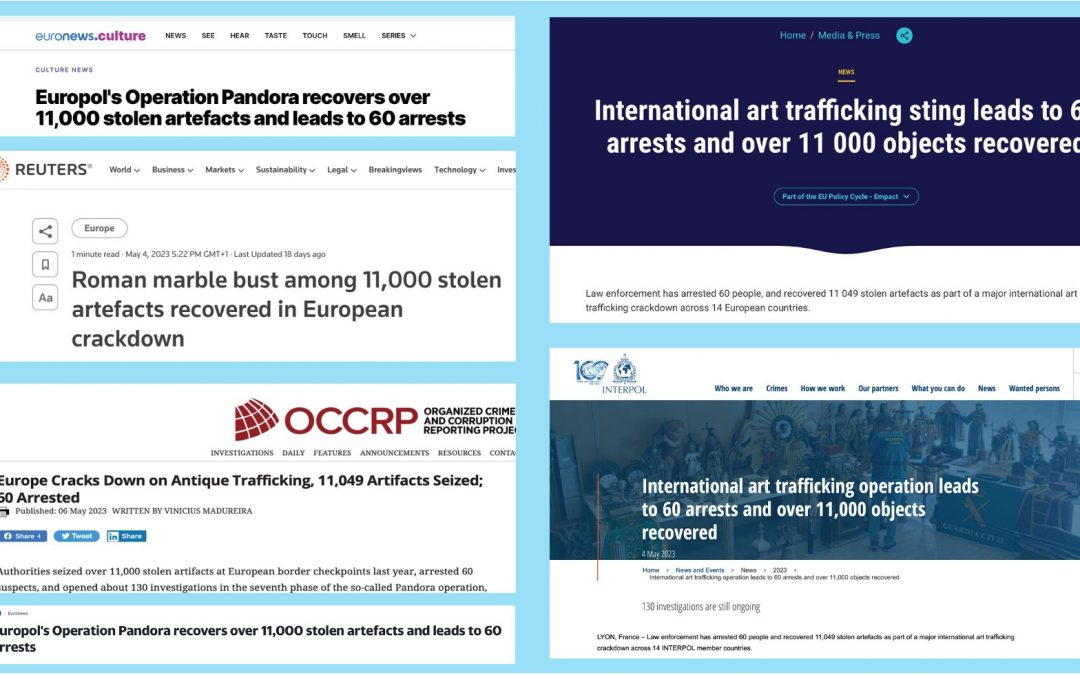
Many media outlets have covered the results of the latest transnational operation co-ordinated by Interpol and Europol with a view to tackling trafficking in cultural property.
Pandora VII, led by the Guardia Civil in Spain, took place over 11 days in September 2022 with two cyber weeks in May and October.
The Europol media release itself stated that the operation led to the arrest of 60 people and the recovery of 11,049 stolen objects across 14 countries.
As the ADA knows well, there is a great deal of difference between seizing items and showing that they are stolen, just as arrests do not equate with convictions.
These operations, along with others named Athena and Odysseus, have been running for almost a decade, and to our knowledge, the authorities have never published either conviction rates or figures confirming how many seizures later proved justified. The ADA and fellow trade association IADAA have sought this information from Europol more than once, but Europol has replied each time that it does not have it, which makes its official release claim this time that 11,049 seized items were stolen all the more surprising.
The twin priorities in carrying out these operations have always been to clamp down on money laundering and terrorism financing, but while there may have been limited evidence of the former across the years, we have heard of no evidence at all of the latter.
Once again we contacted Europol asking the following: a) How many arrests have led to successful convictions? b) How many seizures proved to be valid + how many had to be returned to their owners? c) How many seizures were shown to be linked to money laundering? d) How many seizures proved to be linked to terrorism financing?
As others have also argued, without these accurate clear-up figures, the data serves no purpose beyond propaganda.
Europol’s media office ADMITS IT HAS NO ACCESS TO VITAL DATA
Europol’s media office replied on May 10 as follows: “Unfortunately, we won’t be able to help as we do not have these figures. Europol is not a statistical organisation – Europol’s priority is to support cross-border investigations and the information available is solely based on investigations supported by Europol.”
Confirmation, then, yet again that Europol has no statistics to support the claims it makes, with the further emphasis that Europol is “not a statistical organisation”. If so, what is it doing making statistical claims it admits it cannot support in the introduction to its media release, claims that history tells us will influence policy at a national and international level, as with the introduction to this recent important European Commission document?
Interpol, which has also denied having any reliable statistical information in this field, compounded the error.
Arguably more shameful is the number of media outlets that have reported the unsupported claims Europol has put out in this release without checking them. Newspapers, art market websites and others – all of them experts in their own fields and trained to check their sources – have singly failed to do so in this case.
They include Yahoo News, Artnet News, Euronews, and Reuters, among others.
It also includes outlets whose credibility entirely relies on accurate data, such as the Organised Crime and Corruption Reporting Project, and Border Security Report (the Journal of border security and transnational crime).
This is not the first time this has happened; these operations have been going on for a decade and the ADA and IADAA have highlighted the failure of intelligence on numerous occasions. As we showed in this instance, a single email request revealed the truth. So why can’t the experienced journalists working on this story make such a simple check as this to ensure that their reporting is accurate?
One of the worst offenders was Ursula Scheer, a journalist for Frankfurter Allgemeine, who not only swallowed everything she was told without checking, but added even more bogus data to the story unchecked: “According to estimates by the FBI and UNESCO, the annual turnover of the global black market for art and antiques is ten billion dollars, which puts the black market right behind the illegal drug and arms trade.” She also stated: “Selling art and antiques helps mafia activities finance terrorism and war.”
Those who want to know where the bogus data ends and the accurate data begins can check on our Facts & Figures page, which includes independently verifiable data through quoted sources and direct weblink.
by ADA | Nov 2, 2022 | News, Uncategorized, Views |
The World Customs Organisation has finally published a new report following the 2019 report, covering two years from 2019-2021, probably delayed because of the Covid 19 pandemic. Its results once again show that global levels of illicit trade in cultural property are far lower than claimed.
In the press release we read: “This year, the analysis provided in this Report is based on data collected from 138 Member administrations. Previously composed of six sections, the Report now covers seven key areas of risk in the context of Customs enforcement: Anti-money laundering and terrorist financing; Cultural heritage; Drugs; Environment; IPR, health and safety; Revenue; and Security.”
It also states: “The analysis contained in this Report is mainly based on the collection of data from the WCO Customs Enforcement Network (CEN) — a database of worldwide Customs seizures and offences”….
“However, the CEN database relies heavily on voluntary submissions by Members hence the quantity and quality of the data submitted to the system has its limitations”…
“However, as part of this new methodology, the data and information sources used to elaborate this Report has been enlarged to include various open sources.”
While the rest of the report might be “mainly based on the collection of data from the WCO Customs Enforcement Network (CEN)”, in the introduction to the Cultural Heritage chapter on page 57, the WCO goes further, admitting: “Unfortunately, the data received through the WCO’s Customs Enforcement Network (CEN) in 2020-2021 being incomplete, the following analysis will be mostly based on open source information.”
Case studies based on media reports rather than primary research
The result for the Cultural Heritage section is that most of the case studies are based on newspaper articles, sometimes even on events that happened decades ago, and have nothing to do with recent trafficking activities. This is alarming as much of the problem with false data plaguing the cultural property sector stems from misreporting in the media. It is even more alarming when the misleading picture created by a surface reading of the chapter will undoubtedly be used as ‘evidence’ in future campaigns against the art market, as past reports have been.
The WCO is supposed to report recent and reliable figures, like figure 3 on page 35, showing that the number of worldwide reported cultural goods cases for 2021 is a mere 156, that is 1.1 case per reporting country….
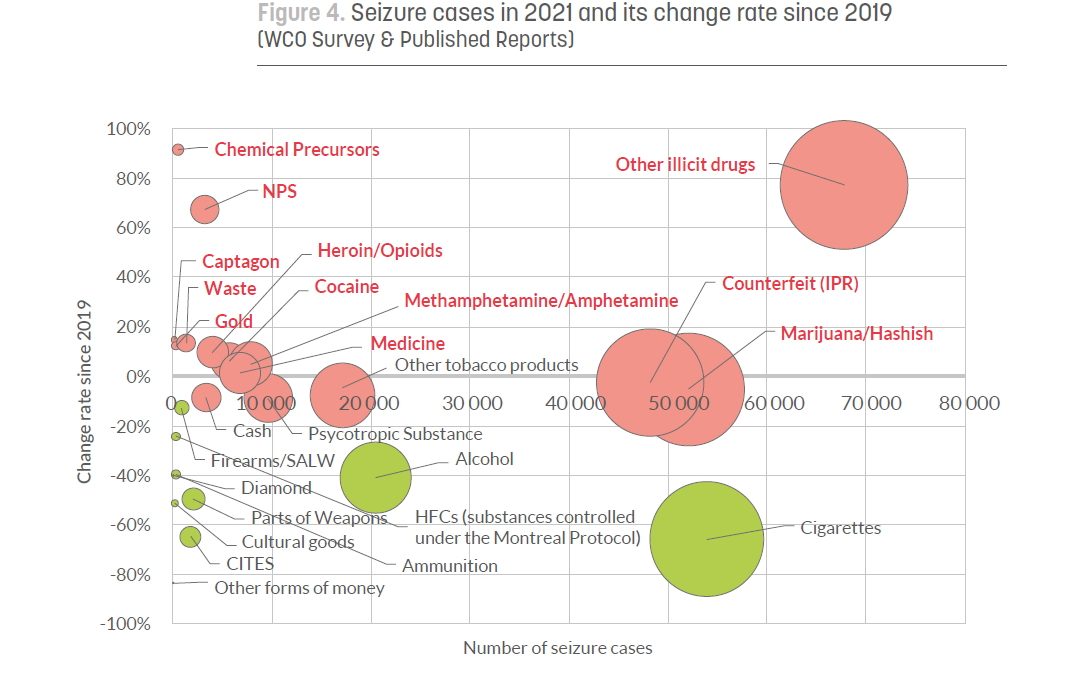
A newly introduced graph (shown here) in the WCO report (Page 17, Fig. 4) reveals precisely what the ADA and its fellow association IADAA have reported over the past years: the illicit trade in cultural heritage is so small that it barely shows in the statistics. Not only is it the smallest category – so small that you have to look carefully in case you miss it – but the graph also shows that seizures have fallen by around 50% between 2019 and 2021.
Let’s not forget, too, that the Cultural Heritage category is not limited to antiquities, as so many mistakenly believe; it covers 13 distinct sub-categories, including: all forms of art, antiques and collectables, household items, flora and fauna, books and manuscripts. In 2019, the top three categories of recovered item sub-categories were: Fauna, Flora, Minerals, Anatomy & Fossils; Other; and Hand-painted or Hand-drawn articles and works of art. No mention of antiquities, which did not even warrant its own sub-category.
All of this begs the question as to why, in its chapter on Cultural Heritage, the WCO has chosen to focus exclusively on photographs of seized antiquities (at least one of which seems to be a fake) alongside fossils and coins. The choice appears politically charged.Consistent reporting of
The WCO has stated in the past and here that there is under-reporting of crime in the culture sector and that it only counts seizures and cases reported via the Customs Enforcement Network (CEN), the implication being that the problem is much larger.
Figures consistently show low rate of illicit trade in cultural property
However, the miniscule share of illicit trade represented in its reports over the years by cultural property has been consistent, only now augmented by media reports not sourced via the CEN.
It further boosts this chapter of the report with a summary of Pandora VI, the latest in a seven-year campaign of international operations involving mass seizures and arrests. What the WCO, Europol or Interpol have never done, however, is to provide data on how many of their seizures and arrests later prove to be justified and how many were shown to be related to terrorism financing. It is not just the trade asking for these figures, academic investigators want them too to see how effective these operations are.
Previously the WCO has attempted to rebut the ADA and IADAA’s analysis of its reports, stating that the figures cannot be relied on. As our analysis always provides transparent sources for the data emanating from the reports, however, the WCO’s case against our analysis simply does not stand up.
Ultimately, its figures must be indicative of the global state of affairs; if they are misleading, why publish them?
by ADA | Mar 16, 2022 | News
CINOA, IADAA and others call for major review and propose five-point plan for future
Trade and cultural heritage groups including global trade federation CINOA and international antiquities association IADAA have called for a major international review of policy and legislation as it applies to the art market.
The call comes in a letter after the US Treasury review of anti-money laundering proposals found the art market to be low risk, with Congress turning its attention to shell companies and the real estate industry instead for the moment.
CINOA secretary general Erika Bochereau and IADAA chairman Vincent Geerling pointed out that all of the numerous recent studies researching possible links between the art market, money laundering and terrorism financing found no justification for clamping down on the market on this basis.
They argued that the lack of hard evidence produced by any of the reports meant that authorities should stop targeting “dealers, collectors and auction houses with wave after wave of damaging and unjust legislation.” Policy making is “being driven by assumptions and false claims,” they argued in their open letter.
Why false claims and bogus data abound
It is thought that one of the reasons so much misinformation is so widely spread is the interests of drawing attention to the pet issues of international NGOs, law enforcement and others all vying for attention and funding as they push their agendas.
The trade and cultural heritage groups singled out UNESCO’s claim that the annual value of trade in illicit cultural goods is $10 billion, a claim that is demonstrably false and not supported by the source that UNESCO gave for it. Despite being informed of this in November 2020, and despite numerous public clarifications on this point by the trade, UNESCO continues to promote the figure and it is still quoted in the media.
The trade and cultural heritage groups have now set out a five-point plan for better policy, listed in the Art Newspaper as follows:
- “Policy makers, including governments, when discussing the development of and drafting any policy or legislation which impacts cultural property and the art market, should ensure that recognised representatives from the relevant sector of the art market are co-opted on to any relevant panel or consulting body.
- Regulatory review boards or panels assessing the impact of government proposals should focus on how far they have actively addressed concerns and suggestions raised by recognised market representatives, while all proposals should be tested against clear standards of evidence and proportionality.
- A designated contact person at the decision-making level of government should be named, whose role is to follow any on-going laws or regulations affecting the art and antiques market, and they should act as a sector contact, with whom the trade can open a dialogue to ensure that the conservation of art or cultural heritage objects is not being unintentionally demoted or ignored.
- All relevant active and pending cultural property legislation should be reviewed to take account of the facts and data currently available, particularly if those facts are at odds with the assumptions on which legislation was predicated.
- Legislators, particularly in the EU, should commission an independent review to analyse the way in which significant public resources, supposedly dedicated to combating illicit trade in cultural goods, have been wasted as a result of relying on misinformation. Clear guidance should be produced to prevent legislation affecting the art market from misdirecting resources in the future.”
As well as CINOA, signatories of the letter include: the ACPCP (American Council for the Preservation of Cultural Property), the ATADA (Authentic Tribal Art Dealers’ Association), the Committee for Cultural Policy (Cultural policy think tank and information source), Drouot Patrimoine auction house, the EFA (European Federation of Auctioneers), the Global Heritage Alliance advocacy group and the IADAA (International Association of Dealers in Ancient Art).
by ADA | Jan 26, 2022 | News
ADA chairman Joanna van der Lande has written the first in a series of articles on issues concerning antiquities and the art market for distribution within the European Parliament and to representatives at the recent Davos summit.
The article appears in MACE, a Brussels-based political magazine whose purpose is to raise issues of cent and spark debate among politicians, civil servants and other people of influence within the EU machine.
Articles will follow by IADAA chairman Vincent Geerling on data, fake news and how they help create misguided policy, and Ivan Macquisten on the wider implications of how this is affecting the art market.
The objective is to encourage deeper understanding of the challenges the market faces, with a view to establishing better relationships with decision makers on the political stage.
by ADA | Mar 5, 2021 | News
CINOA, the global trade federation for dealers in the international art market, with 5,000-plus members, has published a wide-ranging new report that exposes the causes and sources of bogus information used to damage the market.
From the deliberate dissemination of false evidence, as seen in the October 2020 UNESCO advertising campaign, The Real price of art, to the misreporting of facts, the report shows how many bodies of international standing, from NGOs to law enforcement and even governments, perpetuate falsehoods about the art and antiques market.
It also demonstrates how the bogus evidence – as well as its constant reinforcement via the media and other sources – has directly influenced policy, including new laws that damage the market.
One of the most shocking aspects of all this has been the clear failure of highly influential bodies such as the European Commission and the United Nations Office for Drugs and Crime to properly check the sources of the information that they publish; the repercussions for legitimate interests have echoed down the years.
Another shameful feature is just how much of the false information now being relied on can be traced back to media articles and other reports that are decades old and either do not carry the information claimed at all or whose evidence has been completely misreported as it has been filtered through other sources over time.
Frequently cited claims that prove to have no foundation in fact whatsoever include:
- Trafficking in cultural property is third only to that in drugs and weapons
- 80-90% of sales of antiquities involve goods with illicit origins
- Cultural property trafficking is a multi-billion dollar industry
However, bearing in mind the time, resources and legislation already dedicated to this subject in recent years, perhaps the most startling fact CINOA publishes is that it cannot find a single instance anywhere in the world of an arrest or seizure of artworks leading to confirmation that the items in question have been used to fund terrorism. Considering how keen the authorities are to demonstrate the link between the art market and terrorist financing, it is hard to believe that they would not engage in a major media campaign to publicise such a case if it ever arose.
Quite apart from the unwarranted damage this lack of probity has inflicted on the innocent, it has also led to a wider failure of policy, with real problems that need dealing with under international conventions and other agreements being ignored in favour of the pursuit of propaganda-fuelled ideology. While the report focuses on the repercussions for the art market, the institutional failures resulting from this misguided policy have claimed other victims, notably vulnerable cultural heritage sites and the vulnerable people living near them, who should enjoy better support as they are asked to help in the protection of their heritage.
Much of this inappropriate policy development is funded by public money, yet acts against the public interest. Even when its failures are drawn to the attention of the authorities responsible, as those involving UNESCO and the European Commission have been, they ignore or dismiss them and carry on as before. It is hard to think of any other walk of life where such scandalous behaviour would go unpunished, let alone continue to be encouraged and even celebrated.
Unlike many of the bodies it takes to task, the report provides properly checked primary sources, including weblinks, for all the data it publishes, so that they can readily be verified independently.
Recent Comments