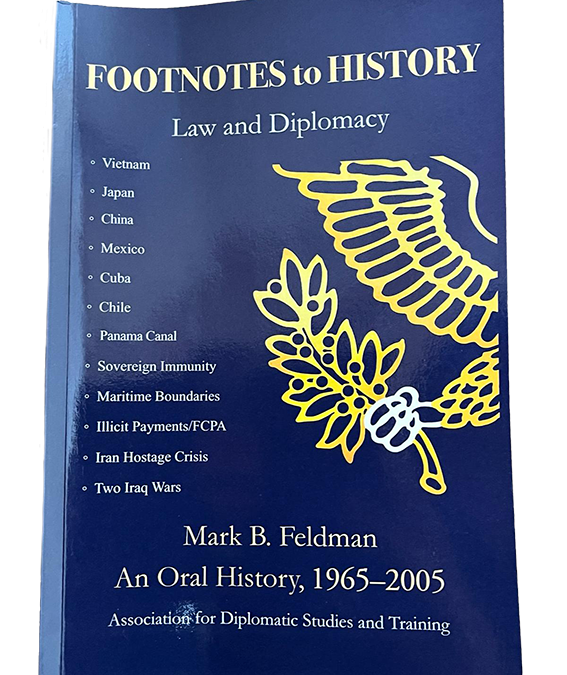
Published last year and highlighted in a recent talk is the fascinating book by Mark B. Feldman, Footnotes to History: Law and Diplomacy.
Feldman has been engaged in U.S. foreign relations law and transnational litigation since 1965, including 16 years at the U.S. Department of State, where he played a pivotal role in developing the concept of the bilateral treaty and the 1970 UNESCO illicit cultural property Convention.
More than 50 years on from his work on the UNESCO Convention, he shares his thoughts on its origins and objectives, as well as what he thinks now.
When the idea of the convention arose, Feldman noted how museums, collectors and dealers feared that a clampdown via UNESCO “would lead to demands for the repatriation of the great collections of ancient art in the United States and Europe”.
He clearly saw his role as balancing interests, describing how he brought together stakeholders across the American art world – archaeologists, art museums, antiquities dealers, and attorneys – later co-authoring a report, which addressed a bilateral treaty with Mexico; an Act of Congress prohibiting the import of Pre-Columbian sculptures from Latin America without the permission of the country of origin; and a multilateral UNESCO Convention based on the principle of non-retroactivity with import controls on archaeological materials threatened by pillage.
Original objectives of the Convention lost over time
Feldman was precise and targeted in his approach. On the pre-Columbian Act of Congress, he writes: “It was the first step by any art importing country to address illicit trade in stolen cultural property, but the reciprocal obligations ‘to recover and return’ were limited to pre-Columbian and colonial objects ‘of outstanding importance’ [and official archives] that had become government property in the other country.”
The bilateral treaty with Mexico was “in practice” a one-off, and has been superseded by “more aggressive actions by U.S. agencies”.
He is enlightening on just how ambitious original plans for the UNESCO Convention were, explaining that the Secretariat “proposed a comprehensive scheme, brutal but coherent, that would have required all parties to refuse import of any cultural property, broadly defined, not accompanied by an export certificate from the country of origin”.
Needless to say, art rich countries blocked measures that they considered would destroy the international art market.
The United States continued to take the lead, drafting a compromise convention.
“The most fundamental points were two: first the convention would not be retroactive – acquisition guidelines would be forward looking – and two, import controls would be limited to cultural property stolen from museums and to specific categories of archaeological interest threatened by pillage to be determined by agreement among the countries concerned.”
Even at that point, however, the antiquities trade was alert to potential abuses. Feldman describes how dealers were “always doubtful about the convention” and “opposed import controls because they feared the State Department would use that authority as a bargaining chip for diplomatic purposes unrelated to protecting the cultural heritage…”. Prescient indeed.
How the concept of bilateral treaties backfired
The U.S. market was also concerned that as it abided by the terms of the convention, others would not, putting it at a competitive disadvantage, leading to Feldman proposing that the State Department “make bilateral agreements for import controls with countries damaged by pillage of their cultural heritage”.
Next came the establishment of the Cultural Property Advisory Committee (CPAC). The idea was for it to be a bulwark in defence of the art market, but, as history, has shown, if anything its role has been the opposite.
“Over the years the State Department has negotiated dozens of bilateral agreements and there have been numerous complaints that State has abused the process for diplomatic reasons as the dealers originally feared,” Feldman accurately observes, as he acknowledges that times have changed, and the behaviour of the trade and wider market “has got a great deal better.”
He also considers that current U.S. policy on cultural heritage protection in relation to foreign patrimony is out of step and “contrary to the U.S. position negotiated in UNESCO in 1970 and adopted by Congress in 1983.”
Many in the market hope that the State Department will take as much notice of what Feldman has to say today on these matters as it did in the late 1960s.
•The false claim that illicit trade in cultural property is third only to that in drugs and weapons
So many conflicting claims have been made about Interpol’s art crime figures, including the looting and trafficking of antiquities, that it is difficult to know what to believe these days.
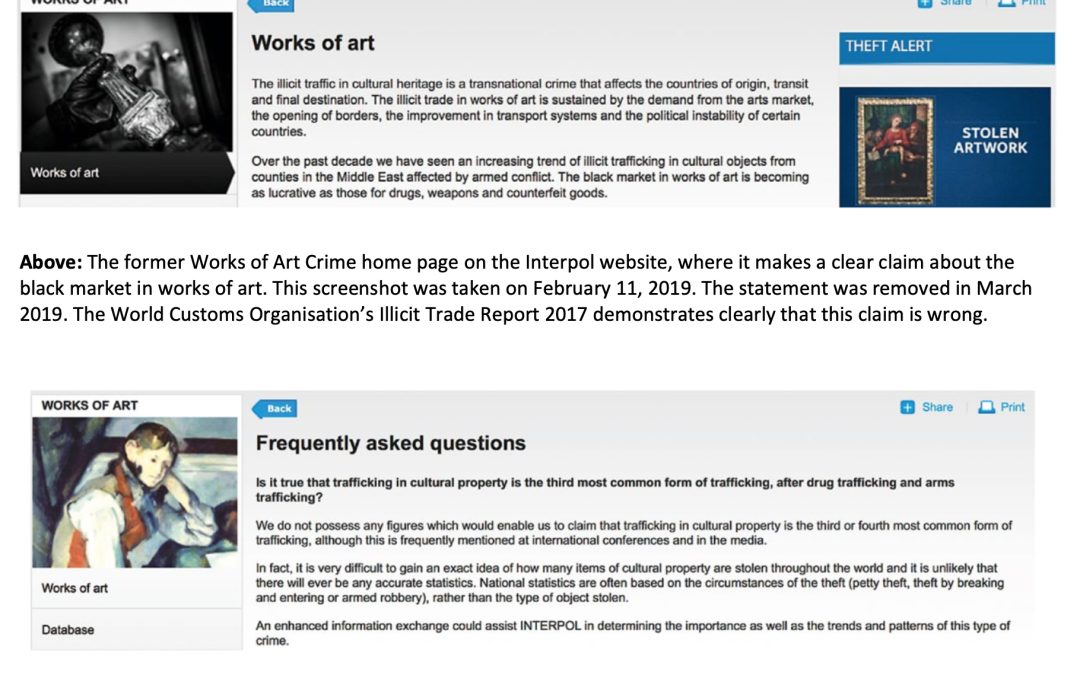
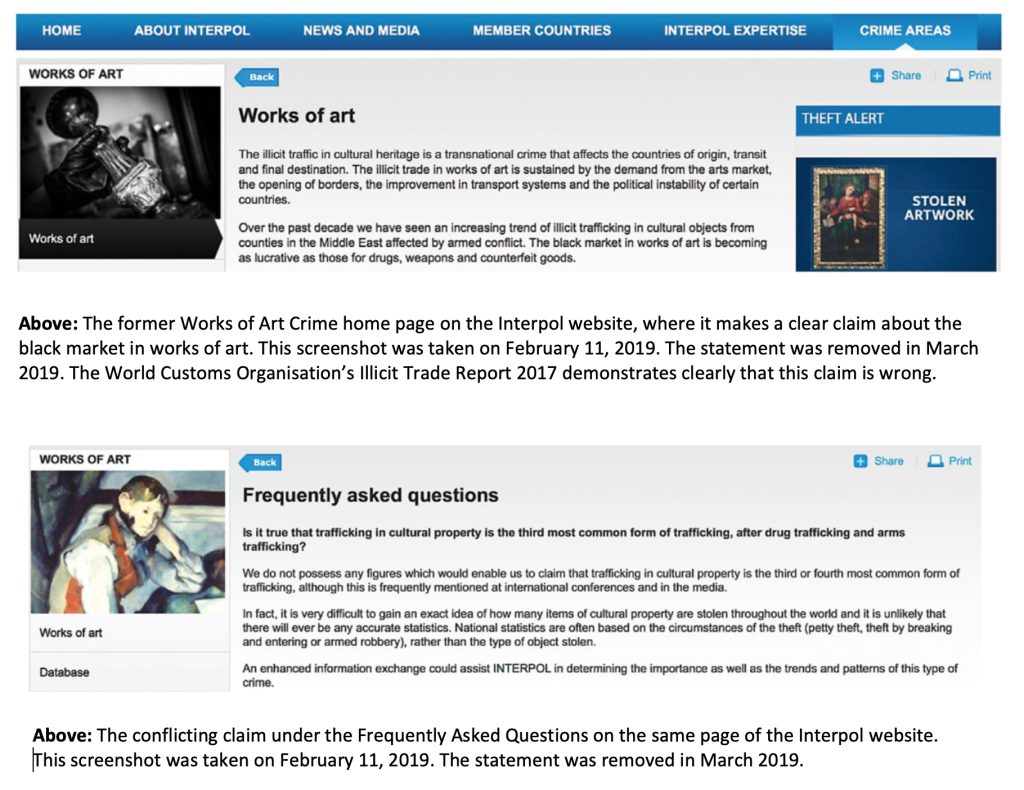
Part of the problem was that for years Interpol published conflicting claims on the Art Crime home page of its website, as the screenshots here show:
Headlining was the claim that “The black market in works of art is becoming as lucrative as those for drugs, weapons and counterfeit goods”. Earlier claims by Interpol valued the global illicit market in cultural property at around $4 billion to $5 billion annually.
This has never been true, and recent figures in the World Customs Organisation’s annual Illicit Trade Reports demonstrate this clearly. In fact, cultural property crime, which includes categories such as household goods is, by a very long way indeed, the smallest risk category.
The admission that Interpol has never had any figures to demonstrate its headline claim, nor is ever likely to obtain such figures, appeared in a click-through section lower down on the same page (see above).
Unfortunately, bodies such as the European Commission, the Carabinieri and UNESCO have promoted the headline claim while ignoring the admission lower down, leading to the widespread dissemination of what amounted to a false claim. This matters because the false claim has directly influenced new policy and further restrictions on the art market.
Fortunately, after having the discrepancy pointed out to it for several years, Interpol finally removed the conflicting claims from its website in March 2019. However, the headline claim’s pervasiveness, in what amounted to a long-term viral online campaign against the art market, means that it is still widely quoted and believed to this day.
Transnational operations (Operation Pandora etc)
For the past decade and more Interpol has co-ordinated with Europol and national police forces in dozens of countries on an annual basis to mount operations aimed at stemming the flow of illicit cultural property that might be involved in money laundering and terrorism financing.
With names such as Odysseus, Athena and Pandora, these huge operations target individuals, households, business and transport. The resulting media releases enumerate vast numbers of seizures, as well as arrests, while also providing examples, including photographs of important items that have been seized.
While this all looks impressive, what neither Interpol nor Europol have ever done is to follow these data up with the crucial information about how many of these seized items later turned out to be illicit and linked to money laundering or terrorism financing. Nor do they ever publish conviction rates for those arrested.
The ADA and IADAA have twice asked Europol for these figures.
The first occasion was in February 2017, when Europol told us: “As your questions are very detailed and some are focused on particular countries, I suggest you get in contact with the countries involved. We can only communicate on a general level and don’t hold all the details of the different participating countries.”
The second occasion was in May 2023, when Europol told us: “Unfortunately, we won’t be able to help as we do not have these figures. Europol is not a statistical organisation – Europol’s priority is to support cross-border investigations and the information available is solely based on investigations supported by Europol.”
Interpol has published numerous media releases on the same subjects and has included operational results in separate reports, including its 2020 report, Assessing Crimes Against Cultural Property.
This included data on Operation Pandora V, which took place across 32 countries and resulted in more than 56,400 cultural goods being seized and 67 arrests. 27,300 of the items seized came in a single haul in France where Customs officers arrested a man who had been illegally digging up archaeological pieces.
The leading publicised highlight from the operation was a set of three gold coins that “could have been worth up to €200,000 on the black market”, which were recovered after the arrest of two men in Spain.
Data in the Interpol report relating to global crime referred to arrests, but shed no light on convictions or how much of what was seized later proved to be illicit. No mention of terrorism financing was made.
Page 14 of the report revealed that of the 567,465 items seized in Europe, 83% (or 472,933) were library materials. This single category of library items accounted for 55% of the global total of 854,742 objects seized for the whole of 2020.
Ongoing issues
Despite supposedly cleaning up its act with the 2019 relaunch of its website, Interpol has continued to promote false and unsubstantiated claims.
In the introduction to its 2021 report it stated: “The illicit trafficking of cultural property is a major source of revenue for organized crime groups and terrorists alike…” (see page 4) – It is clear from Interpol’s other statements on data that it has no evidence to show cultural property to be a major revenue source for terrorists.
Following these conflicting claims and lack of vital intelligence, what does Interpol publish on its website in 2024?
Despite providing no data, and having admitted that it has never had it, nor is ever likely to obtain it, Interpol’s headline claim on its Cultural Heritage home page is: “Trafficking in cultural property is a low-risk, high-profit business for criminals with links to organized crime.”
Click through to the section on Crimes: The issues – cultural property, and it is largely populated by general statements. The one hard claim is that “the majority of thefts are carried out from private homes”.
The related news section at the bottom includes links to other news, including the most recent release on a transnational operation, Pandora VII, from May 2023, which again limits data to arrests and seizures, but gives no information on outcomes.
Nowhere on its website does Interpol provide clear data as to the scope and value of illicit cultural property.
However, despite admitting that it does not have the data, and despite WCO and other figures showing it not to be true, and despite updating the Art Crime home page, Interpol still promotes false claims via an out-of-date video from 2015 on its web page How we fight cultural crime.
Worse still is that the person making the claims in the video is Interpol’s Secretary General Jürgen Stock, who states that the illicit trade in cultural property is as lucrative as those for drugs, weapons and counterfeit goods, and then directly links them to terrorist financing, even though no evidence of this happening has been provided beyond the very limited Abu Sayyaf case of May 2015. In doing so, he directly links these purported crimes to the international art market, despite providing no evidence to support this.
The Secretary General makes his claims based on UN sanctions relating to Syria (2199) and Iraq, but these are preventive measures, not evidence of executed crimes. At the time of adoption in 2014, the sanctions’ text stated that terrorists were benefiting from trade in cultural property but gave no examples of this happening. As noted above, the Abu Sayyaf raid in 2015 – after the sanctions were introduced – remains the only cited example of this happening, and the sums involved were small and not clearly identified.
It is not clear from the website that the video is from 2015, so viewers may think this is current thinking at Interpol. Mr Stock must surely know better now nine years on from this recording and should remove it from the website. The ADA and fellow trade association IADAA have contacted him directly recently and asked him to update the website, but so far we had no reply.
To repeat: Nowhere on its website does Interpol provide clear data as to the scope and value of illicit cultural property
Europol has admitted not having any reliable statistics to support its headline claim over stolen objects in Operation Pandora VII, aimed at tackling cultural property trafficking.
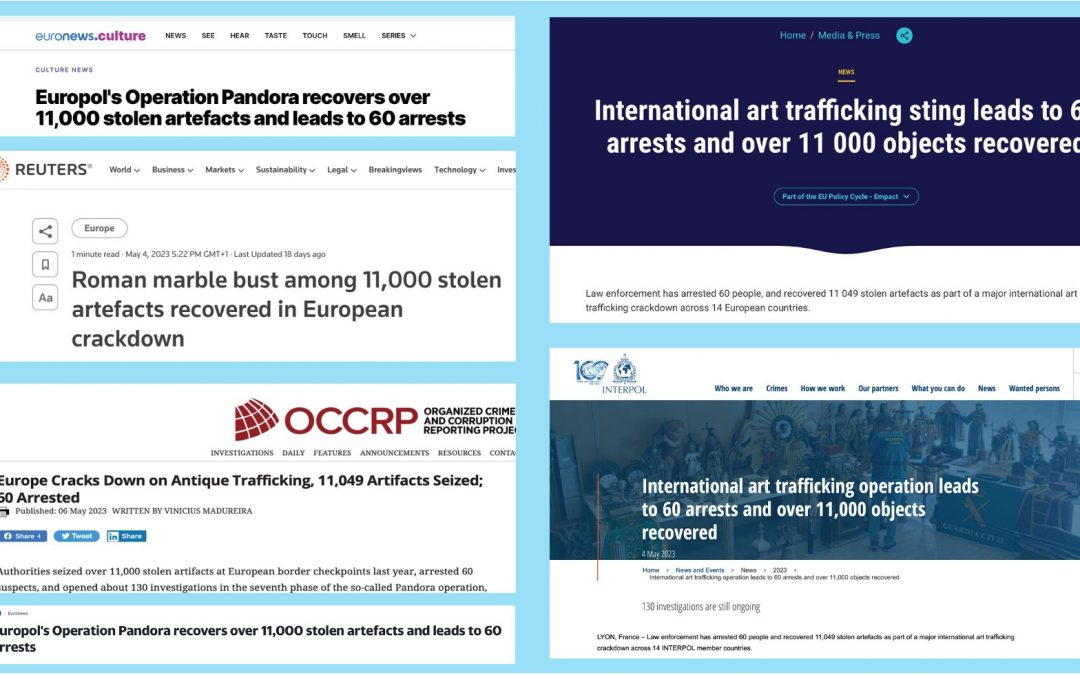
Many media outlets have covered the results of the latest transnational operation co-ordinated by Interpol and Europol with a view to tackling trafficking in cultural property.
Pandora VII, led by the Guardia Civil in Spain, took place over 11 days in September 2022 with two cyber weeks in May and October.
The Europol media release itself stated that the operation led to the arrest of 60 people and the recovery of 11,049 stolen objects across 14 countries.
As the ADA knows well, there is a great deal of difference between seizing items and showing that they are stolen, just as arrests do not equate with convictions.
These operations, along with others named Athena and Odysseus, have been running for almost a decade, and to our knowledge, the authorities have never published either conviction rates or figures confirming how many seizures later proved justified. The ADA and fellow trade association IADAA have sought this information from Europol more than once, but Europol has replied each time that it does not have it, which makes its official release claim this time that 11,049 seized items were stolen all the more surprising.
The twin priorities in carrying out these operations have always been to clamp down on money laundering and terrorism financing, but while there may have been limited evidence of the former across the years, we have heard of no evidence at all of the latter.
Once again we contacted Europol asking the following: a) How many arrests have led to successful convictions? b) How many seizures proved to be valid + how many had to be returned to their owners? c) How many seizures were shown to be linked to money laundering? d) How many seizures proved to be linked to terrorism financing?
As others have also argued, without these accurate clear-up figures, the data serves no purpose beyond propaganda.
Europol’s media office ADMITS IT HAS NO ACCESS TO VITAL DATA
Europol’s media office replied on May 10 as follows: “Unfortunately, we won’t be able to help as we do not have these figures. Europol is not a statistical organisation – Europol’s priority is to support cross-border investigations and the information available is solely based on investigations supported by Europol.”
Confirmation, then, yet again that Europol has no statistics to support the claims it makes, with the further emphasis that Europol is “not a statistical organisation”. If so, what is it doing making statistical claims it admits it cannot support in the introduction to its media release, claims that history tells us will influence policy at a national and international level, as with the introduction to this recent important European Commission document?
Interpol, which has also denied having any reliable statistical information in this field, compounded the error.
Arguably more shameful is the number of media outlets that have reported the unsupported claims Europol has put out in this release without checking them. Newspapers, art market websites and others – all of them experts in their own fields and trained to check their sources – have singly failed to do so in this case.
This is not the first time this has happened; these operations have been going on for a decade and the ADA and IADAA have highlighted the failure of intelligence on numerous occasions. As we showed in this instance, a single email request revealed the truth. So why can’t the experienced journalists working on this story make such a simple check as this to ensure that their reporting is accurate?
One of the worst offenders was Ursula Scheer, a journalist for Frankfurter Allgemeine, who not only swallowed everything she was told without checking, but added even more bogus data to the story unchecked: “According to estimates by the FBI and UNESCO, the annual turnover of the global black market for art and antiques is ten billion dollars, which puts the black market right behind the illegal drug and arms trade.” She also stated: “Selling art and antiques helps mafia activities finance terrorism and war.”
Those who want to know where the bogus data ends and the accurate data begins can check on our Facts & Figures page, which includes independently verifiable data through quoted sources and direct weblink.
The World Customs Organisation has finally published a new report following the 2019 report, covering two years from 2019-2021, probably delayed because of the Covid 19 pandemic. Its results once again show that global levels of illicit trade in cultural property are far lower than claimed.
In the press release we read: “This year, the analysis provided in this Report is based on data collected from 138 Member administrations. Previously composed of six sections, the Report now covers seven key areas of risk in the context of Customs enforcement: Anti-money laundering and terrorist financing; Cultural heritage; Drugs; Environment; IPR, health and safety; Revenue; and Security.”
It also states: “The analysis contained in this Report is mainly based on the collection of data from the WCO Customs Enforcement Network (CEN) — a database of worldwide Customs seizures and offences”….
“However, the CEN database relies heavily on voluntary submissions by Members hence the quantity and quality of the data submitted to the system has its limitations”…
“However, as part of this new methodology, the data and information sources used to elaborate this Report has been enlarged to include various open sources.”
While the rest of the report might be “mainly based on the collection of data from the WCO Customs Enforcement Network (CEN)”, in the introduction to the Cultural Heritage chapter on page 57, the WCO goes further, admitting: “Unfortunately, the data received through the WCO’s Customs Enforcement Network (CEN) in 2020-2021 being incomplete, the following analysis will be mostly based on open source information.”
Case studies based on media reports rather than primary research
The result for the Cultural Heritage section is that most of the case studies are based on newspaper articles, sometimes even on events that happened decades ago, and have nothing to do with recent trafficking activities. This is alarming as much of the problem with false data plaguing the cultural property sector stems from misreporting in the media. It is even more alarming when the misleading picture created by a surface reading of the chapter will undoubtedly be used as ‘evidence’ in future campaigns against the art market, as past reports have been.
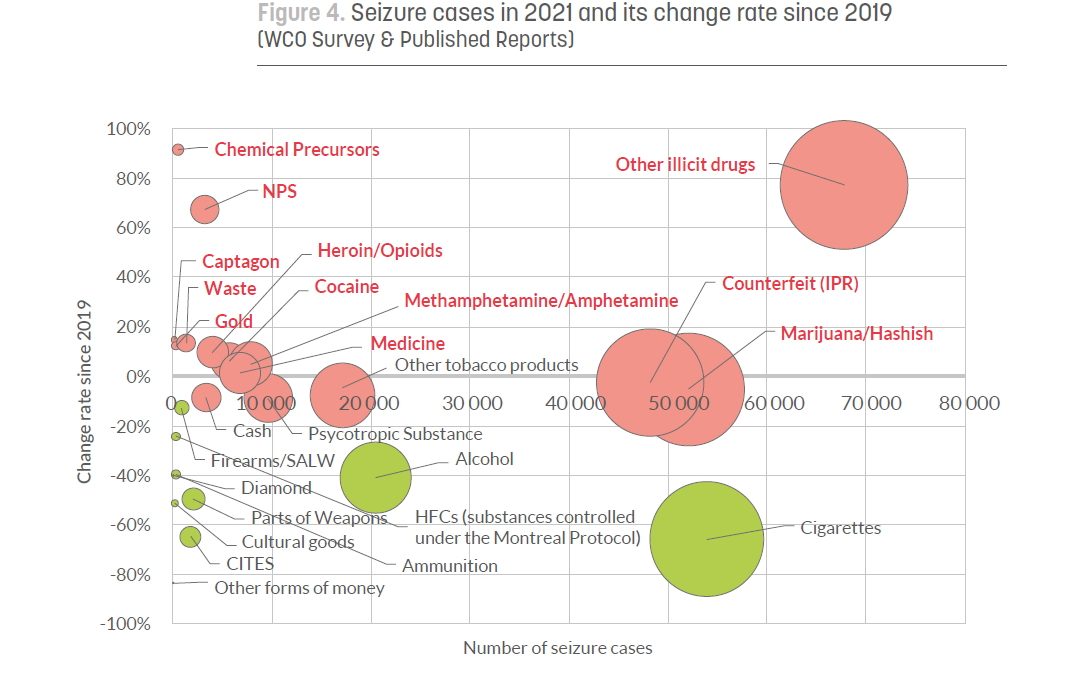
The WCO is supposed to report recent and reliable figures, like figure 3 on page 35, showing that the number of worldwide reported cultural goods cases for 2021 is a mere 156, that is 1.1 case per reporting country….
A newly introduced graph (shown here) in the WCO report (Page 17, Fig. 4) reveals precisely what the ADA and its fellow association IADAA have reported over the past years: the illicit trade in cultural heritage is so small that it barely shows in the statistics. Not only is it the smallest category – so small that you have to look carefully in case you miss it – but the graph also shows that seizures have fallen by around 50% between 2019 and 2021.
Let’s not forget, too, that the Cultural Heritage category is not limited to antiquities, as so many mistakenly believe; it covers 13 distinct sub-categories, including: all forms of art, antiques and collectables, household items, flora and fauna, books and manuscripts. In 2019, the top three categories of recovered item sub-categories were: Fauna, Flora, Minerals, Anatomy & Fossils; Other; and Hand-painted or Hand-drawn articles and works of art. No mention of antiquities, which did not even warrant its own sub-category.
All of this begs the question as to why, in its chapter on Cultural Heritage, the WCO has chosen to focus exclusively on photographs of seized antiquities (at least one of which seems to be a fake) alongside fossils and coins. The choice appears politically charged.Consistent reporting of
The WCO has stated in the past and here that there is under-reporting of crime in the culture sector and that it only counts seizures and cases reported via the Customs Enforcement Network (CEN), the implication being that the problem is much larger.
Figures consistently show low rate of illicit trade in cultural property
However, the miniscule share of illicit trade represented in its reports over the years by cultural property has been consistent, only now augmented by media reports not sourced via the CEN.
It further boosts this chapter of the report with a summary of Pandora VI, the latest in a seven-year campaign of international operations involving mass seizures and arrests. What the WCO, Europol or Interpol have never done, however, is to provide data on how many of their seizures and arrests later prove to be justified and how many were shown to be related to terrorism financing. It is not just the trade asking for these figures, academic investigators want them too to see how effective these operations are.
Previously the WCO has attempted to rebut the ADA and IADAA’s analysis of its reports, stating that the figures cannot be relied on. As our analysis always provides transparent sources for the data emanating from the reports, however, the WCO’s case against our analysis simply does not stand up.
Ultimately, its figures must be indicative of the global state of affairs; if they are misleading, why publish them?
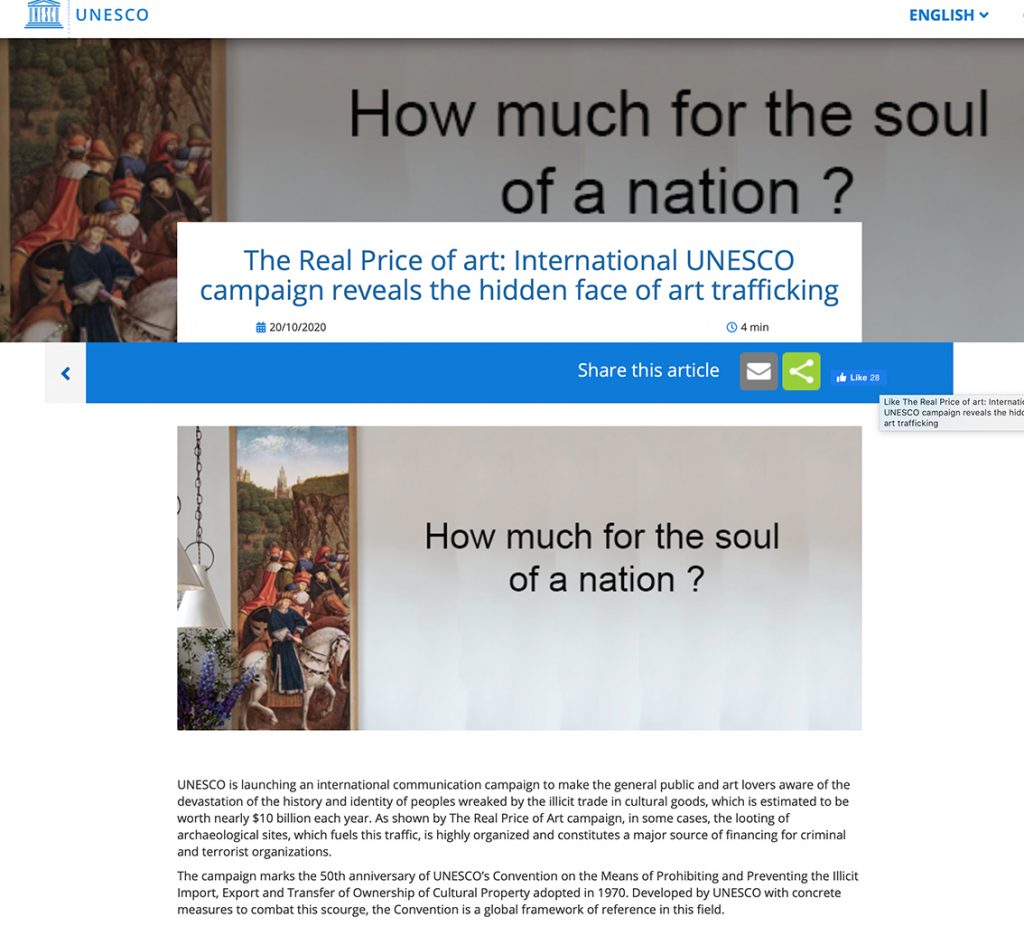
In the latest of a string of baseless claims, UNESCO reports that the illicit trade in cultural property is estimated to be worth nearly $10 billion a year. It’s a handy figure to use as a headline to launch its 1970 Convention’s 50th anniversary conference and accompanying campaign. However, it gives no source for this claim. “As shown by The Real Price of Art campaign, in some cases, the looting of archaeological sites, which fuels this traffic, is highly organized and constitutes a major source of financing for criminal and terrorist organizations,” the article on its website continues. Launched on October 20, the campaign has included the first International Day against Illicit Trafficking in Cultural Property on November 14 and an international conference (November 16-18) organised in partnership with the Federal Foreign Office of Germany, the European Commission and the Council of Europe. Having asked the UNESCO author for the source of the $10 billion claim, our fellow trade association, IADAA, was sent a copy of the French version of the 2018 Joint European Commission-UNESCO Project report, Engaging the European Art Market in the fight against the illicit trafficking of cultural property, by Professor Marc-Andre Renold with the message that the evidence was in section C. It isn’t. As we pointed out to the author, the Renold study doesn’t mention a $10 billion figure anywhere. The closest it comes is in quoting an estimated figure of $6 billion to $8 billion from page 50 of the 2011 study by Frank Wehringer listed in the footnotes. However, Wehringer did not give it as his estimate but as a figure “regularly given” without providing any real source for it. He also said that “according to widespread statements, [this] makes it the third largest illegal market after drugs and weapons (according to estimates by UNESCO and FBI according to Anton 2010a: 2)”. In fact, this supposition is not true, as confirmed by Interpol and the WCO Illicit Trade Reports (the latest published in June), which yet again put the number of cases being investigated and seizures made in cultural property at 0.2% of the global total reported through the Customs Enforcement Network, whereas for drugs it was 35%/30% and for weapons 8%/8% – other risk categories were much higher than for cultural property, which was by far the smallest category). In addition, the Renold study itself states: “There are no comprehensive and reliable statistics that would allow us to capture the true scale of illicit trafficking or monetary value of the black market in cultural goods.” This is a view adopted by Interpol, which has also stated that it never expects to have any reliable figures, as well as by the RAND Corporation report, studying open source data, published in May 2020. As the ADA and IADAA pointed out to UNESCO, this is important because in recent years so many misguided policy decisions have been made on the back of false information, with the result that funding and other resources have been diverted away from where they are really needed in the fight against crime, including trafficking. We then pointed out that in the absence of a reliable source for the $10 billion claim, UNESCO is currently promoting inaccurate information in what is a highly sensitive area. This being the case, we asked the author to correct the error before it was disseminated any further in the wider media than it already had been. As yet, we have received no further reply and the article remains unchanged on UNESCO’s website.
UNESCO risks misleading the very public it wishes to educate
Bearing in mind that the express aim of the international communication campaign to which this article is linked is to “make the general public and art lovers aware of the devastation of the history and identity of peoples wreaked by the illicit trade in cultural goods”, it seems reasonable to expect UNESCO to get its facts right and to correct mistakes when they are brought to its attention. Otherwise it risks misleading the very public it wishes to educate. However, as was later reported, almost the entire advertising campaign devised by UNESCO surrounding this has been exposed as fraudulent. If only this were an isolated incident, but unfortunately it’s all too commonplace within UNESCO itself, as the autumn 2020 editorial in The UNESCO Courier demonstrates. Written by Ernesto Ottone Ramírez, Assistant Director-General for Culture, UNESCO, it states as fact (“The figures prove it”) that the attraction of illicit antiquities has never been greater, and attempts to justify this using the bogus claim that “The illicit flow of cultural goods is now believed to be the third-largest in terms of volume, after drugs and arms”. As shown above, this is not true. (See the WCO Illicit Trade Reports 2017-2019), plus all the evidence on the IADAA website, all of which is independently verifiable through the links and references supplied. Meanwhile Lazare Eloundou Assomo, Director of Culture and Emergencies for UNESCO’s Culture Sector, was interviewed on “Antiquités du sang”, quand pillage et pandémie font bon ménage! on Radio France Culture on October 24, during which (7 mins in) he claimed that estimates put the value of the global trade in illicit antiquities at around $64 billion. Bearing in mind that the world’s leading art market report, the Art Basel Report, estimated in 2019 that the value of the entire global art market was $67.4 billion, and the legitimate market in MENA antiquities is around 0.5% of this, it would be interesting to learn his source for the claim. During another radio interview, broadcast as part of the BBC World Services’ Business Daily special Zombie Statistics on February 20, 2019 (5 mins 20 secs in), Assomo was challenged over the inaccuracy of the figures UNESCO had been promoting since 2011. His response: “I don’t think we should enter into a debate about whether these figures are right or not right.” Whilst stating that “today we do not consider it any more important to concentrate on figures”, he claims that looting has increased, a claim immediately challenged by the interviewer, who says: “How do you know… you don’t have a global figure and you don’t support the 2011 [UNESCO report] figure?” Dismissing the importance of figures is an odd position to take when you headline your campaign with an inaccurate but persuasive $10 billion figure. Statistics guru Dr Tim Harford’s response to this on the same radio programme was that it is important to take statistics seriously because they are essential for understanding the world. “If people start treating them in a very cavalier way, that spoils it for everybody, because then people start not trusting statistics… Listing where a claim came from and how it was arrived at is a very important starting point.” It’s time UNESCO followed this advice. If, as both Ramírez and Assomo keep claiming, the evidence is there and clear, why don’t they produce it, especially when directly challenged to do so by organisations like the BBC? The Ramírez article mentioned above was an ideal opportunity to set the record straight on this front, yet it did not do so. If the evidence is so clear, why the need to rely on bogus figures instead? For an organisation like UNESCO, with its reputation and influence, to behave in the sort of cavalier way Dr Harford describes over such a sensitive subject is not only highly irresponsible and damaging, but also contemptuous of the public interest it pledges to serve.
Recent Comments