by ADA | Apr 15, 2026 | Views |
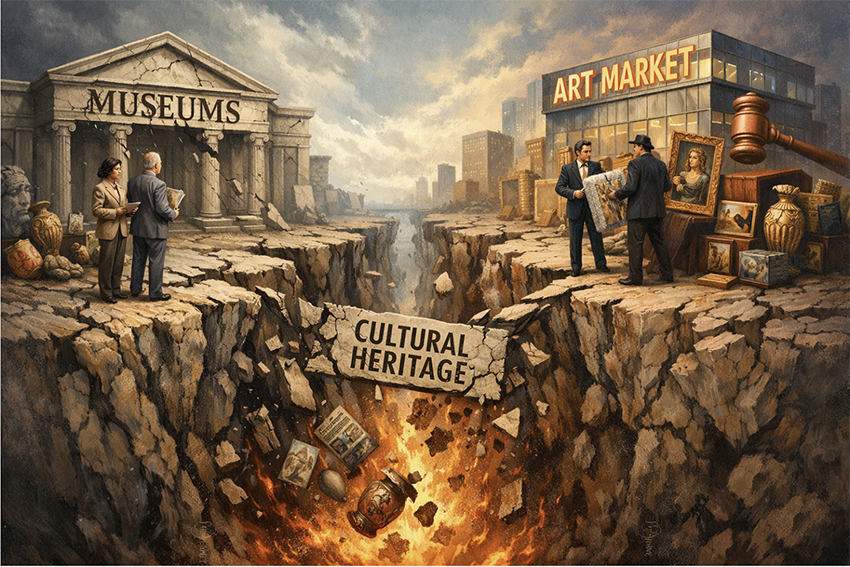
Academic and cultural institutions, as well as governments, continue to look down on the art market – it’s unfair and is in no one’s interest
Provenance and Due Diligence have become the critical factors in assessing cultural goods in recent years. Theft, trafficking, unethical acquisition in colonial times, suspected links to money laundering and terrorism financing have all been presented as arguments for tighter controls and reversing the burden of proof so that items and people are deemed ‘guilty’ unless they can demonstrate their innocence.
The ardent pursuit of this ‘solution’ has brought its own problems: an embarrassing dearth of reliable evidence – hence the reversal of the burden of proof (initially under UNIDROIT 1995) – false data and fake news, failure to check facts and sources, overreach that risks breaching human rights and brings other ethical issues. The exploitation of the cultural sphere for soft power diplomacy includes further exploitation by those who wish to harness it for financial gain or political influence. State-backed programmes and institutional interests are where the real power lies: funding and ‘capacity building’ the self-interests at its core.
This is the environment in which the international art market finds itself the useful whipping boy of those who wish to justify their actions and budgets.
For many on the institutional side of the argument, however, the market really is the problem; they see themselves as being in conflict with – and better than – the trade, while positive actions on the part of the market are deemed merely incidental.
A conversation on…Provenance Research and Due Diligence in the Art and Antiquities World: Distinctions, Connections, Synergies, Challenges, held online on April 8 as part of the International Art Market Studies Association Law & the Arts course 2025–2026, attracted more than 140 attendees.
It addressed the increasing relevance of provenance research and the reasons for this, from the social responsibility of institutions, via the Washington Principles relating to Nazi-looted art to a wider moral responsibility to society and history.
Defining the difference between due diligence and provenance research
Attempts to define the difference between provenance research and due diligence were most usefully summarised as the following: due diligence is the checking of provenance to the extent of what a reasonable person should be expected to carry out related to a specific event, such as a sale or acquisition, whereas provenance research is a wider, ongoing investigation into the history, origins and circumstances of an object.
A higher standard of diligence should be expected from art market professionals as they have more knowledge of objects, it was argued. Presumably such a standard would also apply to museum experts for the same reason, but this was not mentioned.
An overwhelming number of attendees to the session work in the public or academic sphere, as curators, provenance researchers attached to institutions or as officials linked to museum organisations. This resulted in a largely uniform perception and opinion.
Despite this being a course staged by the Art Market Studies Association, art market representatives were extremely thin on the ground. None were included as speakers.
This is a chronic issue with much of the debate over ethics, standards and the law relating to the market. A good example came early on, when Sofia Bollo of the Ethnographic museum at the University of Zurich, who also serves on the Chair of the ICOM Italian section, discussed the working group on provenance research at ICOM. Set up in 2023, it includes more than 100 members: anthropologists, archaeologists, art historians, unemployed people, museum and research interest – but apparently no one from the international art market. This means that we have a body proposing a set of stringent rules for a market that it has not consulted and about which it has a limited understanding. While this may be fine for setting common standards among institutions such as museums, it is unfortunate when it is quite clear that for any measures to be effective in the market, they must address the market from a practical standpoint.
A useful summary of post Second World War initiatives addressing ethics and behaviour covered UNESCO (1970), UNIDROIT (1995), and various EU Directives. As market professionals have found, however, States Parties to the UNESCO Convention tend to cherry pick the articles that suit them, which means that most, if not all, have yet to submit essential lists of goods of national importance, and few are keen to offer the compensation they are committed to when reclaiming items from honest purchasers.
This trampling of a long-established moral right by a new and questionable ‘ethical’ standard is the whole cultural heritage debate in microcosm.
Bilateral agreements and the creeping recognition of domestic laws internationally (not all of them reasonable, notably US vs McClain – 1977) is increasingly creating a situation where honest owners are deprived of the valid title to their belongings. This trampling of a long-established moral right by a new and questionable ‘ethical’ standard is the whole cultural heritage debate in microcosm.
The Australian academic and specialist in cultural heritage law, Lyndel Prott, argued for ‘required diligence’ rather than ‘due diligence’, but that would also require very clear, globally adopted parameters that have yet to be defined. She took a realistic approach to historical norms, acknowledging that provenance standards today could not be applied retroactively to purchases of decades ago.
Alyssa Thiel, of the Penn Cultural Heritage Center, one of several attendees who have worked in the Manhattan District Attorney’s Antiquities Trafficking Unit (ATU), also considered historic norms. She noted the pressure on museums to acquire the best pieces at a time when their context was seen as more important than their history of ownership.
An enlightened approach, it is not shared by the head of the ATU, Assistant District Attorney Matthew Bogdanos, who has seized many such items.
Prott also argued that private sellers were now more of a problem than market professionals because the latter were subject to greater regulation, including anti-money laundering laws, and many have professional compliance departments.
It is almost as though anyone outside the market refuses to believe that market professionals can act with anything other than dishonest or dishonourable intent.
Absent from the debate, however, was any recognition that just as museums and other institutions don’t want to find themselves handling illicit material, neither do auction houses or dealers – and for the same reasons. It is almost as though anyone outside the market refuses to believe that market professionals can act with anything other than dishonest or dishonourable intent.
The webinar also set out the list of checks that should be undertaken when carrying out due diligence, from checking stolen art databases and ICOM red lists to requiring sellers to provide written evidence and supporting paperwork or, in their absence, a notarised statement. While much of this is already the norm, how much would it cost to pursue all the avenues set out and how long would it take? If such checks are essential for all transactions, how much of the market would survive for lesser, cheaper objects?
As Daniel Healey, a Provenance Research specialist at Worcester Art Museum, Massachusetts (and another former ATU staffer) noted, the work of provenance research can become very expensive for museums – sometimes they have to travel to check sources. It is a challenge to museums to fund such provenance research and it requires ongoing support, he advised. They have to rely a lot on colleagues in other institutions.
Again, attendees seemed to apply a double standard here: while Healey complained of the lack of time and resources facing museum curators as they tried to assess items coming up for auction – and blamed auction houses for this – no one considered that auction house specialists themselves, and dealers, faced the same challenges. Why should special consideration be given to one set of professionals but not the other?
Export certificates were another consideration. Now vital under the EU import licensing regulations, the fact that they rarely survive in any useful form continues to be overlooked.
Despite this, the UNIDROIT working group on cultural objects with significant gaps in provenance (usually known as Orphan objects) has been able to make some sensible contributions. Due Diligence is not just about compliance, it’s also about reducing costly mistakes and sustaining public trust.
France is attempting to standardise provenance research
A move in France to nationalise how provenance research is carried out includes a mandatory eight-page provenance form for any public acquisition that is already in place. How would this apply to the market? Who would pay for the compliance? Again, no consideration of the practicalities. Nonetheless, as with every forum of this type, a common complaint was the lack of resources and funding to support their work. Yet no one considers that market professionals face identical issues.
Engaging with the art market is an oft-quoted objective to justify what are usually predictable anti-market outcomes of projects and research. In practice, however, such ‘engagement’ is ignored, ineffectual or simply a fig leaf to cover an ideological approach. Until those in the public sector, together with those in the private institutional sector, recognise that the market faces identical challenges to them, it will be hard to move forward. You cannot expect to apply impossible rules to others while giving a free pass to yourself in the same context.
by ADA | Jul 10, 2023 | Views
As the UK Parliament amends the rules on detectorist and other heritage discoveries, ADA chairman Joanna van der Lande reflects on its role and effectiveness
When Chris Chafin of The House, the Politics Home magazine for the UK parliament, asked to interview ADA chairman Joanna van der Lande about changes to the Treasure Act, it proved an excellent opportunity to reflect on the Portable Antiquities Scheme.
No system is perfect, but the PAS comes closer than any other Joanna knows of balancing the interests of the nation with those of individuals who devote their own time and money to helping us uncover the past in an informative way that protects our heritage.
Just published, Chafin’s article, titled Treasure Island, explains how and why the changes are being made, and what factors must be considered in revising our heritage laws such as this.
Understandably, he could not include the full answers to all of the questions on the trade’s perspective, which he asked Joanna, so here they are for your interest:
Can you briefly give me an idea of how private antiques dealers traditionally interact with the Treasure Act?
Private antique dealers really only interact either as Valuers for the Treasure Valuation Committee or as independent valuers for the finder. There is no reason for dealers to be involved within the process.
I’m sure you’re familiar with the changes which have now gone through to the Act. Do you generally consider them well-considered, or do you feel they fall short in any way?
Generally, my association and colleagues in the trade think the changes have been well considered after a fair period of consultation with all parties concerned. With a certain subjective measure now introduced into the Treasure system, the trade awaits further guidance prior to the changes coming into force in July.
What effect do you anticipate them having?
Very few finds are of the importance covered by the changes, so any impact should be minimal, but it will mean previously significant British finds will not end up at auction. This means museums will have to worry less about raising funds for bidding bid at auction, or about being outbid. It also means that finders and landowners may benefit less from huge auction prices, as significant finds auctioned in recent years have often exceeded pre-auction estimates. I have no doubt the Treasure Valuation Committee and their valuers will understand the implications of fewer comparable objects appearing on the market which are used to help value treasure finds.
There is a great deal of respect for the Treasure system and the Portable Antiquities Scheme, which are extremely well run and been successful in building bridges with all the groups involved.
Much of the discussion around these changes from members of government poses a kind of public/private dichotomy, where things sold at auction “disappear” into private collections. What’s your reaction to those lines of argument?
I think they demonstrate little understanding of what motivates a collector, but they do expose the difficulties collectors face in this age of repatriation and returns, where private ownership of cultural objects is often demonised. Many museums and academics appear to be distancing themselves more and more from the private sector. It is important that for the public benefit we re-kindle museums’ and academics’ increasingly fractured relationships with the trade.
Private collectors and the trade have a wealth of knowledge, gained by many years of experience, as well as personal study, to offer. They have the advantage over museum curators of seeing many more fresh objects as they pass through their hands. This knowledge and experience should be shared.
Pieces rarely disappear completely from public view. While some collectors seek privacy, collections inevitably reappear on the market at some point. Also, there is a long-standing tradition of private collectors publishing their collections, either online or in books, at their own expense. In addition, it is very unusual for dealers not to have their stock listed publicly online or in printed catalogues; the same applies to auction houses.
Privately owned cultural objects have never been so visible and often at considerable risk to collector and trade alike in terms of security and insurance. Added to that are the frequent claims from foreign embassies and campaigners making public demands for the return of cultural objects, even where there is no valid reason for doing so. The media tend to lap these up because they make a good story, but rarely question the validity of these demands.
The situation is different with British finds because there are no foreign claims on them; the trade is very supportive of significant British finds remaining in the United Kingdom and in the public domain.
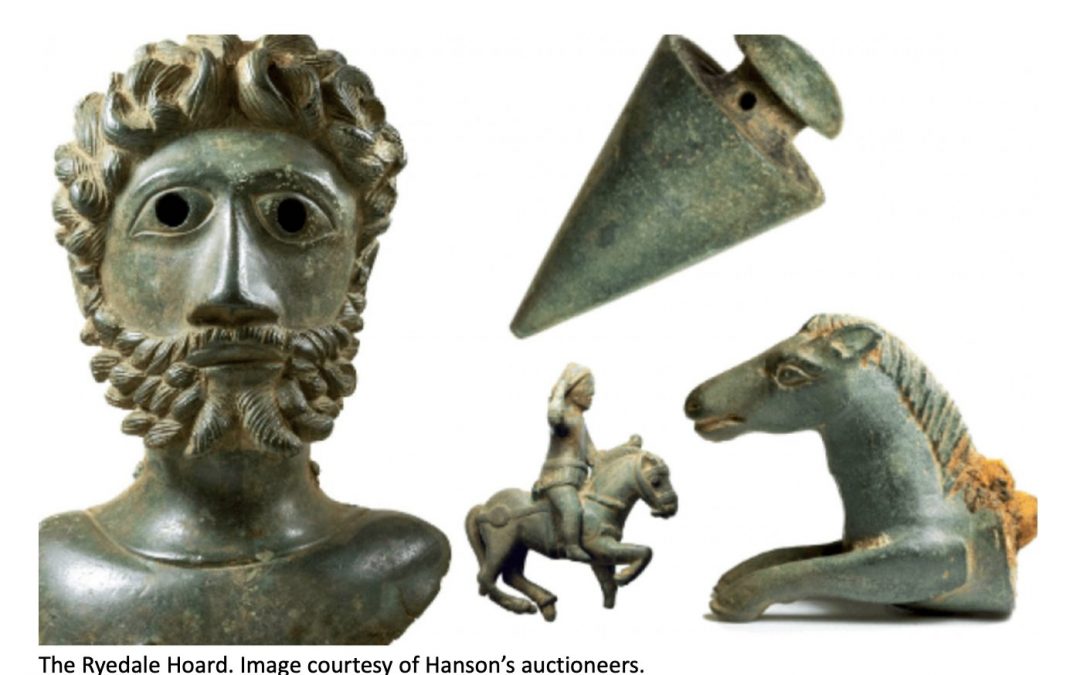
A member of my trade association was the winning bidder of the Ryedale Hoard when it came up for auction in 2021. There was understandable upset that York Museum lost out to higher bidders, but it all came out well in the end. That was because the winning bidder, a dealer, got together with a private numismatics collector and others to negotiate a deal for the hoard to be gifted to York Museum, where it is now on public display. The Crosby Garrett helmet, cited as a catalyst for the amendments to the Treasure Act, might have sold to a private collector, but that collector has loaned it for public display four times already.
One of the benefits of the legislative changes should be to reduce friction between museums, collectors, detectorists and the trade. This is, however, only possible because the system, unique to the UK, is admirably fair and largely respected by all parties – the composition of the Treasure Valuation Committee reflects this. It is a system we can all be proud of, but these are complex relationships that we need to constantly nourish and help evolve – it is easy for misunderstandings to arise.
Are there any other areas of antiques law where you feel changes are needed?
The wider antiques trade (so not just antiquities) has been subject to many legal and regulatory changes in recent years, the two most notable being the Ivory Act and the 5th Anti-Money Laundering Directive.
The Ivory Act will soon extend beyond the ban in antique elephant ivory. Whatever the benefits to the natural world – and the jury is out over whether a single elephant’s life will have been saved – it will mean the destruction or loss of pieces containing antique ivory that is not of museum quality and will be rendered unsalable. We can see the impact already as objects containing more than the maximum amount of ivory allowed for trade are being dismembered.
I think we need to be very careful of introducing any more laws that could mean antiques are not protected, as this can put even objects in museums at risk in the long term from deaccession and possible destruction. The Ivory Act has also caused a great deal of damage to relationships.
In a world where ‘up-cycling’, recycling and ‘pre-loved’ are ever more popular, we should be giving tax breaks to support the second-hand goods market – be they old or ancient. The antiques business has long been a trail-blazing business for the green economy, and we should all do more to help it flourish.
Understood if this isn’t your area, but I’ve heard that many small museums don’t have the budget or space to showcase even more objects, which is what these changes would ideally lead to. Do you have any insight there?
The number of objects involved is likely to be under 50 each year, so I can’t see it overwhelming museum storerooms, but it’s an interesting point. Supposedly storerooms are accessible for public study, but the reality is that few people know this, and generally not enough staff are available to allow this to happen. The British Museum and the V&A have less than 1% of their holdings on public display. It would be interesting to conduct a survey of other museums, both in the UK and overseas, to establish what percentage of their holdings are actually on public (or online) display. For museums to fulfil their public benefit remit, they should focus on digitally recording objects for online study.
Any other general comments you’d like to make here?
Although it is an EU law, the new import licensing regulation due to come into force in June 2025 is likely to prove disastrous for art markets across the world, including the three largest, in the US, UK and China. However, the EU art market is likely to suffer the most. The measures are unrealistic, oppressive, unjustified and will prove very costly. They also risk damaging customs operations across the EU.
The EU will essentially close its borders and prevent its private citizens from buying a wide range of cultural objects because the paperwork and costs required will make it impossible. The UK and European trade have been working hard to communicate the dangers posed by this regulation since it began working its way through the European Parliament prior to Brexit, and we continue to do so, collaborating with our European trade partners. However, this is a battle none of us can fight alone.
by Antiquities Dealers' Association | Nov 10, 2017 | Uncategorized, Views |
Collector Matthew Polk, a board member of the Committee For Cultural Policy and trustee of a number of museums, has written a detailed paper on how the war on terror has shifted cultural property policy from preservation to enforcement, with a number of unwarranted and unfortunate policies that have the potential to damage the trade and museums.
From grossly exaggerated figures for the revenues raised by ISIS from looted artefacts to the silencing of dissent on such topics, Polk studies their sources and effects, and notes how law enforcement policy has moved from evidence-based debate to political expediency.
“Reading this you could be forgiven for thinking that museums should just give up and close their doors,” writes Polk. “Museums take their public missions seriously and should be at the forefront of world cultural heritage preservation efforts. Instead, museums are being pushed aside as legislative efforts driven by a fear of terrorism create a nightmarish regulatory environment in which museums, their staffs, trustees and donors are often portrayed as villains.”
Proposals under the US TAAR Act are even worse: “It is a shocking but real possibility that US citizens and institutions could suddenly find themselves subject to thousands of foreign laws not even available in English which could be applied retroactively at the whim of government officials as will apparently now be the case in the EU,” Polk notes.
He also accuses law enforcement of preferring “high profile actions, such as the Elliot Ness style raids conducted during 2016 NYC Asia Week or Fish and Wild Life’s SWAT raids on Gibson Guitars in 2009 and 2011” and says this suggests that “they are more interested in high profile press coverage than in seeking cooperation to help stamp out illegal or destructive activities”.
“This is unfortunate as it has created an atmosphere of fear bringing less transparency to the art markets when what we need is more,” he concludes, adding: “Enforcement has also relied increasingly on civil forfeiture actions to seize objects even when no crime has been proven and customs continues to use administrative obstacles and minor paperwork errors as justifiable cause for seizing objects entering the country without having to prove they are in any way illegal.”
The full article appears on the Committee For Cultural Policy website.
Recent Comments