by ADA | Aug 29, 2023 | Uncategorized, Views
Even when an antiquities dealer proves to be the hero of the hour, the media and others try to blame the market instead of those responsible
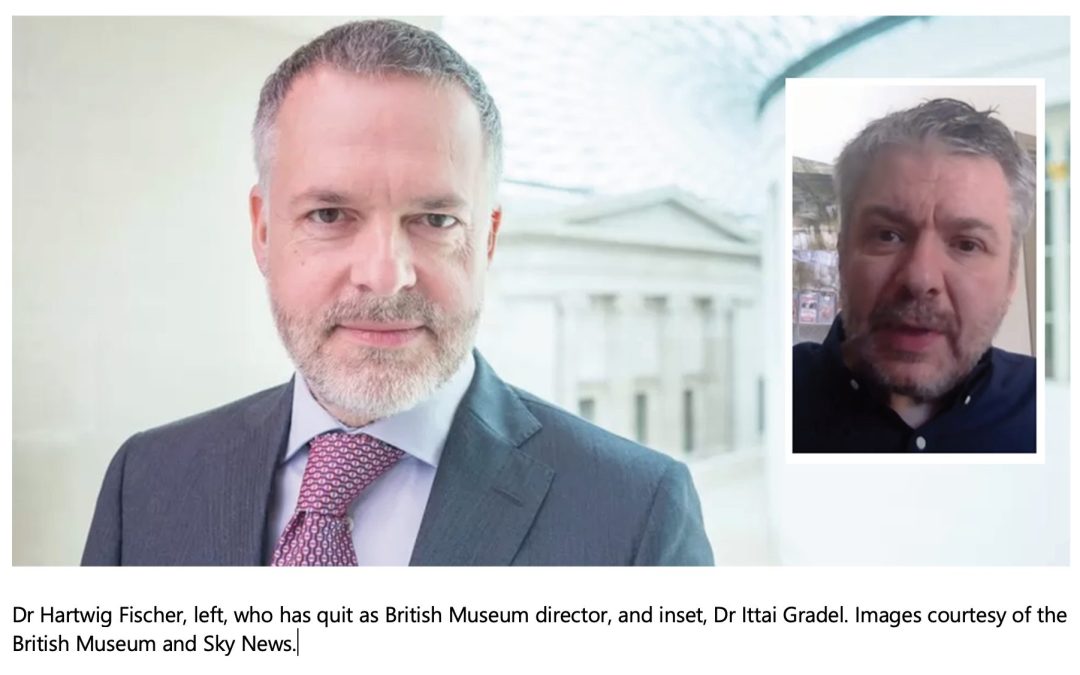
Much of the past ten days has been taken up with the thefts scandal at the British Museum. A senior curator sacked, the director of the museum quitting early, and the deputy director stepping back from duties pending an investigation.
Covered in disgrace, senior executives made their position worse by attempting to divert blame to the man who had blown the whistle in the first place, even though he had spent several years trying to get them to take him seriously.
Why did they think they might get away with it? Perhaps because Dr Ittai Gradel, an academic and collector of antiquities, is also a dealer. And perhaps, too, because history shows us that the media are all too ready to believe the worst of the trade even when confronted by evidence to the contrary.
BM director Dr Hartwig Fischer was quoted as follows: “When allegations were brought to us in 2021, we took them incredibly seriously, and immediately set up an investigation.
“Concerns were only raised about a small number of items, and our investigation concluded that those items were all accounted for.
“We now have reason to believe that the individual who raised concerns had many more items in his possession, and it’s frustrating that that was not revealed to us as it would have aided our investigations.”
Dismissing these claims as “lies”, Dr Gradel accused the director of “shooting the messenger”: “They never even contacted me. I was waiting the whole time for them to ask me to give testimony. Why can’t they just own up to their responsibility?”
Excoriating censure by the Telegraph
Fortunately The Telegraph, which had secured the scoop on the story, had conducted a thorough investigation of the email trail between Dr Gradel and the BM, so it knew who was telling the truth. It went so far as to publish a leader article on August 25 censuring the BM management: “Although the British Museum ostensibly opened an investigation, it reached a swift conclusion that nothing untoward had happened. Now we know that was not the case… the whistleblower gave the British Museum the opportunity to stem the disappearances without publicity. For it to supposedly take no action was a dereliction of duty and has made it harder to argue against demands for the repatriation of important parts of the collection such as the Elgin Marbles.”
Most damningly, the Telegraph concluded: “Why are those accused of ignoring warnings still in post? If they refuse to resign then George Osborne, the UK’s former chief finance minister and now museum’s chairman, should dismiss them for tarnishing the reputation of a great institution.”
While Dr Fischer’s crisis management proved a disaster for him and the museum, as one of the two most senior government ministers in the land during the David Cameron premiership, Mr Osborne is a seasoned politician with a much more authoritative grasp on the playbook of public opinion and reacted accordingly to limit the damage. He revealed that some items had been recovered, calling it “a silver lining to a dark cloud”.
In a BBC interview, Mr Osborne also revealed what he thought had gone wrong in the failure to address Dr Gradel’s concerns promptly: “…was there some potential groupthink in the museum at the time, at the very top of the museum, that just couldn’t believe that an insider was stealing things, couldn’t believe that one of the members of staff were doing this? Yes, that’s very possible.”
IADAA and ADA adviser Ivan Macquisten was quoted in The Times, explaining the importance of the trade’s role in crime prevention, as the media turned its attention to the unwelcome challenges that the possible sale of so many stolen items might pose.
It became clear that many of the missing items had never been properly catalogued or photographed, meaning they will probably never be identified or restored to the British Museum’s collection. Nonetheless, the most strenuous efforts must be made to recover as much as possible.
Trade associations launch media campaign over crisis
Both IADAA and the ADA launched a media campaign on August 25 calling on the British Museum to publish a full list of the missing objects, together with photographs, prominently on its website as a matter of urgency so that the trade and others can help in their safe recovery. Mr Osborne has said that only the police can publish a list on the Interpol website and that the BM is working with the Art Loss Register, adding that simply publishing the list itself might not bring the best response. This was unconvincing. The Art Loss Register is unlikely to focus on less important items among those stolen, and regardless of what other measures the BM is taking, it should also publish the list prominently on its website to ensure the greatest public awareness in the quest for recovery. If that is too much to ask, the least it could do is to provide the correct information to dealers and auction houses for enhanced due diligence.
Despite it being a member of the antiquities trade who devoted four years to uncovering the scandal and reporting it, some commentators have used the scandal to attack the trade.
Foremost of these is anti-trade campaigner Morgan Belzic, doctor in archaeology at the French Archaeological Mission in Libya, who reportedly told classicist Daisy Dunn, also writing for The Telegraph: “The London art market is one of the most involved in antiquities theft and looting… It can move objects very easily and quickly out of the country. It’s one of the least controlled markets in the world. There’s a lot of complacency, a lot of negligence and, of course, some dealers are directly involved with the illegal trade.”
Belzic stuck the knife in further with bogus statistics: “I’d estimate the legal art and antiquities market is only 20 per cent of the total trade,” he said. “It’s impossible to give an accurate number, so little research has been done in the field, but the illegal trade is certainly in the billions [of pounds].”
If it is impossible to give an accurate number, how can he estimate that the legal market is only 20 per cent of the total trade?
He is clearly also unaware of the recently published Cambridge University paper by Dr Neil Brodie and Assistant Professor Donna Yates, The illicit trade in antiquities is not the world’s third largest illicit trade: a critical evaluation of a factoid, or the 2020 RAND report, the latter of which demonstrates convincingly why any illicit trade in antiquities could not be worth billions of dollars – a logical point earlier noted by the ADA’s and IADAA’s own analysis.
Hypocritical approach of trade’s critics
Belzic follows the pattern of many critics of the trade by demanding unquestionable documented provenance for their claims over artefacts, while considering himself free to make wild, inaccurate and damaging claims about the trade without offering any provenance to support what he has to say. He makes a very serious allegation, accusing London dealers of criminal activity. If he has proof of this, why does he not name them? His careless approach is irresponsible.
The additional problem with this is that it is such critics, spreading the bogus claims over an illicit trade worth billions of pounds, who themselves risk encouraging further looting by those who think they are going to make a fortune from such thefts when the reality is otherwise.
One of the more important aspects of this whole sorry saga is the spotlight it has thrown on the politicisation of the museum sector and how it is run. In a letter to The Times on August 25, the former curator of Salisbury Museum, Peter Saunders, agreed with an earlier comment piece decrying the way that museums were losing their way: “…museums have too long felt pressured by funders and politicians to focus on flavour-of-the-month matters such as decolonisation, equality, diversity, restitution and climate change, to the detriment of basic, old-fashioned curatorship. Cataloguing and security are unglamorous activities. Yet might a national scheme to mark all collections with DNA identifiers to deter theft and aid police recovery of stolen artefacts not prove attractive to sponsors? It would surely help prevent the sort of ‘plundering’ suffered by the British Museum.”
The scandal has also led to other issues coming to light. In an August 18 article, Thefts by staff a common problem in UK museums, say experts, The Guardian reported on claims from a former London Museum employee that the sector was :”institutionally corrupt”, with the theft of items being considered “fair game”.
Even after all this, with Dr Gradel doing everyone the greatest of favours by his hard work and determination – and the museum world exposed as having a very serious institutionalised problem – elements of the media exploited the crisis to attack the trade once more.
Article full of unwarranted smears
In an article that didn’t even bother to consult anyone in the trade, on August 28 The Guardian fired a series of unprofessional and unsubstantiated smears against the market, starting with: “Close observers of the antiquities market tend to be a cynical bunch, having witnessed any number of scams, dubious practices and illicit trading.”
In what appeared to approach a defamatory line, it went on to ignore all the reasons Dr Gradel had given to explain why he had kept in contact and continued to buy from the BM thief – building a case, keeping him on the hook etc. Instead it questioned his probity: “After all, the only reason the story about the British Museum has come to light is because a Danish antiques dealer, Ittai Gradel, says he became suspicious about a dealer with whom he continued trading for several years.”
It then added to the insult with the following:
“According to Gradel, he alerted George Osborne, the museum’s chairman, after being “fobbed off” by its managers for two years. Apparently he first had doubts about one seller back in 2016, when he recognised an item he’d seen many years before at the British Museum. When he asked the seller, whom he’d been dealing with since 2014, where he came by his objects, he was told that the man’s grandfather had owned a junk shop in York between the wars.
“That’s the kind of cover story that allows both parties involved to continue with business without having to explore any more awkward questions or pay an expert to establish provenance, even though it is a dealer’s legal responsibility to do just that.
“It took Gradel a further four years before he says he realised that he had been inadvertently handling the seller’s stolen goods. And that’s when, he says, the British Museum started dragging its feet.”
Journalist did not even speak to Gradel or trade as he attacked them
This is an extensive and unfair criticism of the whistleblower by a journalist who has not even had the courtesy to speak to him – even at a time when Dr Gradel was conducting a major round of media interviews. Why not?
The article then questions whether a dealer buying from someone from the British Museum would have a duty to conduct due diligence, as though that did not happen. It is the fact that Dr Gradel did conduct such checks that led to his discovery, a fact that The Guardian ignores.
What it does do is talk extensively to the trade’s arch critic, Dr Christos Tsirogiannis, who says: “It’s a huge red flag,” agrees Tsirogiannis, “but on the other hand, how many dealers of antiquities out there are not dealing with unprovenanced objects? I don’t know anyone.”
As usual, in launching this attack on the trade, Dr Tsirogiannis ignores the reality of provenance surrounding ancient objects: that few, if any, have comprehensive documentation dating back to the point of creation or discovery because of the fact that they are so old and that either such paperwork never existed or has not survived.
If the journalist involved, Andrew Anthony, had dug a little deeper, spoken to someone from the Antiquities Dealers’ Association, or at least bothered to check the ADA website, he would have found all the illuminating answers he needed, from the association’s position on responsible collecting, through its mass of independently verifiable data to its analysis of ethics, due diligence, provenance and provenance research.

by ADA | Aug 9, 2023 | News, Views |
The introduction of the new Aboriginal Cultural Heritage Act 2021 in Western Australia on July 1 has proved such a disaster that it has been scrapped after little more than a month.
Announcing the withdrawal, Premier Roger Cook said: “Put simply the laws went too far, were too prescriptive, too complicated and placed unnecessary burdens on everyday Western Australian property owners.”
As the Brisbane Times concluded: “It’s hard to think of a bigger lawmaking failure in recent political history than the WA government’s impending backflip on its Aboriginal Cultural Heritage Act.”
Why is this of interest to the world of antiquities? Because it deals with the same competing priorities that cause friction between commercial and personal interests on the one hand and heritage campaigners on the other, and because it shows what can happen when you tip the balance too far in one direction.
The news that the 2021 Act would be scrapped came after fears that the legislation, which undermined personal property rights for a huge section of business, farming and the public, in favour of the cultural heritage rights of indigenous peoples, might be extended across Australia.
One example of how enforcement of the law had an immediate and stifling impact was the cancellation of civic tree-planting ceremonies after an Aboriginal land corporation demanded $2.5 million to allow them to go ahead.
WA Premier Roger Cook had come under personal attack over the measures, which he refused to delay after complaints that the law was poorly written and its likely impact unclear.
He introduced the Aboriginal Cultural Heritage Act 2021 (ACH Act) after Rio Tinto destroyed sacred rock shelters at Juukan Gorge while searching for iron ore in May 2020, despite being warned of their significance earlier. Rio Tinto later apologised, and the CEO and other senior executives later resigned over the matter.
Redefining the meaning of Cultural Heritage
Section 18 of the original 1972 Aboriginal Heritage Act, which held sway until now, provided for land owners to proceed with activities that might be severely damaging to cultural heritage interests if granted permission by the government after a review.
The new act redefined the meaning of Aboriginal cultural heritage so that it was no longer limited to places and objects but also included cultural landscapes and intangible elements, although what they might be was uncertain.
It also replaced Section 18 with far tighter restrictions on property over 1,100 sqm, with permissions to be sought via Local Cultural Aboriginal Heritage Services (LCAHS), bodies that have yet to be fully established.
Effectively the Act gave Aboriginal bodies a direct and greater say – tantamount to a veto – over what landowners could do with their land through the oversight of a new Aboriginal Cultural Heritage Council (ACHC) to whom the LCAHS report.
The type of work covered could be as simple as putting up a new fence or updating irrigation works, as well as more complex projects.
Successful applications by landowners would be issued with an ACH permit, while those of greatest concern winning that approval also had to provide a management plan before going ahead.
Even when they had complied fully with all this at their own expense, landowners risked seeing their plans cast aside if new information arose concerning heritage aspects of the site.
New law “suffocates” private property rights
Those opposed to the early introduction of the law said its statutory guidelines, published at the end of May, were not clear.
Sky News political commentator Caroline Di Russo argued the new law was much worse, saying it “suffocates” private property rights of landowners, and adding that it is “the most disproportionate and overblown response imaginable”.
Red tape and ambiguity would plague farmers and industry as they tried to comply under the threat of prosecution and even jail, Russo said. Even where permission was eventually granted, it was unclear how long the drawn-out process would take.
Despite the extended definition of Aboriginal cultural heritage, Western Australia’s planning chief, Anthony Kannis, who had ultimate responsibility for overseeing the changes, was unable to define what would be covered when asked about this in a question-and-answer session with ABC News, saying “…if there is any doubt whatsoever about the advice you’re getting, there are opportunities to consult with us as a department and raise questions with us”.
One farmer whose family had farmed land in the region for over 50 years had deliberately preserved 1,000 hectares of forest country for decades, only to be told by Mr Kannis that a decision to clear it using fire in keeping with Aboriginal tradition was a possibility if the ACH ruled in its favour. “This is about giving Aboriginal people a say, and that shouldn’t be lost in all this discussion,” he countered.
In what the Financial Review dismissed as “farcical scenes”, at a forum hosted by the Association of Mining and Exploration Companies, “one mining executive asked government officials whether planting a tree near the Swan River in Perth would require a site inspection by traditional owners and the preparation of a heritage management plan.
“The officials replied it would depend on the size of the tree.”
The estimated cost of consulting what Mr Kannis described as “knowledge holders” ranged between AUS$80 and AUS$280 per hour (≠ £42/$55) (≠ £140/$150).
However, as the Financial Review also noted, “Junior exploration companies complained of being charged upwards of $200,000 for heritage surveys in the lead up to the new laws coming into force and said the rollout had been shambolic.”
Penalties for those in breach of the law included fines that started at AUS$20,000 for moving or selling ACH objects. An individual seriously harming ACH could be fined AUS$1m, while a corporation could be fined AUS$10m, with both also risking jail terms.
Concern led to scrapping of fines for initial period
Such was the concern over this amid confusion over how the law would be interpreted that Mr Cook scrapped fines for the first 12 months of enforcement while the legislation bedded down.
The WA government dismissed calls for a review, even after a petition launched by the Pastoralists and Graziers Association demanding a six-month delay raised 27,000 signatures.
Mr Cook ruled out any delay to the new regulations, despite the widespread concern, saying: “The laws are about a simpler, fairer, like-for-like transition of the current laws already in place.”
However, reality soon struck, with the impact on mining interests, as well as farming, seen as devastating. Support for the government plummeted.
Meanwhile, having secured a cultural hegemony via the new law, Aboriginal Heritage groups are now furious at the WA government change of heart.
In all, this was a textbook case in how not to address the valid concerns of indigenous groups as they fight to protect their culture. The WA government under Roger Cook dismissed the equally valid concerns of ordinary people in protecting fundamental human rights relating to property. In turn, this infringement blighted the economy in such a way that much of it risked grinding to a halt in weeks if not days. And that would have driven a deeper wedge between the competing interests of landowners and indigenous groups.
Add to all this the predictable risk of abuse of power by heritage groups handed almost unlimited say in what landowners could do, and the government had prepared the ground for toxic levels of corruption when it came to consultancy fees.
Now Mr Cook is being forced to re-adopt the 1972 law that he had argued was problematic. Having overseen this catastrophic and avoidable policy change, his credibility in seeking to resolve the issue any time soon is in tatters, and he will be doubtless focused now on shoring up support.
His arrogance in dismissing the loud and valid concerns of farmers and others as he declared the new law “simpler, fairer, like-for-like” won’t be forgotten any time soon.
WA disaster an object lesson for law makers
The WA disaster is an object lesson for law makers across the globe when it comes to balancing commercial and private interests with the demands of heritage groups. Effective policy means a nuanced approach that takes both into account, not throwing one side to the wolves in the hope of ingratiating yourself with the other.
Failure to strike this balance despite being obliged to do so by a clear policy directive does not augur well for the European Union’s import licensing regulation (2019/880) for cultural property, due to be enforced from June 2025. The damage to the international art market, including that of the EU itself, as well as the infringement of ordinary people’s rights, is likely to be widespread if that goes ahead – and Brussels has been alerted to this this often, but continues to ignore the warnings.
Too often laws are ushered through with barely a nod at genuine scrutiny of the concerns of all stakeholders. As the Brisbane Times concluded about the WA affair: “Had there been a robust parliamentary debate the practical issues that eventually emerged may have been ironed out before the laws came into effect on July 1.”
The European Commission would do well to look closely at what has just happened in Western Australia.
by ADA | Jul 17, 2023 | News, Uncategorized
Ministry’s legal head reinforces ‘innocent until proven guilty’ principle in interpreting law
The Italian Ministry of Culture has issued a potentially ground-breaking statement, following a court ruling. It challenges current thinking on cultural heritage and patrimony and reinforces private property rights.
Essentially the statement addresses conflicting priorities between private property rights and the Italian state’s desire to protect its cultural heritage, and how this conflict addresses proof of ownership.
Recent years have seen a significant shift in attitudes among state authorities and law enforcement towards the idea of reversing the burden of proof regarding the legitimate ownership of antiquities and ancient coins. This is despite private property rights being enshrined in all fundamental clauses of international human rights conventions and in both common law and natural justice. Guilty until proved innocent has almost become the new normal.
Now, however, comes evidence of a fight back against this fundamentally undemocratic idea. This statement is one of them, and it has an additional welcome twist.
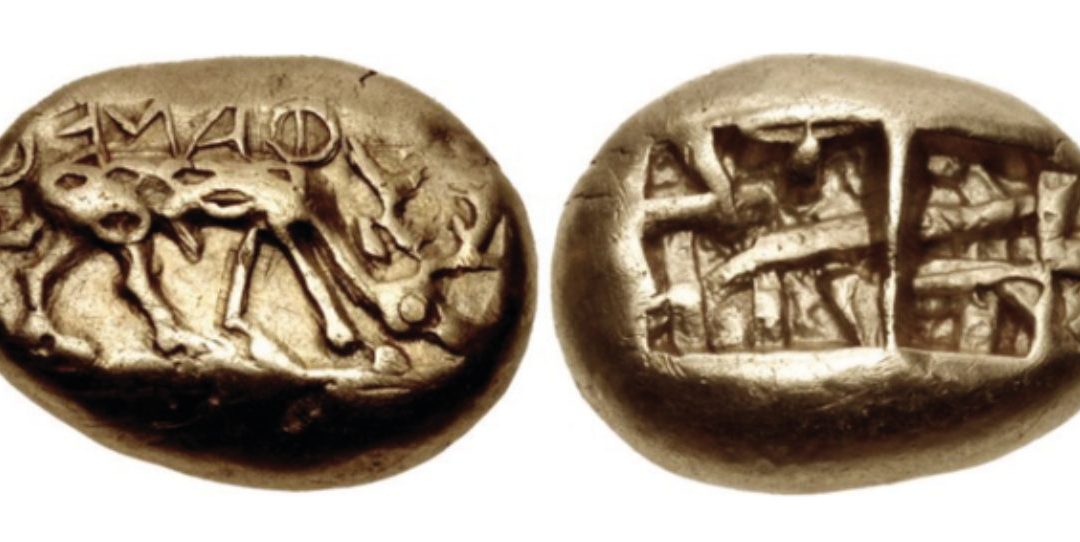
It arose after Italy’s Directorate-General of the Department of Archaeology, Fine Art and Landscape sought advice from the legal department on how to interpret Article 72 of the Cultural Property Act. As Coins Weekly notes: “This article governs the import of archaeological (numismatic) objects originally from Italy and demands extensive proof of origin.”
The legal department’s head, renowned professor of law Antonio Tarasco, came back with a surprising statement, acknowledging competing views. On the one hand, some lawyers argue that protecting Italian cultural heritage is a priority that renders significant objects as state property unless private ownership can be proved (reversal of the burden of proof); on the other are lawyers who argue that private ownership should take priority except in the most exceptional circumstances.
Law professor acknowledges Court of Cassation ruling as precedent
This dichotomy led the professor to look at the part documentation has played over the years in establishing ownership rights for coins in Italy. The first thing he noted was that as late as the 1980s, retaining proof of purchase was highly unusual. But he also noted that in 2009, his department insisted that “proper documentation issued by the countries of origin” was essential in establishing the lawful circulation of objects.
Importantly, this meant that any certification issued on import had to be renewed at the appropriate time or the Italian State might take possession of the item in question.
Fast forward to 2021, however, and Italy’s Court of Cassation – the highest appeal court which focuses only on how laws are interpreted – re-established the priority of private ownership without automatically having to provide supporting documentation (innocent until proven guilty).
Professor Tarasco points out that this meets the test of proportionality and reasonableness (just as the ADA has been arguing needs to happen with the EU import licensing regulation 2019/880). Of particular note is what Professor Tarasco has to say about this: “Forcing citizens (be they collectors or professional numismatists who buy abroad) to provide (almost fiendishly extensive) proof of the legitimate origin of the coins they buy, which must even date back to before 1909 [when Italy’s patrimony law was passed], is ultimately making it more difficult to buy – and therefore import into Italy – significant numismatic material that may one day enter public collections.”
The welcome twist Professor Tarasco adds at the end of his statement argues that making imports more difficult is actually damaging to Italian cultural heritage: “If we look closely, we can see that this approach – even if applied with good intentions – will not result in Italy protecting its national cultural property, but rather losing it.”
A fascinating statement from the head of the legal department of Italy’s Ministry of Culture, then. With all this in mind, how does Professor Tarasco view Italy’s application of Article 4 of the EU regulation 2019/880 from June 2025? It insists on the sort of “fiendishly extensive” documentation and evidence that effectively reverses the burden of proof in the way he decries here. And how does he feel about the Memorandum of Understanding Italy shares with the United States, which does exactly the same?
Professor Tarasco has highlighted the importance of proportionality and reasonableness here – qualities echoed in the European Commission President’s guiding principles for policy. If the Italian government’s leading legal authority on the issue, together with its highest court, acknowledges that private property rights have priority over what may be seen as the national interest in this way, how can it continue to move forward with either the new EU law or its MoU?
by ADA | Nov 2, 2022 | News, Uncategorized, Views |
The World Customs Organisation has finally published a new report following the 2019 report, covering two years from 2019-2021, probably delayed because of the Covid 19 pandemic. Its results once again show that global levels of illicit trade in cultural property are far lower than claimed.
In the press release we read: “This year, the analysis provided in this Report is based on data collected from 138 Member administrations. Previously composed of six sections, the Report now covers seven key areas of risk in the context of Customs enforcement: Anti-money laundering and terrorist financing; Cultural heritage; Drugs; Environment; IPR, health and safety; Revenue; and Security.”
It also states: “The analysis contained in this Report is mainly based on the collection of data from the WCO Customs Enforcement Network (CEN) — a database of worldwide Customs seizures and offences”….
“However, the CEN database relies heavily on voluntary submissions by Members hence the quantity and quality of the data submitted to the system has its limitations”…
“However, as part of this new methodology, the data and information sources used to elaborate this Report has been enlarged to include various open sources.”
While the rest of the report might be “mainly based on the collection of data from the WCO Customs Enforcement Network (CEN)”, in the introduction to the Cultural Heritage chapter on page 57, the WCO goes further, admitting: “Unfortunately, the data received through the WCO’s Customs Enforcement Network (CEN) in 2020-2021 being incomplete, the following analysis will be mostly based on open source information.”
Case studies based on media reports rather than primary research
The result for the Cultural Heritage section is that most of the case studies are based on newspaper articles, sometimes even on events that happened decades ago, and have nothing to do with recent trafficking activities. This is alarming as much of the problem with false data plaguing the cultural property sector stems from misreporting in the media. It is even more alarming when the misleading picture created by a surface reading of the chapter will undoubtedly be used as ‘evidence’ in future campaigns against the art market, as past reports have been.
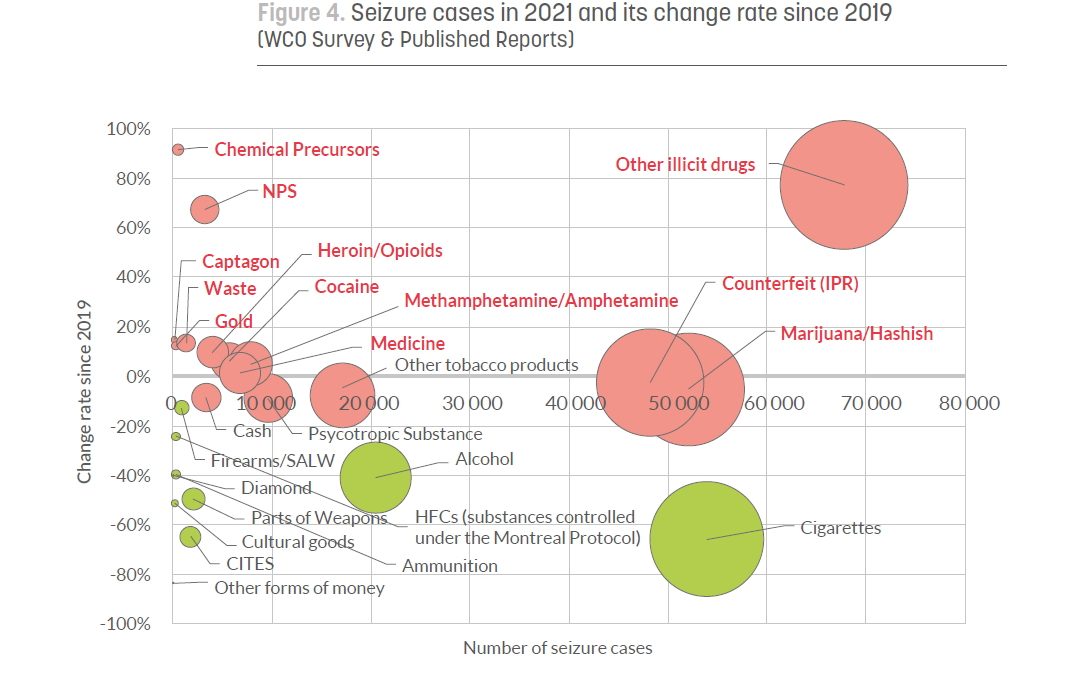
The WCO is supposed to report recent and reliable figures, like figure 3 on page 35, showing that the number of worldwide reported cultural goods cases for 2021 is a mere 156, that is 1.1 case per reporting country….
A newly introduced graph (shown here) in the WCO report (Page 17, Fig. 4) reveals precisely what the ADA and its fellow association IADAA have reported over the past years: the illicit trade in cultural heritage is so small that it barely shows in the statistics. Not only is it the smallest category – so small that you have to look carefully in case you miss it – but the graph also shows that seizures have fallen by around 50% between 2019 and 2021.
Let’s not forget, too, that the Cultural Heritage category is not limited to antiquities, as so many mistakenly believe; it covers 13 distinct sub-categories, including: all forms of art, antiques and collectables, household items, flora and fauna, books and manuscripts. In 2019, the top three categories of recovered item sub-categories were: Fauna, Flora, Minerals, Anatomy & Fossils; Other; and Hand-painted or Hand-drawn articles and works of art. No mention of antiquities, which did not even warrant its own sub-category.
All of this begs the question as to why, in its chapter on Cultural Heritage, the WCO has chosen to focus exclusively on photographs of seized antiquities (at least one of which seems to be a fake) alongside fossils and coins. The choice appears politically charged.Consistent reporting of
The WCO has stated in the past and here that there is under-reporting of crime in the culture sector and that it only counts seizures and cases reported via the Customs Enforcement Network (CEN), the implication being that the problem is much larger.
Figures consistently show low rate of illicit trade in cultural property
However, the miniscule share of illicit trade represented in its reports over the years by cultural property has been consistent, only now augmented by media reports not sourced via the CEN.
It further boosts this chapter of the report with a summary of Pandora VI, the latest in a seven-year campaign of international operations involving mass seizures and arrests. What the WCO, Europol or Interpol have never done, however, is to provide data on how many of their seizures and arrests later prove to be justified and how many were shown to be related to terrorism financing. It is not just the trade asking for these figures, academic investigators want them too to see how effective these operations are.
Previously the WCO has attempted to rebut the ADA and IADAA’s analysis of its reports, stating that the figures cannot be relied on. As our analysis always provides transparent sources for the data emanating from the reports, however, the WCO’s case against our analysis simply does not stand up.
Ultimately, its figures must be indicative of the global state of affairs; if they are misleading, why publish them?
by ADA | Jan 26, 2022 | News
ADA chairman Joanna van der Lande has written the first in a series of articles on issues concerning antiquities and the art market for distribution within the European Parliament and to representatives at the recent Davos summit.
The article appears in MACE, a Brussels-based political magazine whose purpose is to raise issues of cent and spark debate among politicians, civil servants and other people of influence within the EU machine.
Articles will follow by IADAA chairman Vincent Geerling on data, fake news and how they help create misguided policy, and Ivan Macquisten on the wider implications of how this is affecting the art market.
The objective is to encourage deeper understanding of the challenges the market faces, with a view to establishing better relationships with decision makers on the political stage.
Recent Comments