
by ADA | May 28, 2024 | News
Sir John Boardman OBE FBA Hon RA, Emeritus Lincoln Professor of Classical Art and Archaeology at the University of Oxford and an Honorary Fellow of the Magdalene College Cambridge for 40 years, was not just the pre-eminent scholar of Archaeology and Ancient Greece, he also proved to be a remarkable friend to the antiquities trade and collecting.
Sir John, who died on May 24, aged 96, published numerous notable works, including The Greeks Overseas (1999), Persia and the West (2000), World of Ancient Art (2006), and Archaeology of Nostalgia (2002).
Born in 1927, and educated at Chigwell School and Magdalene College, Cambridge, his early career included three years as Assistant Director of the British School of Archaeology at Athens, while later he served as an Assistant Keeper in the Ashmolean Museum, Oxford, and then Reader in Classical Archaeology and Fellow of Merton College, Oxford.
By 1963, Sir John had become a fellow of Merton College, Oxford, going on to succeed John Beazley as Lincoln Professor of Classical Archaeology and Art. Having been knighted in 1989 and frequently cited as “Britain’s most distinguished historian of ancient Greek art”, he retired in 1994, his long life bringing him another 30 years of research, study, and influence.
This influence included the development of a simple, logical and compelling assessment of the ancient world as being divided into three geographical zones, with accompanying characteristics that did much to inform their art. These were the nomadic peoples of the north, the farming and city peoples of the temperate zones and the inhabitants of the hotter zone at the tropics. As the Telegraph obituary noted: “Nomads, he found, whether in Asia, Europe or America, tend to have an art based on small, portable figures, often animals; monumental architecture is largely confined to the temperate zone, while in the tropics art largely based on the human form, with an emphasis on ancestors.”
He took part in excavations in Smyrna, Crete, Chios and Libya, and his awards included the Kenyon Medal (1995) from the British Academy and the Onassis Prize for Humanities (2009).
Sir John was especially concerned with the art and architecture of ancient Greece, particularly sculpture, engraved gems, and vase painting.
When it came to the sensitive and combative debate surrounding antiquities in the context of Middle Eastern conflict – especially over the past ten years – Sir John was a robust defender of the trade and argued that we all have a responsibility to prevent looting and smuggling, including those nations from whom artefacts are removed. Article 5 of the 1970 UNESCO Convention puts the primary burden on the country of origin, as he reminded us. As the Convention summarises: “It is essential for every State to become increasingly alive to the moral obligations to respect its own cultural heritage and that of all nations,” he said.
In recent years he considered the merits of antiquities whose find context could not be traced and the relentless drive towards the reversal of the burden of proof when it came to the legitimacy of objects.
In 2017, he wrote an article for Cahn’s Quarterly, titled Academic Censorship, that touched on the subject, beginning: “A majority of the books published in the last fifty years about ancient art have depended on illustration of objects which are not from controlled excavations, and to pretend that they are therefore illegal, useless and misleading is, of course, absurd, yet this is the logical conclusion to be drawn if the extreme view about ‘academic’ or ‘moral’ integrity is accepted, and all objects not from controlled excavations are ignored.”
In the article Sir John argued that it was very doubtful whether sites could ever be controlled effectively. As an example of an artefact that is out of context but useful, he gave a silver chalice of no known provenance in the Bible Lands Museum, Jerusalem of around A.D. 500.
“It is no doubt from the Palestine area and its Latin inscriptions show it to have been made for a Eucharist ceremony – “Holy is God, holy the mighty one, holy the immortal one, have mercy on us” – typical for the Eastern Orthodox Church. Its lack of detailed provenance cannot disqualify it as a record of Antiquity.”
Unlike so many other academics, Sir John proved himself impartial in search of history and the truth: “Some years ago it was said that in Turkey boys who found antiquities on an ancient site could sell them to dealers who would then supply them with forgeries to sell on to tourists/collectors. Yet the recent publication of some 500 Roman seals, gems and rings, picked up over some 30 years by a family walking over the fields concealing the ancient city of Caesarea (S. Amoral-Stark & M. Hershkovitz, Ancient Gems, Finger Rings and Seal Boxes from Caesarea Maritima: the Hendler Collection, 2016) shows how much is still on the surface, and no less valid as evidence than excavated material.”
Demonstrating just how relevant the study of Ancient Greece remains to this day, less than 24 hours after Sir John’s death, a new study using volunteer marines from today’s Hellenic Forces to test the effectiveness of Greek Bronze Age body armour revealed just how good it would have been in protecting Mycenean soldiers 3,500 years ago.
Longstanding ATG columnist and former Christie’s specialist Richard Falkiner still owns a Greek scarab that Sir John published when he first became acquainted with him in 1963.
“He was very easy to have discussions with, even those to those who knew infinitely less than him,” he said.
by ADA | Apr 24, 2024 | Views
Fifty-two years ago today, the UNESCO 1970 Convention on the prevention of illicit trade in cultural property first came into force. Nine days ago, Kenya became the latest country to finally ratify the Convention, adopting it into domestic law. It comes into force there on May 15.
It’s worth remembering that delay: 52 years plus three weeks.
And it’s well worth revisiting the terms of the Convention because so many people these days misinterpret it for their own ends.
As its articles set out, it was designed to protect exceptional objects – national treasures specifically designated as important in published lists by the countries where they originated (Article 1). Today those campaigning against the art market argue that it covers every last commonplace artefact: it doesn’t. What’s more, few if any States Parties have submitted such lists of important works.
States Parties to the Convention make seven pledges under Article 5. These include a further commitment to keeping an updated national inventory of protected property (few, if any do); organising the supervision and protection of archaeological excavations (few do); and ensuring that interested parties such as curators, collectors and the market observe the principles of the Convention (these parties tend to do this themselves).
Article 6 commits States Parties to introducing a system of export licensing that includes the issuance of an export certificate or licence (only some do).
Article 7.b(ii) introduces one of the key elements of the Convention: “The States Parties to this Convention undertake: at the request of the State Party of origin to take appropriate steps to recover and return any such cultural property imported after the entry into force of this Convention in both States concerned, provided, however, that the requesting State shall pay just compensation to an innocent purchaser or to a person who has valid title to that property.” [emphasis added].
The words highlighted here in Article 7.b(ii) are vital. They show that the terms of the Convention only apply to a State Party after it has adopted them into its national legislation either automatically or via ratification. So, in Kenya’s case that is May 15, 2024.
Who signed up to the Convention and when?
The adoption list shows that the first countries to adopt the Convention were Bulgaria, Ecuador and Nigeria, which did so on the first day of enforcement, April 24, 1972.
Apart from Kenya, countries that have ratified or accepted the Convention much more recently include Switzerland (2004), Afghanistan (2005), Germany (2008), The Netherlands (2009), Austria (2015), Ethiopia (2018), Yemen (2019) and Malawi (2022). Many countries in Africa and Asia did not accede to the Convention until the 21st century.
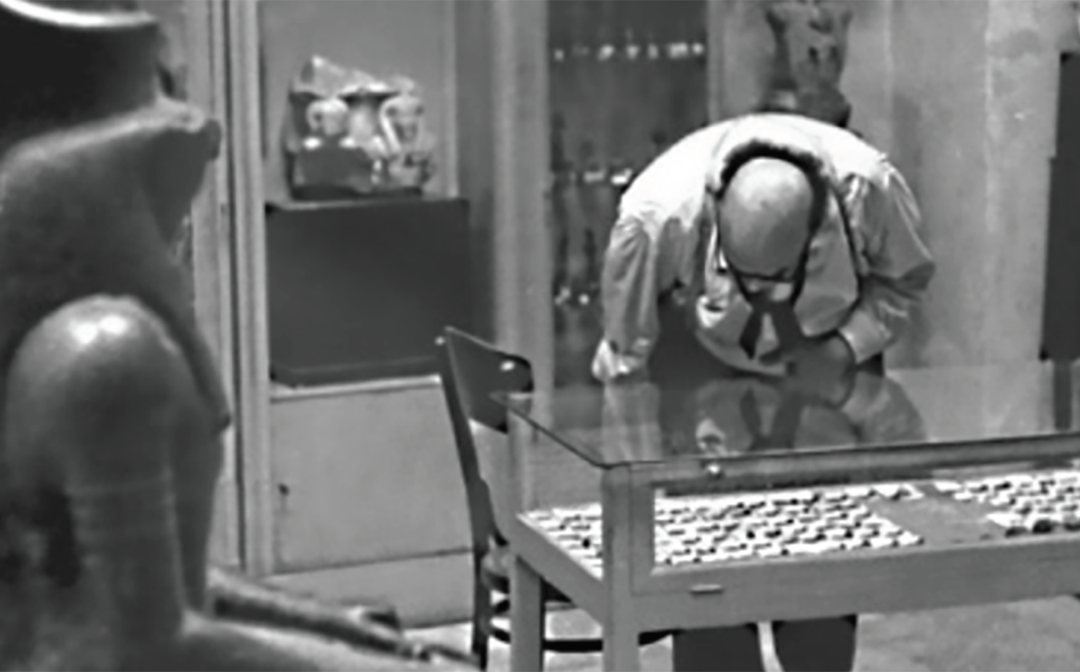
An interesting case in point is Egypt, which did not accept the Convention until July 5, 1983. Up to that time, not only had Egypt overseen a system of licensed dealers selling antiquities for legal export, it even ran a saleroom from the Cairo Museum. The picture here shows a visitor inspecting items for sale there around 1965.
Why is this important? Because under numerous proposals now being made – in particular via Regulation (EC) 2019/880 within the European Union – a widespread attempt is being made to enforce the terms of the Convention on a global basis from April 24, 1972.
This means imposing its rules on States Parties that have not agreed to such a move. In Egypt’s case, it will effectively outlaw any item sold and exported legally from Egypt in the 11-year period between 1972 and 1983 for which documentary proof to the standards demanded today cannot be provided to show that the purchase and export were legal. In reality, that will mean just about everything, because the export licence, which it would be essential to produce today, probably no longer exists and, in the extremely rare cases where it did, it would probably not have sufficient identifiable detail to meet the exacting standards now imposed for import.
It should be remembered that in 1980, for instance, no requirement would have existed to retain an export licence once used – indeed it would have expired. (Even today no requirement subsists to retain such licences once used and expired.) In many, if not most cases, a single export licence would have covered multiple items, and so would not have stayed with any or all of them once the export/import process had been completed. Items then sold on to new owners legally would not have been accompanied by the export licence, and many of these items would have changed hands several times since.
The challenge for the private citizen
How would a current owner supply the required proof under such common circumstances?
The retroactive application of the 1970 UNESCO Convention terms by national law enforcement bodies such as customs would effectively outlaw objects that have been exported and traded since entirely legitimately. Such an imposition would be in direct contravention of human rights conventions (as well as basic principles of international law) to which the countries imposing these new rules are signatories. As a reminder, Article 17.2 of the Universal Declaration of Human Rights states: “No one shall be arbitrarily deprived of his property,” while Article 1 of the Protocol to the European Convention of Human Rights states: “Every natural or legal person is entitled to the peaceful enjoyment of his possessions. No one shall be deprived of his possessions except in the public interest and subject to the conditions provided for by law and by the general principles of international law.”
‘Arbitrary’ has a meaning that includes “unrestrained and autocratic in the use of authority”, while “general principles of international law” include the concept of innocent until proven guilty.
By retroactively outlawing legitimate activity and doing so in a way that an individual cannot demonstrate their innocence, the authorities effectively breach the human rights conventions, yet this is what is proposed.
It should also be remembered that the articles of the UNESCO Convention were drawn up specifically to prevent such an imbalance of interests, as noted by one of its architects Mark B. Feldman in his 2023 book Footnotes to History.
Under Article 7.b(ii) of the Convention, in Kenya’s case, its terms should only apply from May 15, 2024, not 52 years ago.
As we celebrate the 52nd birthday of the UNESCO Convention on the means of Prohibiting and Preventing the Illicit Import, Export and Transfer of Ownership of Cultural Property, it is timely to remind those who support its aims that they should follow its terms and not abuse it for their own undemocratic ends.
by ADA | Jan 4, 2024 | Views
The cheap and easy way to gain diplomatic influence can cost individuals and vulnerable groups dearly
Cultural heritage Memoranda of Understanding are good for diplomacy but can damage the rights of citizens
As anyone from the art market involved in the international world of cultural heritage will know, dealers, auction houses, buyers and sellers have long been the unjustified targets of governments, NGOs and law enforcement.
The message has been that the looting and trafficking of cultural property from vulnerable nations – many of whom are in an almost permanent state of crisis or war – is funding terrorism. Stolen items smuggled to Western markets lead to a flow of cash in the other direction to pay for bombs and bullets, they argue.
The problem is that despite innumerable research projects, studies and other initiatives to show this over the past 20 years and more, evidence of the art market’s role in this is so thin on the ground as to be all but non-existent.
Independent studies, such as the ground-breaking RAND Corporation report of 2020, state that open source evidence clearly demonstrates that the antiquities market could not possibly sustain the billion-dollar level of international crime it is accused of fomenting.
This has not prevented bodies like the European Union, the United States Government and others competing for influence in strategically important countries like Egypt, Iraq and Syria from introducing proposal after proposal – so numerous that they seem to be falling over each other for precedence – to tackle the perceived problem.
Campaigner highlighting injustice
Collector and cultural property lawyer Peter Tompa has been at the vanguard in highlighting abuses of power and influence when it comes to policy in this field.
His latest article, published by Cultural Property News, shows how the US State Department has been harnessing bilateral agreements (Memoranda of Understanding) involving works of art and ancient artefacts to curry favour in geopolitics. In doing so, it is acting against the will of Congress and against the interests of private citizens, including vulnerable ethnic and religious groups, he believes.
At the heart of the problem is the fact that MoUs effectively reverse the burden of proof over the ownership of cultural property at the point of import; you’re guilty until deemed innocent. Importers to the United States must secure a current licence from the source country covered by the MoU confirming that the imported item in question was originally exported legally from there, whenever that might have been – and it could have been centuries ago.
So, this would apply to a Roman vase that could have left Italy during the 18th century, having been purchased by a wealthy young man on the Grand Tour, and has since changed hands and moved countries numerous times. How likely is it that the current importer would hold paperwork from that original sale and export that would convince the Italian authorities to issue such a licence? But that is what Article 1 of theMoU with Italy stipulates if Customs are not to seize the vase and send it back to Italy.
Similar agreements are in place with 30 other nations, from China to Yemen.
Tompa has previously highlighted the fact that MoUs can also deprive vulnerable minority groups, such as the expelled Jews of Libya, of their moral and legal rights in reclaiming their cultural patrimony. Instead, under the terms of the MoU, objects are returned to these peoples’ oppressors in the states from which they have been expelled or subjugated.
So, how can the State Department justify this rapid spread of these agreements?
Lack of funding for archaeologists has forced many of them to earn a living doing something else, Tompa notes. “Thanks to government largess, however, lucrative new opportunities have arisen for a select few archaeologists working with State Department bureaucrats to help justify cultural property Memorandums of Understanding (MoUs) or “emergency import restrictions.”
‘Jihad against private ownership’
For many, this is an easy choice to make: “Not surprisingly, such work often draws those most committed to the view that cultural artifacts should be clawed back from U.S. collectors and museums for the benefit of countries that have been victimized in the past by Western colonialism. Most collectors, dealers and museum curators have no idea about all the State Department money that is funding this jihad against the private ownership of cultural goods in the U.S.”
Tompa looks at who is running what he describes as a “cottage industry”.
“The U.S. State Department Bureau of Educational and Cultural Affairs (ECA) and its Cultural Heritage Center have done more than anyone to grow this new cottage industry through grants and contracts as part of their ‘soft power’ efforts that seek to make hostile third world governments ‘like us more’,” he writes.
He also explains how the State Department circumvents restrictions imposed by Congress on the former’s ability to exploit MoUs for its own ends.
As always, following the money provides a clearer picture. The State Department needs better evidence of looting and trafficking to justify MoUs. It also needs to show that recipient source countries have appropriate controls in place to protect their cultural patrimony.
Tompa notes that critics have asked how much of an incentive those being funded have to come up with what the State Department wants. He describes the long-established American Society of Overseas Research (ASOR) as a major grant recipient and “evidence maker” for some of the most difficult to justify MoUs and cites examples of how those receiving hundreds of thousands of dollars in funding may be creating false narratives to suit the State Department’s purposes.
Tompa provides several examples of concerning behaviour, in one case citing an archaeologist associated with ASOR, working under a $600,000 State Department contract, who was identified as the source for a widely reported false claim that the ISIS terror group’s profits from antiquities looting were “second only to the revenue the group derives from illicit oil sales”.
Where is the media on this?
This is explosive stuff and a potentially dream investigation for any curious journalist worth their salt, involving, as it does, vast sums of money, Washington insiders and international policy that favours countries with questionable human rights records. So far, though, both the mainstream and leading art market media outlets have remained silent, leaving experts likes Tompa to do all the heavy lifting. This is curious when one considers how frequently and keenly the widespread media reports any example (alleged or actual) of crime involving cultural property.
The harnessing of such bilateral agreements for geopolitical gain – with art traders and private citizens paying the price – has long been a subject of concern. Could fear among journalists of falling out with influential advocacy groups who act as regular story sources be the reason for their apparent lack of interest?
This hands-off approach from hacks may be emboldening the State department. Tompa writes: “The State Department acting as both decision maker and facilitator for cultural property MoUs raises other concerns. More recently, the State Department has dropped all pretense of following the intent of the CPIA (Cultural Property Implementation Act) by showering additional funding on archaeologists to facilitate new and renewed cultural property MoUs.”
What we are seeing on a widespread basis is not the development of evidence-based policy, but policy-based evidence as the stakes rise among MENA nations and in the Far East, as well as in Central and South America. Security, diplomatic influence and other issues may be the real concerns, but cultural heritage Memoranda of Understanding are the currency by which a favourable position can easily and inexpensively be achieved. While that is understandable, the conditions under which they are being issued raise serious ethical, moral – and in the case of the U.S. Constitutional – questions, particularly about the rights of citizens and vulnerable groups, as well as fundamental principles of law.
Let’s not forget that the same U.S. citizens having their goods seized are also unwittingly funding this unjust process.So far, no one in authority has made any serious challenge to this process. It is about time that changed.
by ADA | Nov 23, 2023 | Views
Assistant District Attorney Matthew Bogdanos has been head of Manhattan’s Antiquities Trafficking Unit (ATU) since 2018. He has understood since at least 2011 – and probably earlier – that claims of a multi-billion dollar market in looted and trafficked antiquities have no basis in fact. This is evident from the opinion piece he wrote for CNN, published on July 7, 2011. In that piece he wrote:
“One of the main problems with looting is that if a site is undiscovered, you simply don’t know what you don’t know. Interpol estimates that the illicit antiquities trade is worth billions of dollars. My question is: How do they know that?
“If it is illegal and, therefore, a clandestine trade, how do you know the dollar amount? It is similar to the drugs trade, you guess from the amount you’re able to seize. It is not a scientific approach, nor one I am comfortable using in assessing the total value of the worldwide trade in illegal antiquities.”
These two paragraphs additionally confirm that Bogdanos is guessing when he associates the scale and importance of antiquities trafficking with that of drugs and weapons. He even tells us that that is exactly what he is doing and that he is not comfortable with it.
If, as he argues, that Interpol – and so anyone else – cannot possibly know the value of the illicit market, it is a logical consequence that they also cannot claim that it is of equal standing in scale and scope to markets in trafficked drugs or weapons. These are simply false claims about antiquities.
Further evidence to show claims are false
Little has changed regarding such data since 2011, except that since 2015, the World Customs Organisation (WCO) has produced annual Illicit Trade Reports assessing the size and comparative extent of risk categories, including cultural heritage. Those reports include information registered via the Customs Enforcement Network (CEN) and so are not comprehensive. However, the figures for cultural heritage, of which antiquities form a miniscule part, are so small compared with other risk categories, including drugs, counterfeit goods, tax evasion and weapons, that it is clear there is no similarity at all in scale or scope between drugs and weapons trafficking, on the one hand, and antiquities trafficking on the other.
Further, the 2020 RAND Corporation report, an independent study into open source data on the issue by what is arguably the United States’ most trusted research organisation, concluded that available evidence showed that a multi-billion dollar illicit global market in antiquities was simply unsustainable: “Simply put, while we cannot claim to measure the size of the illicit market, we can show that observable market channels are too small to act as conduits for a billion-dollar-a-year illicit trade.”[1]
That report also concluded that what had become widespread claims of the trade in illicit antiquities being linked to those in drugs and weapons could be traced back to Bogdanos as the original source.[2]
Twelve years on from publicly declaring that the multi-billion dollar claim had no basis in fact, and that the link to drugs and weapons claim was pure guesswork, we find that the Manhattan District Attorney’s office is still promoting the first claim in its media releases.
False claim repeated more than once in recent media releases
On March 21, 2023, under the headline D.A, Bragg Returns 29 Antiquities to Greece, the official media release from the D.A.’s office included the following statement: “Antiquities trafficking is a multi-billion-dollar business with looters and smugglers turning a profit at the expense of cultural heritage…”. The speaker was Special Agent in Charge for HSI New York Ivan J. Arvelo.
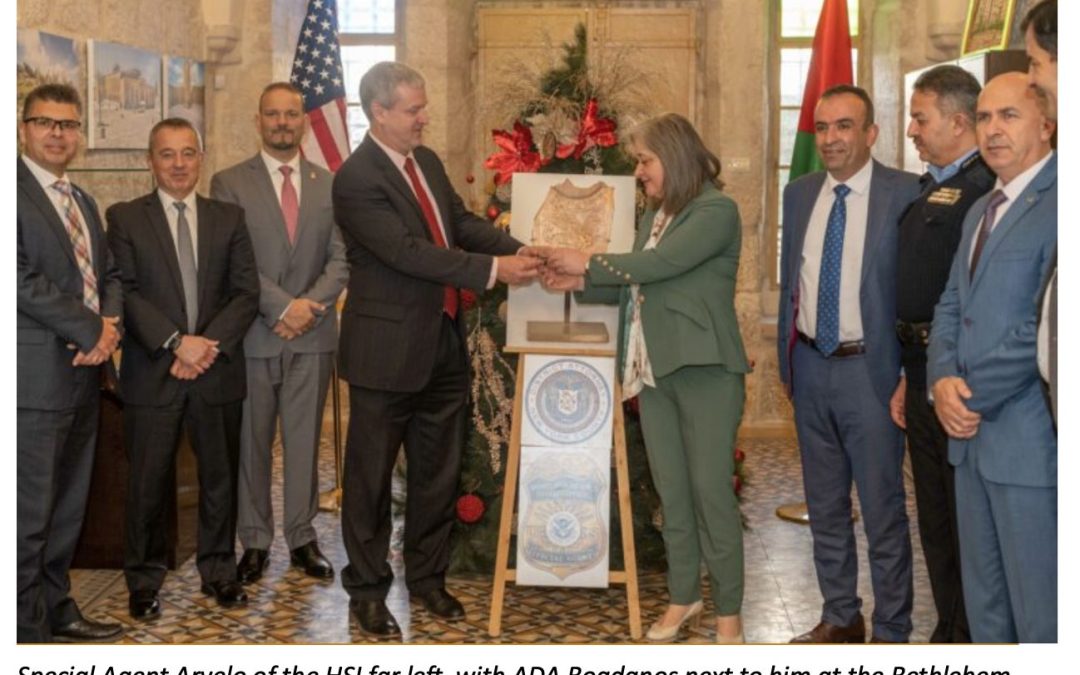
The same quote from Arvelo had been included in the D.A.’s earlier official media release on January 5, 2023, regarding the return of an artefact to the Palestinian authority. It is not clear whether Arvelo made his comment during the ceremony at Bethlehem, when Bogdanos was standing next to him, or afterwards, but it remained uncorrected in both releases.
It is hard to believe that in such a sensitive area of crime fighting official releases from the District Attorney’s office would not be scrutinised and signed off by its leading officer prior to release. If Bogdanos is not screening official releases, it raises the question as to why not. If he is, why is he not correcting what at best can be called misinformation that he is well aware of prior to their issue, or at least doing so once they have been released?
He has long known about how controversial and false these claims about antiquities are and, as in his 2011 opinion piece for CNN, expressed his discomfort with their use. Such oversight is crucial to the ATU’s credibility.
If we cannot rely on the D.A.’s office to issue accurate information relating to this highly sensitive area, how can we have confidence in the rest of what it has to tell us on this subject?
[1] See Measuring the international trade in antiquities, page 70 AND Issues with the Current Approach for Assessing the Antiquities Market to Terrorist Funding, page 12 AND Summary, page 84-85 AND Findings, page xii
[2] See Antiquities Trafficking Using Telegram, pages 49-50
by ADA | Sep 20, 2023 | Views
How do those buying antiquities protect themselves and the public?
Anyone buying items online needs to ensure that what they are paying for is genuine and that the seller has the right to sell them. That’s true for ordinary household goods and consumer wares, and especially true when it comes to the trade in antiquities.
The two trade associations supporting the Antiquities Forum, the UK-based Antiquities Dealers’ Association (ADA) and the International Association of Dealers in Ancient Art (IADAA), have long pioneered policy on this. Having a clear and effective crime-prevention policy is the best way of safeguarding their members and their members’ reputation, as well as boosting confidence in the trade among the public. It is also essential for preventing ancient artefacts being exploited by the unscrupulous.
In doing this, the two essential considerations are Provenance and Due Diligence. But what do they mean?
Provenance is the history of an object, tracing its ownership back as far as possible to ensure that it remains an item that can legitimately be traded. The ADA sets out a detailed summary of the different types of provenance an object can have, what that means and why it is important, on this website.
Due diligence, meanwhile, is the process which trade professionals undertake to ensure that the items they are handling are authentic and can be traded legitimately. It is important to remember that in the event of any legal dispute, the effectiveness of the due diligence undertaken by those responsible will be taken into account.
Effective due diligence is a vital part of protecting traders’ good reputations, which are essential for success in business.
What the associations have to say
The ADA sets out the process of due diligence for its members as follows:
Before offering property for sale, members must be satisfied that they have conducted the level of due diligence required to establish that the property they are handling is authentic and that there are no known legal obstacles to selling and passing title.
The ADA requires members to adhere to the relevant domestic and international laws that govern the markets for archaeological and ancient property and, in many respects, ADA standards go beyond the legal requirements.
If members are not certain as to the laws of a particular jurisdiction, or their application to a specific item, please consult the ADA Council for advice.
Members must act in good faith throughout all transactions.
Members should record each transaction with diligence and keep records for a minimum of 6 years.
Where a member is buying from another dealer or an auction house then the member should record the transaction and note the provenance as provided. Some items will have more detailed provenance than others.
Where a member is buying from a person other than a dealer or an auction house then the member should establish the identity of the vendor. Unless the vendor is well known to the dealer, where an item is worth over £3,000 then member should request photographic identification and if practical take and retain a copy of it. Members should obtain in writing:
- The name and address of the vendor;
- A warranty that the vendor has good title to the objects;
- Confirmation of where, when and how the vendor obtained the objects, as can be provided by the vendor;
- Where the vendor acquired the objects outside the United Kingdom, confirmation that the item has been exported or imported in conformity with local laws and where available evidence of that.
In addition, wherever possible members should arrange payment by a method that leaves an audit.
Lawful Trading
Members undertake to carry out due diligence, as set out under this Code, to ensure, as far as they are able, that objects in which they trade were not stolen from excavations, architectural monuments, public institutions or private property and are lawfully on the market for sale.
Members will make all reasonable enquiries to ascertain earlier ownership history of any object they are considering purchasing, mindful that the illicit removal of archaeological objects from their original context is damaging to our knowledge and understanding of the past.
Members have a duty to record and preserve relevant prior ownership history of an object along with any evidence supplied.
Stolen Art Databases
“It is a condition of membership that all goods acquired at the purchase price of £3,000 or more be checked with an appropriate stolen art database, unless they have already been so checked.’
No system is perfect and many items have very little documented information establishing a detailed history going back decades or longer. This does not necessarily mean that there is anything wrong as there can be a number of valid reasons for this: for instance, paperwork may have been lost or not kept – in the past, such information was not deemed important, as it is today.
As can be seen from the due diligence requirements set out above, however, a higher level of checking is demanded for higher value items.
Market professionals also tend to have effective antennae for picking up ‘red flags’. Remember, just like anyone else, they do not want to hand over ready money for something that may later turn out to be a problem.
Additional things they look out for include items that are significantly under-priced, as this may point to someone handling stolen goods trying to offload them. Another thing to check is how credible the seller is as a source of the material being offered.
The ADA and IADAA have both been proactive in developing due diligence over the years. Indeed, UNESCO’s code of conduct in this field was based on the earlier code published by IADAA.
Both the ADA and IADAA provide further advice on their websites at www.theada.co.uk and www.iadaa.org
Recent Comments