CINOA, the global trade federation for dealers in the international art market, with 5,000-plus members, has published a wide-ranging new report that exposes the causes and sources of bogus information used to damage the market.
From the deliberate dissemination of false evidence, as seen in the October 2020 UNESCO advertising campaign, The Real price of art, to the misreporting of facts, the report shows how many bodies of international standing, from NGOs to law enforcement and even governments, perpetuate falsehoods about the art and antiques market. It also demonstrates how the bogus evidence – as well as its constant reinforcement via the media and other sources – has directly influenced policy, including new laws that damage the market.
One of the most shocking aspects of all this has been the clear failure of highly influential bodies such as the European Commission and the United Nations Office for Drugs and Crime to properly check the sources of the information that they publish; the repercussions for legitimate interests have echoed down the years.
Another shameful feature is just how much of the false information now being relied on can be traced back to media articles and other reports that are decades old and either do not carry the information claimed at all or whose evidence has been completely misreported as it has been filtered through other sources over time. Frequently cited claims that prove to have no foundation in fact whatsoever include:
Trafficking in cultural property is third only to that in drugs and weapons
80-90% of sales of antiquities involve goods with illicit origins
Cultural property trafficking is a multi-billion dollar industry
However, bearing in mind the time, resources and legislation already dedicated to this subject in recent years, perhaps the most startling fact CINOA publishes is that it cannot find a single instance anywhere in the world of an arrest or seizure of artworks leading to confirmation that the items in question have been used to fund terrorism. Considering how keen the authorities are to demonstrate the link between the art market and terrorist financing, it is hard to believe that they would not engage in a major media campaign to publicise such a case if it ever arose.
Quite apart from the unwarranted damage this lack of probity has inflicted on the innocent, it has also led to a wider failure of policy, with real problems that need dealing with under international conventions and other agreements being ignored in favour of the pursuit of propaganda-fuelled ideology. While the report focuses on the repercussions for the art market, the institutional failures resulting from this misguided policy have claimed other victims, notably vulnerable cultural heritage sites and the vulnerable people living near them, who should enjoy better support as they are asked to help in the protection of their heritage.
Much of this inappropriate policy development is funded by public money, yet acts against the public interest. Even when its failures are drawn to the attention of the authorities responsible, as those involving UNESCO and the European Commission have been, they ignore or dismiss them and carry on as before. It is hard to think of any other walk of life where such scandalous behaviour would go unpunished, let alone continue to be encouraged and even celebrated.
Unlike many of the bodies it takes to task, the report provides properly checked primary sources, including weblinks, for all the data it publishes, so that they can readily be verified independently.
Iraq is having a problem encouraging young Iraqis to train as archaeologists, according to the country’s internal media. The cause? Those who train cannot find work.
This is an astonishing state of affairs bearing mind the crying need for new domestic talent and expertise, a long-term plan for conservation and preservation, in keeping with the country’s Article 5 obligations under the UNESCO 1970 Convention and the vital importance of cultural heritage tourism to the future of the county’s economy.
“Many of Iraq’s world heritage sites lie in ruins three years after the collapse of the Islamic State and thousands of mounds conceal remnants of ancient cities,” says Al-Fanar Media. “The sites are under threat of looting and need teams of experts to unveil their treasures. But fewer young people want to study archaeology in what is regarded as the cradle of civilization, and jobs are scarce for those who do.”
Meanwhile field excavations continue, led by teams from the United Kingdom, the United States, France, Italy, Germany and the Czech Republic.
The experiences of one candidate explains their discouragement: “The graduates’ situation is painful,” Al-Obaidi said. “There are no public or private jobs for us. It has become a joke for an archaeologist to apply for jobs.”
The extent of the problem is illustrated by the University of Mosul intake: “only 28 students out of 17,000 students joined the College of Archaeology this year, according to its president, Kossay Al-Ahmady.”
“Usama Adnan, an assistant professor of history at Al-Mustansiriyah University, says the admission of only a handful of students in some of Iraq’s archaeology schools stems from “a lack of archaeological awareness.”
Al-Ahmady believes that poor pay is one of the reasons that put potential archaeologists off. Others experts give their reasons too.
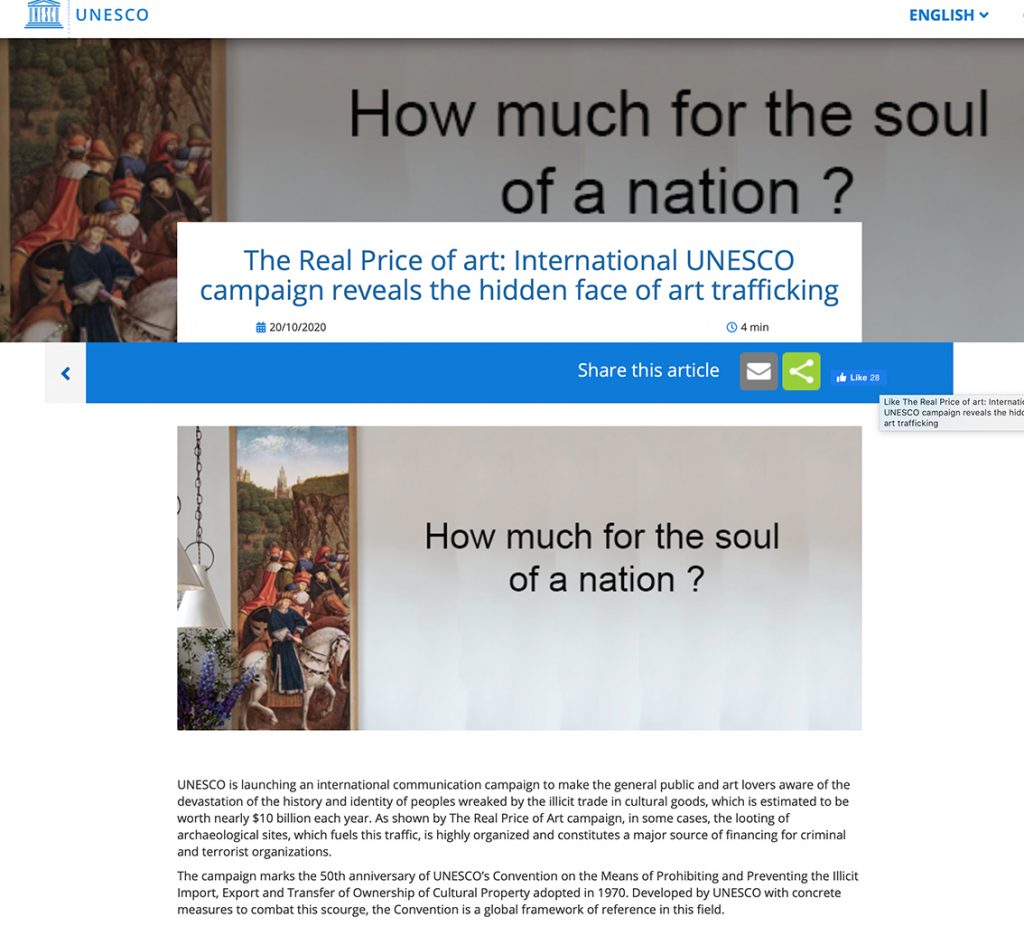
In the latest of a string of baseless claims, UNESCO reports that the illicit trade in cultural property is estimated to be worth nearly $10 billion a year. It’s a handy figure to use as a headline to launch its 1970 Convention’s 50th anniversary conference and accompanying campaign. However, it gives no source for this claim. “As shown by The Real Price of Art campaign, in some cases, the looting of archaeological sites, which fuels this traffic, is highly organized and constitutes a major source of financing for criminal and terrorist organizations,” the article on its website continues. Launched on October 20, the campaign has included the first International Day against Illicit Trafficking in Cultural Property on November 14 and an international conference (November 16-18) organised in partnership with the Federal Foreign Office of Germany, the European Commission and the Council of Europe. Having asked the UNESCO author for the source of the $10 billion claim, our fellow trade association, IADAA, was sent a copy of the French version of the 2018 Joint European Commission-UNESCO Project report, Engaging the European Art Market in the fight against the illicit trafficking of cultural property, by Professor Marc-Andre Renold with the message that the evidence was in section C. It isn’t. As we pointed out to the author, the Renold study doesn’t mention a $10 billion figure anywhere. The closest it comes is in quoting an estimated figure of $6 billion to $8 billion from page 50 of the 2011 study by Frank Wehringer listed in the footnotes. However, Wehringer did not give it as his estimate but as a figure “regularly given” without providing any real source for it. He also said that “according to widespread statements, [this] makes it the third largest illegal market after drugs and weapons (according to estimates by UNESCO and FBI according to Anton 2010a: 2)”. In fact, this supposition is not true, as confirmed by Interpol and the WCO Illicit Trade Reports (the latest published in June), which yet again put the number of cases being investigated and seizures made in cultural property at 0.2% of the global total reported through the Customs Enforcement Network, whereas for drugs it was 35%/30% and for weapons 8%/8% – other risk categories were much higher than for cultural property, which was by far the smallest category). In addition, the Renold study itself states: “There are no comprehensive and reliable statistics that would allow us to capture the true scale of illicit trafficking or monetary value of the black market in cultural goods.” This is a view adopted by Interpol, which has also stated that it never expects to have any reliable figures, as well as by the RAND Corporation report, studying open source data, published in May 2020. As the ADA and IADAA pointed out to UNESCO, this is important because in recent years so many misguided policy decisions have been made on the back of false information, with the result that funding and other resources have been diverted away from where they are really needed in the fight against crime, including trafficking. We then pointed out that in the absence of a reliable source for the $10 billion claim, UNESCO is currently promoting inaccurate information in what is a highly sensitive area. This being the case, we asked the author to correct the error before it was disseminated any further in the wider media than it already had been. As yet, we have received no further reply and the article remains unchanged on UNESCO’s website.
UNESCO risks misleading the very public it wishes to educate
Bearing in mind that the express aim of the international communication campaign to which this article is linked is to “make the general public and art lovers aware of the devastation of the history and identity of peoples wreaked by the illicit trade in cultural goods”, it seems reasonable to expect UNESCO to get its facts right and to correct mistakes when they are brought to its attention. Otherwise it risks misleading the very public it wishes to educate. However, as was later reported, almost the entire advertising campaign devised by UNESCO surrounding this has been exposed as fraudulent. If only this were an isolated incident, but unfortunately it’s all too commonplace within UNESCO itself, as the autumn 2020 editorial in The UNESCO Courier demonstrates. Written by Ernesto Ottone Ramírez, Assistant Director-General for Culture, UNESCO, it states as fact (“The figures prove it”) that the attraction of illicit antiquities has never been greater, and attempts to justify this using the bogus claim that “The illicit flow of cultural goods is now believed to be the third-largest in terms of volume, after drugs and arms”. As shown above, this is not true. (See the WCO Illicit Trade Reports 2017-2019), plus all the evidence on the IADAA website, all of which is independently verifiable through the links and references supplied. Meanwhile Lazare Eloundou Assomo, Director of Culture and Emergencies for UNESCO’s Culture Sector, was interviewed on “Antiquités du sang”, quand pillage et pandémie font bon ménage! on Radio France Culture on October 24, during which (7 mins in) he claimed that estimates put the value of the global trade in illicit antiquities at around $64 billion. Bearing in mind that the world’s leading art market report, the Art Basel Report, estimated in 2019 that the value of the entire global art market was $67.4 billion, and the legitimate market in MENA antiquities is around 0.5% of this, it would be interesting to learn his source for the claim. During another radio interview, broadcast as part of the BBC World Services’ Business Daily special Zombie Statistics on February 20, 2019 (5 mins 20 secs in), Assomo was challenged over the inaccuracy of the figures UNESCO had been promoting since 2011. His response: “I don’t think we should enter into a debate about whether these figures are right or not right.” Whilst stating that “today we do not consider it any more important to concentrate on figures”, he claims that looting has increased, a claim immediately challenged by the interviewer, who says: “How do you know… you don’t have a global figure and you don’t support the 2011 [UNESCO report] figure?” Dismissing the importance of figures is an odd position to take when you headline your campaign with an inaccurate but persuasive $10 billion figure. Statistics guru Dr Tim Harford’s response to this on the same radio programme was that it is important to take statistics seriously because they are essential for understanding the world. “If people start treating them in a very cavalier way, that spoils it for everybody, because then people start not trusting statistics… Listing where a claim came from and how it was arrived at is a very important starting point.” It’s time UNESCO followed this advice. If, as both Ramírez and Assomo keep claiming, the evidence is there and clear, why don’t they produce it, especially when directly challenged to do so by organisations like the BBC? The Ramírez article mentioned above was an ideal opportunity to set the record straight on this front, yet it did not do so. If the evidence is so clear, why the need to rely on bogus figures instead? For an organisation like UNESCO, with its reputation and influence, to behave in the sort of cavalier way Dr Harford describes over such a sensitive subject is not only highly irresponsible and damaging, but also contemptuous of the public interest it pledges to serve.
The following is the original version of a letter sent by ADA chair Joanna van der Lande and published by the Art Newspaper on page 16 of their July/August 2020 issue
While Europol, Interpol and the World Customs Organisation are very good at grabbing headlines, experience tells us that subsequent requests for more detail on the major international operations cracking down on cultural heritage trafficking tend to fall on deaf ears.
The latest set of seizures and arrests across 103 countries as reported in the Art Newspaper on May 8 (International crackdown on art trafficking leads to 101 arrested and 19,000 artefacts recovered) gives rise to the same set of questions we and other trade associations have been asking for years now:
How much of this material is fake?
How much can be traced back to vulnerable archaeological sites?
Who has been arrested and how many of them are actually part of the art market as opposed to ordinary criminals or gangs?
How much can be traced back to terrorist groups?
How much of it qualifies as cultural property under the terms of the UNESCO Convention?
While the headlines sound impressive, the organisations involved continue in their failure to answer on-going questions about the true effectiveness of these operations. Previous investigations undertaken by the Antiquities Dealers’ Association (ADA) and the International Association of Dealers in Ancient art (IADAA), including direct consultation with the authorities, have exposed worrying gaps in intelligence gathering.
In February 2018, for instance, in responding to an IADAA request for confirmation about the number of countries involved in the original Operation ATHENA, as well as information regarding the volume, value and nature of major items seized during that operation, Europol’s Corporate Affairs Bureau told them: “Unfortunately we do not have such information at hand as we only have a fragmented picture: this operation was coordinated between three partners – us, INTERPOL and the WCO.”
This was a surprising response from one of the main players involved, especially as they had already issued a large number of detailed claims in a press release.
Publicity surrounding this latest operation, conducted in November 2019, focuses chiefly on antiquities and ancient art from around the globe, but does not attempt to distinguish between the genuine and the fake – a key factor in tackling crime, as St John Simpson of the British Museum, an adviser to UK law enforcement, has argued in other recent news reports linked to the seizure at Heathrow last year.
The authenticity of the unique and rare Tumaco gold mask, referred to among the Athena II highlights by Europol, for example, has been called into question by some well placed experts in the field.
Previous operations gave the impression of having a major impact on antiquities trafficking and even the financing of terrorism, although closer inspection showed this not to be the case.
In November 2016, Operation Pandora involved a joint customs, Interpol and Europol operation across 18 European countries. Together they searched 48,588 people (81.6% of them in Bulgaria); 29,340 vehicles and 50 ships. This led to 75 arrests (65 of them in Bulgaria) and the seizure of 3,561 objects in total, comprising:
1000 objects from a single seizure in Poland involving an illegal metal detectorist. These comprised spent bullet cartridges and rusted gun stocks from WW2, which qualify as cultural property under Polish law
500 archaeological objects (mostly coins) in Murcia, Spain
400 coins relating to online adverts
Of the remaining 1600 objects, Europol said that “several” were “of great cultural importance in the archaeological world, such as a marble Ottoman tombstone and a post-Byzantine icon depicting Saint George, along with two Byzantine artefacts”. None of these items was rare, valuable or culturally significant to the extent claimed. All were seized in Greece, another country that is not a war zone, nor did they appear to originate in war zones, although seizing such material was a main objective of the operation. This is not to say the looting of such cultural heritage is not of as much concern to members of the legitimate antiquities trade as it is to an archaeologist.
Notwithstanding this, if these comprised the highlights of the operation, as stated, where were the rare antiquities from war zones, or material associated with terrorism financing, whose intended seizure was the mainspring of this operation?
The tendency to count every coin in a seizure individually rather than as a single seizure also risks inflating the operation’s impact.
A similar pattern of claims accompanied by detailed statistical information released by Europol and the WCO arose for Operation Odysseus in June 2014 and the first Operation Athena in November 2017. However, the ADA and IADAA are not aware of any update on any of these operations, such as confirmation of how many of the arrests and investigations led to successful prosecutions, or whether any seizure at all has led back to trafficking from Syria or Iraq or the financing of terrorism, the twin lynchpins behind these operations. Surely such information constitutes the true measure of these operations’ success and should be made public?
The WCO Illicit Trade report 2017, published in December 2018, did reveal that the largest quantity of items of cultural property seized and reported through their network for that year was a consignment of around 3000 LPs being exported to Turkey from The Netherlands.
While Facebook and other social media platforms present a significant challenge in the fight against crime, it should be noted that Facebook has been proactive in seeking trade help in tackling the issue, having contacted us last year on this matter.
It is disturbing that in her official press release, Catherine de Bolle, Europol’s Executive Director, resurrects the now discredited link between antiquities and trafficking in weapons and drugs. It took years for Interpol to remove misleading claims of a similar nature from its website where, at the same time, it admitted that it had never had any information to show that cultural property trafficking was as significant as that in drugs and weapons, nor was ever likely to have such information. The latest WCO Illicit Trade Report, covering 2018 and seizures reported through its network, showed that while drugs accounted for 32% of all trafficking seizures globally and weapons for 3.6%, cultural heritage – including all art, antiques and collectables, not just antiquities – accounted for 0.08%.
If international law enforcement is so keen to promote its work on these operations, then it should be equally eager to publish their ultimate results in terms of successful prosecutions and evidence clearly demonstrating links to terrorism funding.
Such follow-ups are important because the successes claimed by these operations have been used frequently in the media and by politicians in the EU, as well as elsewhere, to support demands for further restrictive legislation controlling the international art market. If the market is to pay the price, it has a right to know why.
Joanna van der Lande Chair Antiquities Dealer’s Association 15 May 2020
Most widely held assumptions are wrong, it argues, and this has led to poor policy in tackling the problem
Report names and shames key figures involved in creating hype and speculation, as well as bloggers and journalists
A major report by one of the most respected independent research organisations in the United States claims that current thinking on the trafficking of antiquities is mostly wrong.
Its findings have prompted it to propose a radical change in direction in the search for solutions.
The RAND Corporation argues that a lack of reliable evidence leads to wild speculation over trafficking[1] and poor policy in tackling the problem[2]. The illicit trade in antiquities is much smaller, opportunistic rather than organised, and more widely dispersed than previously thought, it concludes.[3]
“Our aggregate data suggest that the market for all antiquities, both licit and illicit, is on the order of, at most, a few hundred million dollars annually rather than the billions of dollars claimed in some other estimates … We believe that, going forward, scholars arguing that the illicit market is larger than we suggest here will need to more clearly articulate the means through which these goods are sold.”
Titled Tracking and Disrupting the Illicit Antiquities Trade with Open-Source Data, the report published on May 12 blames bloggers, journalists and advocacy groups for exaggerating – sometime ‘grossly exaggerating’ – the problem to attract headlines, funding and to effect policy change[4]. And it singles out one of the highest profile crusaders against trafficking, New York Assistant District Attorney Matthew Bogdanos, stating that the widely held but inaccurate belief that antiquities trafficking is linked to trafficking in drugs and weapons can mostly be traced back to him as the source.[5]
The report’s findings on this point go directly counter to the claim made by Europol Executive Director Catherine de Bolle in her official statement on the recent Athena II operation.[6]
The report also cites figures of $2 billion for Syria and $3 billion to $10 billion for Egypt quoted by Antiquities Coalition Founder and CEO Deborah Lehr in a Wall Street Journal article as misleading[7], while former AC Chief of Staff Katie Paul, who now heads the Athar Project, is accused of obtaining data and screenshots “with a RAND login to a third-party data provider that were published without consultation or permission”, an action deemed “ethically dubious”.[8]
Major findings in the RAND Corporation report
Major findings in the report, researched with the RAND Homeland Security Operational Analysis Center and partially funded though it work for the US Department of Defense, show that contrary to popular belief, illicit trade in antiquities is largely ad hoc rather than organised and a much smaller problem than previously thought. End markets are global, rather than focused on the West[9], policy and argument “has been dominated by speculation and hypotheses”, while almost no trafficking of antiquities is taking place via the dark web.[10]
It also notes that relatively low sell-through rates of legitimate antiquities at auction and through galleries, combined with the challenges of selling antiquities at all because of compliance, show muted demand, suggesting “that auctions could act only as a limited conduit for illicit sales”.[11]
“This reality that antiquities auctions represent a small market that is not always able to find buyers in well-advertised sales is at odds with the media’s assumption that there is a booming unmet demand for these goods that is capable of supporting a billion-dollar black market,” it concludes.
The report also finds that although fakes are a major issue in general, apparent attempts to traffic illicit items on Facebook are largely illusory, because a large number of the images posted have actually been lifted from recycled news articles or museum websites.[12]
The report concludes that current efforts to tackle trafficking are misguided, ineffective, costly and unrealistic, partially because they are based on inaccurate assumptions.[13]
Referring to transnational policing operations targeting traffickers, like Athena and Pandora, the report states: “For high-value goods and key nodes in the network, efforts by police and customs officials can successfully identify and prosecute criminal actors. However, these enforcement actions are time consuming, costly, and often require significant cross-border cooperation by law-enforcement agencies, which can often be difficult to organize. Instead, a broader-based approach aimed at undermining the trust among illicit actors and in the technologies they rely on could disrupt the illicit market more broadly and cheaply.”
Recognising that “legal standards can be troublesome because a plethora of various laws exist between and within countries, meaning that the correct legal standard that must be met can vary from object to object”, RAND recommends better targeting of clearly identified problem areas.
“…if the market is instead made up of ad hoc opportunists, then there are few centralized nodes that can be targeted to disrupt the whole market,” it argues. “Moreover, expensive and resource-intensive investigations may be inefficient in a market comprising small-scale dealers. In such cases, broader-based disruption tactics, which highlight the risks involved or publicize the damages that looting causes, might be more effective by reshaping the decisions of the individual actors involved.”
It recommends turning to disinformation campaigns: “Messaging campaigns conducted online—for example, through Facebook groups that are used by illicit actors along the supply chain (as discussed in Chapter Four)— would allow destabilizing information to be injected into trafficking networks.”
[11] See Issues with the Current Approach for Assessing the Antiquities Market’s Relationship to Terrorist Funding, page 12, and Measuring the international trade in antiquities, page 73, and Summary page 84 and 85
[12] See Antiquities Trafficking on Arabic-Language Facebook Groups, page 54
[13] See Policy Responses Based on Findings, page xiii and Responding to Illicit Networks, page 96
Recent Comments