Leading art market lawyer says new regulation will risk isolating the EU culturally
British trade associations concerned about impending EU legislation that will affect UK exports will brief dealers on the changes at a seminar in London on June 28.
Titled The increasing difficulty in the international movement of ancient coins and objects, the afternoon session is organised by law firm Devonshires, who will host the event at their London offices and online on behalf of the British Numismatic Trade Association and the Antiquities Dealers’ Association.
The session will focus on how to comply with the news EU import licensing regulation (2019/880), which comes fully into force on June 28, 2025, and affects art and objects created and originally discovered outside the EU.
Provenance, due diligence and paperwork are at the heart of concerns as the trade associations argue that the regulation will make it all but impossible to meet its demands.
Of particular concern is the manner in which the regulation reverses the burden of proof for importers to the EU. Instead of the authorities having to show that imported items have been stolen or illegally moved, it will be up to the importers to show that they haven’t.
Wilson, who is also Chief Legal Officer at Phillips Auctioneers and author of Art Law and the Business of Art, argues that the law is unlikely to prevent the trafficking of cultural property, one of its chief aims: “…the best-case scenario is that trafficking activities will simply be diverted to elsewhere in the world by this law, not stopped,” he writes. Worse, while the legitimate market will face the burden of compliance, traffickers will simply ignore the law, he believes.
“There is a risk that the more difficult it is to import an object legitimately the greater the incentive to resort to smuggling and the greater the rewards for doing so. If that happens trafficking activities will be neither stopped nor diverted – and may even increase,” Wilson warns.
It is also apparent that the EU authorities have significantly underestimated the challenge of establishing an effective electronic registration system for imports – “a mammoth task”, says Wilson – while customs officials are unlikely to have the relevant experience or expertise to deal with applications. The expected clampdown likely to result from this means will mean significant delays, inconsistency in rulings and unjustified refusals, he says.
Wilson concludes: “This complexity and delay – as well as the likely inconsistency of decisions – will likely be a strong disincentive to import art of any kind or origin into the EU. This will lead to fewer imports into the EU of art and fewer EU buyers of art in countries outside the EU. By making it harder to import cultural property, the EU will then risk becoming culturally isolated.”
This is the context in which the June 28 seminar will be conducted.It runs from 3pm to 5.30pm BST, with networking drinks to follow. Those interested in attending in person or remotely can find all the details here.
It’s worth remembering that delay: 52 years plus three weeks.
And it’s well worth revisiting the terms of the Convention because so many people these days misinterpret it for their own ends.
As its articles set out, it was designed to protect exceptional objects – national treasures specifically designated as important in published lists by the countries where they originated (Article 1). Today those campaigning against the art market argue that it covers every last commonplace artefact: it doesn’t. What’s more, few if any States Parties have submitted such lists of important works.
States Parties to the Convention make seven pledges under Article 5. These include a further commitment to keeping an updated national inventory of protected property (few, if any do); organising the supervision and protection of archaeological excavations (few do); and ensuring that interested parties such as curators, collectors and the market observe the principles of the Convention (these parties tend to do this themselves).
Article 6 commits States Parties to introducing a system of export licensing that includes the issuance of an export certificate or licence (only some do).
Article 7.b(ii) introduces one of the key elements of the Convention: “The States Parties to this Convention undertake: at the request of the State Party of origin to take appropriate steps to recover and return any such cultural property imported after the entry into force of this Convention in both States concerned, provided, however, that the requesting State shall pay just compensation to an innocent purchaser or to a person who has valid title to that property.” [emphasis added].
The words highlighted here in Article 7.b(ii) are vital. They show that the terms of the Convention only apply to a State Party after it has adopted them into its national legislation either automatically or via ratification. So, in Kenya’s case that is May 15, 2024.
Who signed up to the Convention and when?
The adoption list shows that the first countries to adopt the Convention were Bulgaria, Ecuador and Nigeria, which did so on the first day of enforcement, April 24, 1972.
Apart from Kenya, countries that have ratified or accepted the Convention much more recently include Switzerland (2004), Afghanistan (2005), Germany (2008), The Netherlands (2009), Austria (2015), Ethiopia (2018), Yemen (2019) and Malawi (2022). Many countries in Africa and Asia did not accede to the Convention until the 21st century.
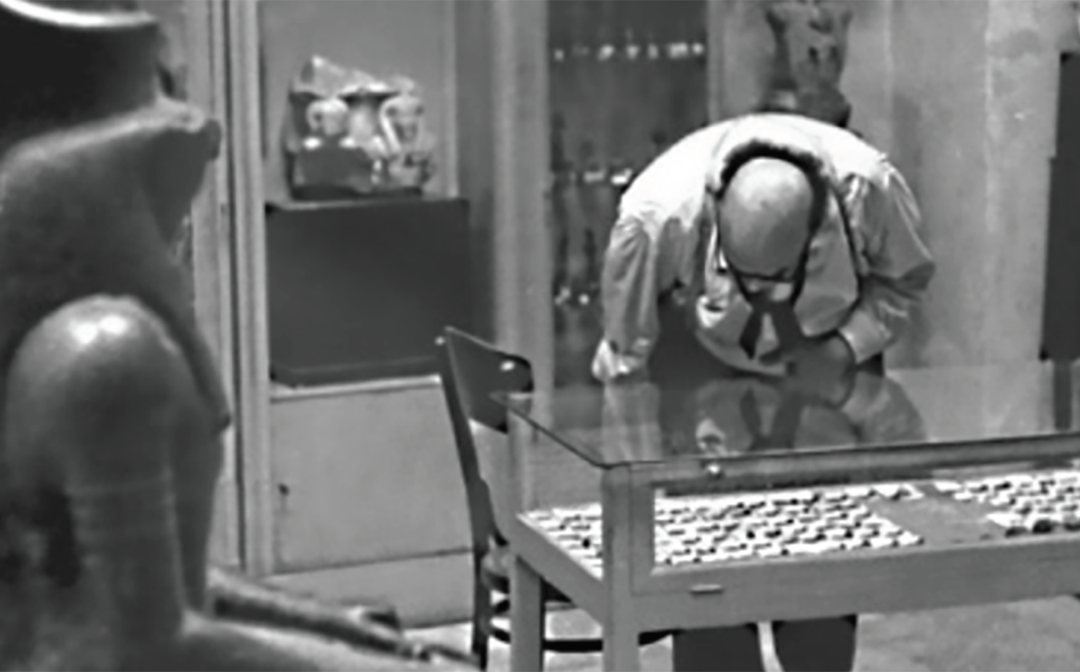
An interesting case in point is Egypt, which did not accept the Convention until July 5, 1983. Up to that time, not only had Egypt overseen a system of licensed dealers selling antiquities for legal export, it even ran a saleroom from the Cairo Museum. The picture here shows a visitor inspecting items for sale there around 1965.
Why is this important? Because under numerous proposals now being made – in particular via Regulation (EC) 2019/880 within the European Union – a widespread attempt is being made to enforce the terms of the Convention on a global basis from April 24, 1972.
This means imposing its rules on States Parties that have not agreed to such a move. In Egypt’s case, it will effectively outlaw any item sold and exported legally from Egypt in the 11-year period between 1972 and 1983 for which documentary proof to the standards demanded today cannot be provided to show that the purchase and export were legal. In reality, that will mean just about everything, because the export licence, which it would be essential to produce today, probably no longer exists and, in the extremely rare cases where it did, it would probably not have sufficient identifiable detail to meet the exacting standards now imposed for import.
It should be remembered that in 1980, for instance, no requirement would have existed to retain an export licence once used – indeed it would have expired. (Even today no requirement subsists to retain such licences once used and expired.) In many, if not most cases, a single export licence would have covered multiple items, and so would not have stayed with any or all of them once the export/import process had been completed. Items then sold on to new owners legally would not have been accompanied by the export licence, and many of these items would have changed hands several times since.
The challenge for the private citizen
How would a current owner supply the required proof under such common circumstances?
The retroactive application of the 1970 UNESCO Convention terms by national law enforcement bodies such as customs would effectively outlaw objects that have been exported and traded since entirely legitimately. Such an imposition would be in direct contravention of human rights conventions (as well as basic principles of international law) to which the countries imposing these new rules are signatories. As a reminder, Article 17.2 of the Universal Declaration of Human Rights states: “No one shall be arbitrarily deprived of his property,” while Article 1 of the Protocol to the European Convention of Human Rights states: “Every natural or legal person is entitled to the peaceful enjoyment of his possessions. No one shall be deprived of his possessions except in the public interest and subject to the conditions provided for by law and by the general principles of international law.”
‘Arbitrary’ has a meaning that includes “unrestrained and autocratic in the use of authority”, while “general principles of international law” include the concept of innocent until proven guilty.
By retroactively outlawing legitimate activity and doing so in a way that an individual cannot demonstrate their innocence, the authorities effectively breach the human rights conventions, yet this is what is proposed.
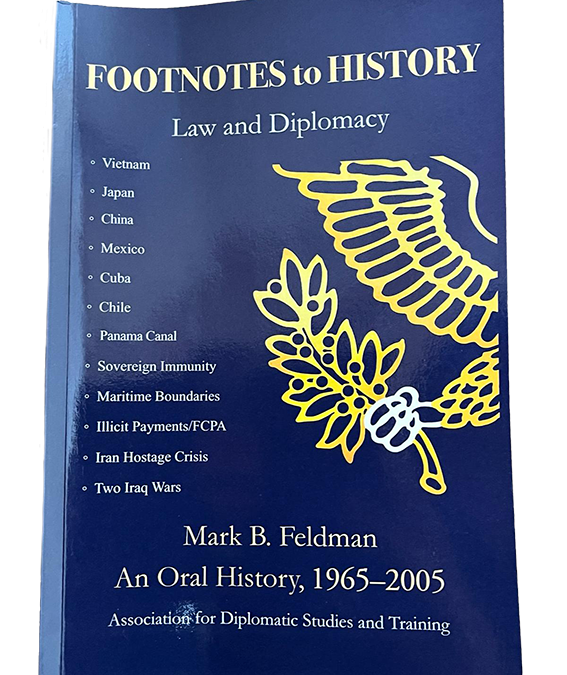
It should also be remembered that the articles of the UNESCO Convention were drawn up specifically to prevent such an imbalance of interests, as noted by one of its architects Mark B. Feldman in his 2023 book Footnotes to History.
Under Article 7.b(ii) of the Convention, in Kenya’s case, its terms should only apply from May 15, 2024, not 52 years ago.
As we celebrate the 52nd birthday of the UNESCO Convention on the means of Prohibiting and Preventing the Illicit Import, Export and Transfer of Ownership of Cultural Property, it is timely to remind those who support its aims that they should follow its terms and not abuse it for their own undemocratic ends.
Published last year and highlighted in a recent talk is the fascinating book by Mark B. Feldman, Footnotes to History: Law and Diplomacy.
Feldman has been engaged in U.S. foreign relations law and transnational litigation since 1965, including 16 years at the U.S. Department of State, where he played a pivotal role in developing the concept of the bilateral treaty and the 1970 UNESCO illicit cultural property Convention.
More than 50 years on from his work on the UNESCO Convention, he shares his thoughts on its origins and objectives, as well as what he thinks now.
When the idea of the convention arose, Feldman noted how museums, collectors and dealers feared that a clampdown via UNESCO “would lead to demands for the repatriation of the great collections of ancient art in the United States and Europe”.
He clearly saw his role as balancing interests, describing how he brought together stakeholders across the American art world – archaeologists, art museums, antiquities dealers, and attorneys – later co-authoring a report, which addressed a bilateral treaty with Mexico; an Act of Congress prohibiting the import of Pre-Columbian sculptures from Latin America without the permission of the country of origin; and a multilateral UNESCO Convention based on the principle of non-retroactivity with import controls on archaeological materials threatened by pillage.
Original objectives of the Convention lost over time
Feldman was precise and targeted in his approach. On the pre-Columbian Act of Congress, he writes: “It was the first step by any art importing country to address illicit trade in stolen cultural property, but the reciprocal obligations ‘to recover and return’ were limited to pre-Columbian and colonial objects ‘of outstanding importance’ [and official archives] that had become government property in the other country.”
The bilateral treaty with Mexico was “in practice” a one-off, and has been superseded by “more aggressive actions by U.S. agencies”.
He is enlightening on just how ambitious original plans for the UNESCO Convention were, explaining that the Secretariat “proposed a comprehensive scheme, brutal but coherent, that would have required all parties to refuse import of any cultural property, broadly defined, not accompanied by an export certificate from the country of origin”.
Needless to say, art rich countries blocked measures that they considered would destroy the international art market.
The United States continued to take the lead, drafting a compromise convention.
“The most fundamental points were two: first the convention would not be retroactive – acquisition guidelines would be forward looking – and two, import controls would be limited to cultural property stolen from museums and to specific categories of archaeological interest threatened by pillage to be determined by agreement among the countries concerned.”
Even at that point, however, the antiquities trade was alert to potential abuses. Feldman describes how dealers were “always doubtful about the convention” and “opposed import controls because they feared the State Department would use that authority as a bargaining chip for diplomatic purposes unrelated to protecting the cultural heritage…”. Prescient indeed.
How the concept of bilateral treaties backfired
The U.S. market was also concerned that as it abided by the terms of the convention, others would not, putting it at a competitive disadvantage, leading to Feldman proposing that the State Department “make bilateral agreements for import controls with countries damaged by pillage of their cultural heritage”.
Next came the establishment of the Cultural Property Advisory Committee (CPAC). The idea was for it to be a bulwark in defence of the art market, but, as history, has shown, if anything its role has been the opposite.
“Over the years the State Department has negotiated dozens of bilateral agreements and there have been numerous complaints that State has abused the process for diplomatic reasons as the dealers originally feared,” Feldman accurately observes, as he acknowledges that times have changed, and the behaviour of the trade and wider market “has got a great deal better.”
He also considers that current U.S. policy on cultural heritage protection in relation to foreign patrimony is out of step and “contrary to the U.S. position negotiated in UNESCO in 1970 and adopted by Congress in 1983.”
Many in the market hope that the State Department will take as much notice of what Feldman has to say today on these matters as it did in the late 1960s.
•The false claim that illicit trade in cultural property is third only to that in drugs and weapons
So many conflicting claims have been made about Interpol’s art crime figures, including the looting and trafficking of antiquities, that it is difficult to know what to believe these days.
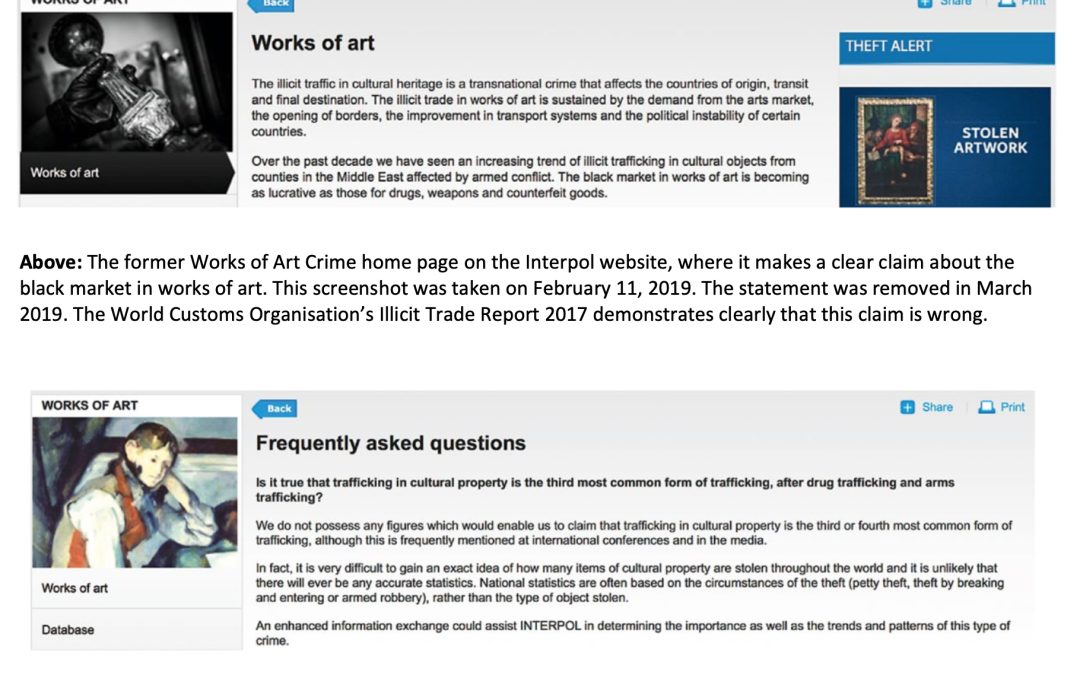
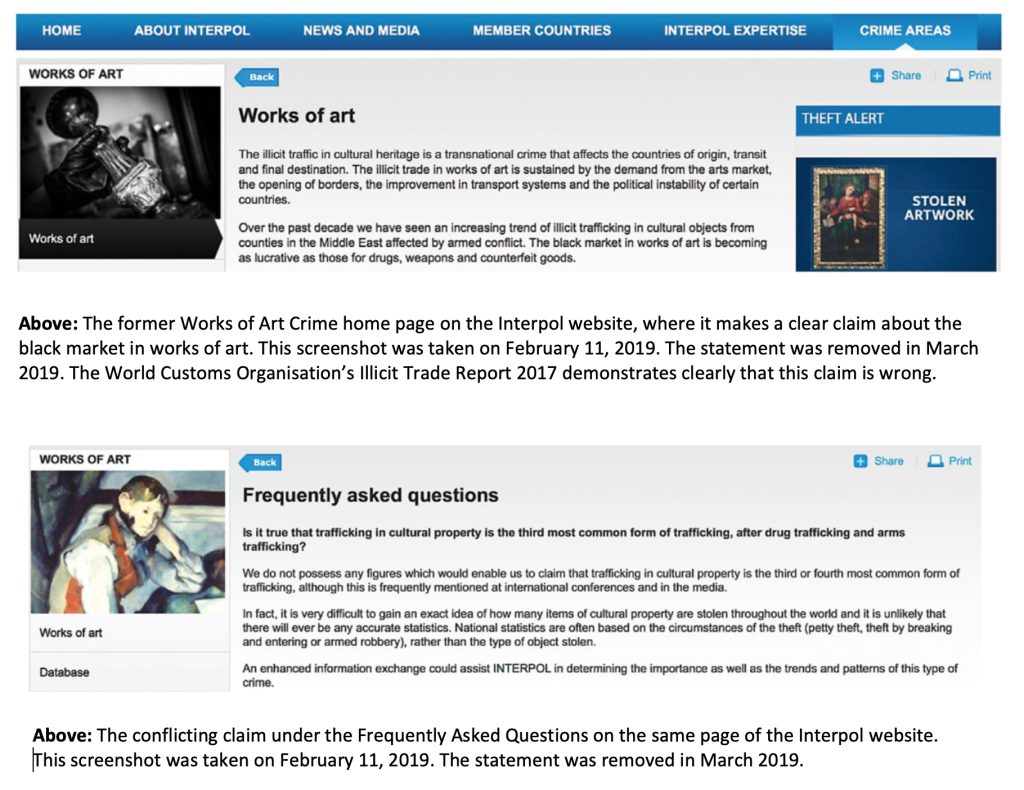
Part of the problem was that for years Interpol published conflicting claims on the Art Crime home page of its website, as the screenshots here show:
Headlining was the claim that “The black market in works of art is becoming as lucrative as those for drugs, weapons and counterfeit goods”. Earlier claims by Interpol valued the global illicit market in cultural property at around $4 billion to $5 billion annually.
This has never been true, and recent figures in the World Customs Organisation’s annual Illicit Trade Reports demonstrate this clearly. In fact, cultural property crime, which includes categories such as household goods is, by a very long way indeed, the smallest risk category.
The admission that Interpol has never had any figures to demonstrate its headline claim, nor is ever likely to obtain such figures, appeared in a click-through section lower down on the same page (see above).
Unfortunately, bodies such as the European Commission, the Carabinieri and UNESCO have promoted the headline claim while ignoring the admission lower down, leading to the widespread dissemination of what amounted to a false claim. This matters because the false claim has directly influenced new policy and further restrictions on the art market.
Fortunately, after having the discrepancy pointed out to it for several years, Interpol finally removed the conflicting claims from its website in March 2019. However, the headline claim’s pervasiveness, in what amounted to a long-term viral online campaign against the art market, means that it is still widely quoted and believed to this day.
Transnational operations (Operation Pandora etc)
For the past decade and more Interpol has co-ordinated with Europol and national police forces in dozens of countries on an annual basis to mount operations aimed at stemming the flow of illicit cultural property that might be involved in money laundering and terrorism financing.
With names such as Odysseus, Athena and Pandora, these huge operations target individuals, households, business and transport. The resulting media releases enumerate vast numbers of seizures, as well as arrests, while also providing examples, including photographs of important items that have been seized.
While this all looks impressive, what neither Interpol nor Europol have ever done is to follow these data up with the crucial information about how many of these seized items later turned out to be illicit and linked to money laundering or terrorism financing. Nor do they ever publish conviction rates for those arrested.
The ADA and IADAA have twice asked Europol for these figures.
The first occasion was in February 2017, when Europol told us: “As your questions are very detailed and some are focused on particular countries, I suggest you get in contact with the countries involved. We can only communicate on a general level and don’t hold all the details of the different participating countries.”
The second occasion was in May 2023, when Europol told us: “Unfortunately, we won’t be able to help as we do not have these figures. Europol is not a statistical organisation – Europol’s priority is to support cross-border investigations and the information available is solely based on investigations supported by Europol.”
Interpol has published numerous media releases on the same subjects and has included operational results in separate reports, including its 2020 report, Assessing Crimes Against Cultural Property.
This included data on Operation Pandora V, which took place across 32 countries and resulted in more than 56,400 cultural goods being seized and 67 arrests. 27,300 of the items seized came in a single haul in France where Customs officers arrested a man who had been illegally digging up archaeological pieces.
The leading publicised highlight from the operation was a set of three gold coins that “could have been worth up to €200,000 on the black market”, which were recovered after the arrest of two men in Spain.
Data in the Interpol report relating to global crime referred to arrests, but shed no light on convictions or how much of what was seized later proved to be illicit. No mention of terrorism financing was made.
Page 14 of the report revealed that of the 567,465 items seized in Europe, 83% (or 472,933) were library materials. This single category of library items accounted for 55% of the global total of 854,742 objects seized for the whole of 2020.
Ongoing issues
Despite supposedly cleaning up its act with the 2019 relaunch of its website, Interpol has continued to promote false and unsubstantiated claims.
In the introduction to its 2021 report it stated: “The illicit trafficking of cultural property is a major source of revenue for organized crime groups and terrorists alike…” (see page 4) – It is clear from Interpol’s other statements on data that it has no evidence to show cultural property to be a major revenue source for terrorists.
Following these conflicting claims and lack of vital intelligence, what does Interpol publish on its website in 2024?
Despite providing no data, and having admitted that it has never had it, nor is ever likely to obtain it, Interpol’s headline claim on its Cultural Heritage home page is: “Trafficking in cultural property is a low-risk, high-profit business for criminals with links to organized crime.”
Click through to the section on Crimes: The issues – cultural property, and it is largely populated by general statements. The one hard claim is that “the majority of thefts are carried out from private homes”.
The related news section at the bottom includes links to other news, including the most recent release on a transnational operation, Pandora VII, from May 2023, which again limits data to arrests and seizures, but gives no information on outcomes.
Nowhere on its website does Interpol provide clear data as to the scope and value of illicit cultural property.
However, despite admitting that it does not have the data, and despite WCO and other figures showing it not to be true, and despite updating the Art Crime home page, Interpol still promotes false claims via an out-of-date video from 2015 on its web page How we fight cultural crime.
Worse still is that the person making the claims in the video is Interpol’s Secretary General Jürgen Stock, who states that the illicit trade in cultural property is as lucrative as those for drugs, weapons and counterfeit goods, and then directly links them to terrorist financing, even though no evidence of this happening has been provided beyond the very limited Abu Sayyaf case of May 2015. In doing so, he directly links these purported crimes to the international art market, despite providing no evidence to support this.
The Secretary General makes his claims based on UN sanctions relating to Syria (2199) and Iraq, but these are preventive measures, not evidence of executed crimes. At the time of adoption in 2014, the sanctions’ text stated that terrorists were benefiting from trade in cultural property but gave no examples of this happening. As noted above, the Abu Sayyaf raid in 2015 – after the sanctions were introduced – remains the only cited example of this happening, and the sums involved were small and not clearly identified.
It is not clear from the website that the video is from 2015, so viewers may think this is current thinking at Interpol. Mr Stock must surely know better now nine years on from this recording and should remove it from the website. The ADA and fellow trade association IADAA have contacted him directly recently and asked him to update the website, but so far we had no reply.
To repeat: Nowhere on its website does Interpol provide clear data as to the scope and value of illicit cultural property
Sources quoted by authorities to clamp down on the art market rarely stand up to scrutiny
How does false data come to influence policy and even law making on such a widespread basis when it comes to cultural property?
One reason is confirmation bias: if the results of your research match what you hope to find, you are less likely to check their validity – a point made by statistics guru Dr Tim Harford when discussing claims made about antiquities and crime.
Another can be the authority of the source. This is very common in the cultural heritage sphere.
This two-part article analyses two studies from what should be an impeccable single source, showing how false data can spread from one official report to another to gain traction, and ultimately become an unchallenged authority among those who should know better.
They also demonstrate that many apparently learned pieces of research published by acknowledged authorities simply can’t be trusted, because it is clear that these professionals are not checking their sources adequately.
Both reports were published by the United Nations Office of Drugs and Crime (UNODC).
The two relevant claims it included were as follows:
• The Museums Association has estimated that profits from the illicit antiquities trade range for $225 million and $3 billion per year.
AND
• The Organized Crime Group of the United Kingdom Metropolitan Police and INTERPOL has calculated that profits from the illicit antiquities trade amounted to between $300 million and $6 billion per year.
Footnotes indicated the source for each of these statements.
For the first it was “See Neil Brodie, Jenny Doole and Peter Watson, Stealing History: The Illicit Trade in Cultural Material (Cambridge, McDonald Institute for Archaeological Research, 2000); and Simon Mackenzie, “Trafficking antiquities” in International Crime and Justice, Mangai Nataajan, ed. (Cambridge, Cambridge University Press, 2011).”
For the second it was “United Kingdom, House of Commons, Culture, Media and Sport Select Committee, Cultural Property: Return and Illicit Trade, seventh report, vols. 1, 2 and 3 (London, 2000).”
These were very precise references, if rather out of date for a 2016 report by the UNODC.
The problem is that whoever researched the UNODC report failed to check where its quoted sources got their data from. If they had, they would have found the following:
– The Brodie, Doole and Watson report from 2000 did not refer to the Museums Association $225 million and $3 billion per year claim at all. Instead, on page 23 in the introduction to section 1.9, The Financial value of the illicit trade, it stated: “Geraldine Norman has estimated that the illicit trade in antiquities, world-wide, may be as much as $2 billion a year.” The footnote for this statement identified the source as journalist Geraldine Norman’s November 24, 1990, Independent article Great sale of the century. However, apart from the fact that the article was actually titled Great sale of the centuries, it included no such claim or figure.
– In fact, the Museums Association did give estimated figures as part of its evidence to the UK House of Commons, Culture, Media and Sport Select Committee, Cultural Property: Return and Illicit Trade, seventh report, vols. 1, 2 and 3 (London, 2000) – the same source as the second claim quoted by the UNODC. In the Seventh Report, Chapter II The problem of illicit trade, The nature and scale of illicit trade, paragraph 9 reads: “The scale of the illicit trade taken is said to be very considerable. According to the Museums Association, as an underground, secretive activity, it is impossible to attach a firm financial value to the illicit trade in cultural material. Estimates of its worldwide extent vary from £150 million up to £2 billion per year.” The Museums Association gave as its source the Brodie, Doole and Watson 2000 report, quoted above, which in turn gave the Geraldine Norman article as the source, when, in fact, it provided no such figures.
So, the Museums Association’s actual claim was that “it is impossible to attach a firm financial value to the illicit trade in cultural material”, but that estimates worldwide [by others] varied greatly between £150 million and £2 billion.
This was rather different from the UNODC claim based on this source: “The Museums Association has estimated that profits from the illicit antiquities trade range for $225 million and $3 billion per year.”
To summarise, then, the £150 million to £2 billion claim ultimately came from nowhere. Its claimed primary source, the Geraldine Norman article from 1990, quoted no such figures. The secondary source which mistakenly quoted them was the Brodie, Doole & Watson report from ten years later in 2000, leading to the tertiary source of the Museums Association. In turn, this was quoted by the UNODC in 2016 – 26 years after the Norman article which gave no figures anyway. The UNODC report then became a new ‘primary’ source, with the figures quoted as UNODC estimates, which they weren’t at all.

Recent Comments