by ADA | May 22, 2023 | Views |
Europol has admitted not having any reliable statistics to support its headline claim over stolen objects in Operation Pandora VII, aimed at tackling cultural property trafficking.
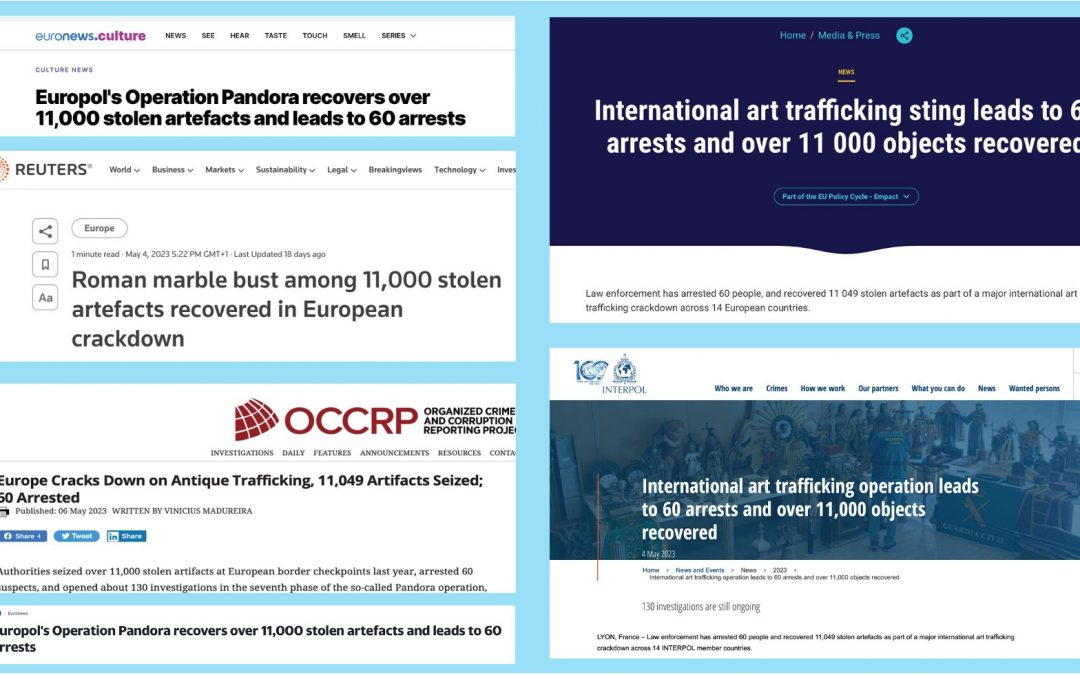
Many media outlets have covered the results of the latest transnational operation co-ordinated by Interpol and Europol with a view to tackling trafficking in cultural property.
Pandora VII, led by the Guardia Civil in Spain, took place over 11 days in September 2022 with two cyber weeks in May and October.
The Europol media release itself stated that the operation led to the arrest of 60 people and the recovery of 11,049 stolen objects across 14 countries.
As the ADA knows well, there is a great deal of difference between seizing items and showing that they are stolen, just as arrests do not equate with convictions.
These operations, along with others named Athena and Odysseus, have been running for almost a decade, and to our knowledge, the authorities have never published either conviction rates or figures confirming how many seizures later proved justified. The ADA and fellow trade association IADAA have sought this information from Europol more than once, but Europol has replied each time that it does not have it, which makes its official release claim this time that 11,049 seized items were stolen all the more surprising.
The twin priorities in carrying out these operations have always been to clamp down on money laundering and terrorism financing, but while there may have been limited evidence of the former across the years, we have heard of no evidence at all of the latter.
Once again we contacted Europol asking the following: a) How many arrests have led to successful convictions? b) How many seizures proved to be valid + how many had to be returned to their owners? c) How many seizures were shown to be linked to money laundering? d) How many seizures proved to be linked to terrorism financing?
As others have also argued, without these accurate clear-up figures, the data serves no purpose beyond propaganda.
Europol’s media office ADMITS IT HAS NO ACCESS TO VITAL DATA
Europol’s media office replied on May 10 as follows: “Unfortunately, we won’t be able to help as we do not have these figures. Europol is not a statistical organisation – Europol’s priority is to support cross-border investigations and the information available is solely based on investigations supported by Europol.”
Confirmation, then, yet again that Europol has no statistics to support the claims it makes, with the further emphasis that Europol is “not a statistical organisation”. If so, what is it doing making statistical claims it admits it cannot support in the introduction to its media release, claims that history tells us will influence policy at a national and international level, as with the introduction to this recent important European Commission document?
Interpol, which has also denied having any reliable statistical information in this field, compounded the error.
Arguably more shameful is the number of media outlets that have reported the unsupported claims Europol has put out in this release without checking them. Newspapers, art market websites and others – all of them experts in their own fields and trained to check their sources – have singly failed to do so in this case.
They include Yahoo News, Artnet News, Euronews, and Reuters, among others.
It also includes outlets whose credibility entirely relies on accurate data, such as the Organised Crime and Corruption Reporting Project, and Border Security Report (the Journal of border security and transnational crime).
This is not the first time this has happened; these operations have been going on for a decade and the ADA and IADAA have highlighted the failure of intelligence on numerous occasions. As we showed in this instance, a single email request revealed the truth. So why can’t the experienced journalists working on this story make such a simple check as this to ensure that their reporting is accurate?
One of the worst offenders was Ursula Scheer, a journalist for Frankfurter Allgemeine, who not only swallowed everything she was told without checking, but added even more bogus data to the story unchecked: “According to estimates by the FBI and UNESCO, the annual turnover of the global black market for art and antiques is ten billion dollars, which puts the black market right behind the illegal drug and arms trade.” She also stated: “Selling art and antiques helps mafia activities finance terrorism and war.”
Those who want to know where the bogus data ends and the accurate data begins can check on our Facts & Figures page, which includes independently verifiable data through quoted sources and direct weblink.
by ADA | Dec 5, 2022 | News
Led by CINOA, the international trade federation for art and antiques dealers, industry bodies across the world have reacted strongly to what they see as “very alarming” proposals from UNESCO to regulate the art market.
The proposals have been drafted by a panel of academics, civil servants and legal specialists from countries that have no sizeable art market themselves; they give the impression of having no serious idea of, or interest in, how the art market operates.
The outcome is predictably draconian, unrealistic and extreme, and if passed into law by States Parties to the 1970 UNESCO Convention on illicit trade would constitute an existential threat to much of the wider art market.
Published under the heading Draft Model Provisions on the Prevention and Fight against the Illicit Trafficking of Cultural Property, the proposals even attempt to redefine the meaning of the term ‘cultural property’ so that it has a far wider meaning that that set out in the Convention. This is an early indicator of how UNESCO appears to be sanctioning an upgrade of the Convention without going through the formal process of properly consulting States Parties on it.
It is not the whole set of provisions that cause a problem. In fact, as a whole, Provisions 1 to 13 set out useful proposals for dealing with the scourge of looting and trafficking linked to cultural property. Of particular note are Provisions 6 and 7, in which UNESCO finally targets States Parties over their obligations under Article 5 of the 1970 Convention to protect vulnerable sites from criminals.
Better methods of protection
“This is something that the art market has reiterated for many years,” says IADAA chairman Vincent Geerling, who has been very vocal on the point. “Fulfilling those obligations are the most effective actions in the fight against illicit trafficking and are long overdue, especially the establishment of digital inventories of protected cultural property (Provision 7) and should include the temporary warehousing at archaeological excavations. Photographing and recording archaeological finds before they are stored would provide a more effective means of reporting possible thefts quickly to INTERPOL (as obliged) for uploading onto their database, thereby making them unsaleable and thus preventing trafficking.”
It is when we arrive at provisions 14 to 18 that the trouble starts. These attempt to regulate the art market, something that has nothing to do with UNESCO and should be excised from the proposals.
Provision 15 proposes: “Only private individuals or legal entities, holders of a license issued by the competent authority, can exercise a professional activity directly or indirectly related to the art market.”
This astonishing power grab effectively imposes compulsory licensing on the global art market in a way that it would be impossible to comply with and which, if followed to the letter, would risk exposing art market operators to legal action from their clients.
It also constitutes a serious threat to human rights as, by default, it would remove the commercial value of countless items in private ownership around the world, as well as depriving their owners of the ability to dispose of them how they see fit.
As one art market lawyer responded: “This provision is highly unrealistic. It envisions that only licensed businesses will sell art; however, most countries do not have the capacity or will to create the necessary bureaucracy for such an endeavour. There is an expectation for these individuals to hold legal degrees and be experts in foreign law when such laws are often unavailable or are not consistently applied in practice. They are also expected to maintain a register of movements or transactions, but such record keeping is of little use unless it is maintained in a database, which again would require a major undertaking.”
Risking breach of trust among states parties
The enforcement of this set of proposals would effectively undermine the existing UNESCO Convention because it would supersede its powers and remit. This would constitute a catastrophic breach of trust of States Parties that had not expressly acceded to the changes as formal alterations to the Convention.
Several countries have already made it clear that they will not accede to these proposals. Australia has said it will not oblige dealers to maintain a register of cultural property and those they trade with; Belgium, France, Sweden and the UK do not accept the wider definition of cultural property; and the United States has reserved the right to determine whether or not impose export or import controls and does not accept that the Convention can be applied retroactively. These reservations alone, which include three of the world’s largest art markets, effectively make the proposals unworkable.
It is telling that not only was no member of the art market co-opted onto the panel of ‘experts’ and not one of them hails from a leading art market nation, but also that leading trade bodies such as CINOA were not directly informed or consulted on the matter – CINOA only learned about the proposals because it was tipped off by someone who found out about them.
Reactions from other leading figures and organisations in the market have been equally damning. The European Federation of Auctioneers points out that the industry is already subject to extensive legal restrictions, including over due diligence.
The draft provisions come at the same time as UNESCO is finalising its code of ethics for the art market, another set of rules that it wishes to impose on traders while ignoring the concerns they expressed during the consultation period.
Deeply flawed questionnaire
The questionnaire involved was also deeply flawed because it failed to consider different circumstances for trading artworks, while also assuming that all restitution claims were valid, when so many are not, and that any export not accompanied by a licence is illicit, when that is not the case.
CINOA has pointed out to UNESCO that its consultation over the code of ethics elicited a very poor response from States Parties (only 12%), with only 27 responses from across the entire art market, which it argues “cannot accurately represent the art trade”.
Although UNESCO’s policies are only advisory, many fear that they will be imposed, first by declaring the code of ethics obligatory, then by using that to force through the Model Provisions. While leading art market countries may not support the measures, active source countries like Mexico, who already operate extremist policies regarding cultural property, would be only too delighted with them.
The summary impression conveyed by the UNESCO proposals and the organisation’s approach to these matters is that they are driven by an extreme ideology that is prepared to trample human rights to achieve its ends rather than an honest desire to fight crime and protect the vulnerable. Coupled with numerous examples of breaches of trust – from the fraudulent advertising campaign The Real Price of Art to its continued promotion of bogus data about the art market – UNESCO’s expressed wish to work with the art market ring increasingly hollow.
by ADA | Nov 2, 2022 | News, Uncategorized, Views |
The World Customs Organisation has finally published a new report following the 2019 report, covering two years from 2019-2021, probably delayed because of the Covid 19 pandemic. Its results once again show that global levels of illicit trade in cultural property are far lower than claimed.
In the press release we read: “This year, the analysis provided in this Report is based on data collected from 138 Member administrations. Previously composed of six sections, the Report now covers seven key areas of risk in the context of Customs enforcement: Anti-money laundering and terrorist financing; Cultural heritage; Drugs; Environment; IPR, health and safety; Revenue; and Security.”
It also states: “The analysis contained in this Report is mainly based on the collection of data from the WCO Customs Enforcement Network (CEN) — a database of worldwide Customs seizures and offences”….
“However, the CEN database relies heavily on voluntary submissions by Members hence the quantity and quality of the data submitted to the system has its limitations”…
“However, as part of this new methodology, the data and information sources used to elaborate this Report has been enlarged to include various open sources.”
While the rest of the report might be “mainly based on the collection of data from the WCO Customs Enforcement Network (CEN)”, in the introduction to the Cultural Heritage chapter on page 57, the WCO goes further, admitting: “Unfortunately, the data received through the WCO’s Customs Enforcement Network (CEN) in 2020-2021 being incomplete, the following analysis will be mostly based on open source information.”
Case studies based on media reports rather than primary research
The result for the Cultural Heritage section is that most of the case studies are based on newspaper articles, sometimes even on events that happened decades ago, and have nothing to do with recent trafficking activities. This is alarming as much of the problem with false data plaguing the cultural property sector stems from misreporting in the media. It is even more alarming when the misleading picture created by a surface reading of the chapter will undoubtedly be used as ‘evidence’ in future campaigns against the art market, as past reports have been.
The WCO is supposed to report recent and reliable figures, like figure 3 on page 35, showing that the number of worldwide reported cultural goods cases for 2021 is a mere 156, that is 1.1 case per reporting country….
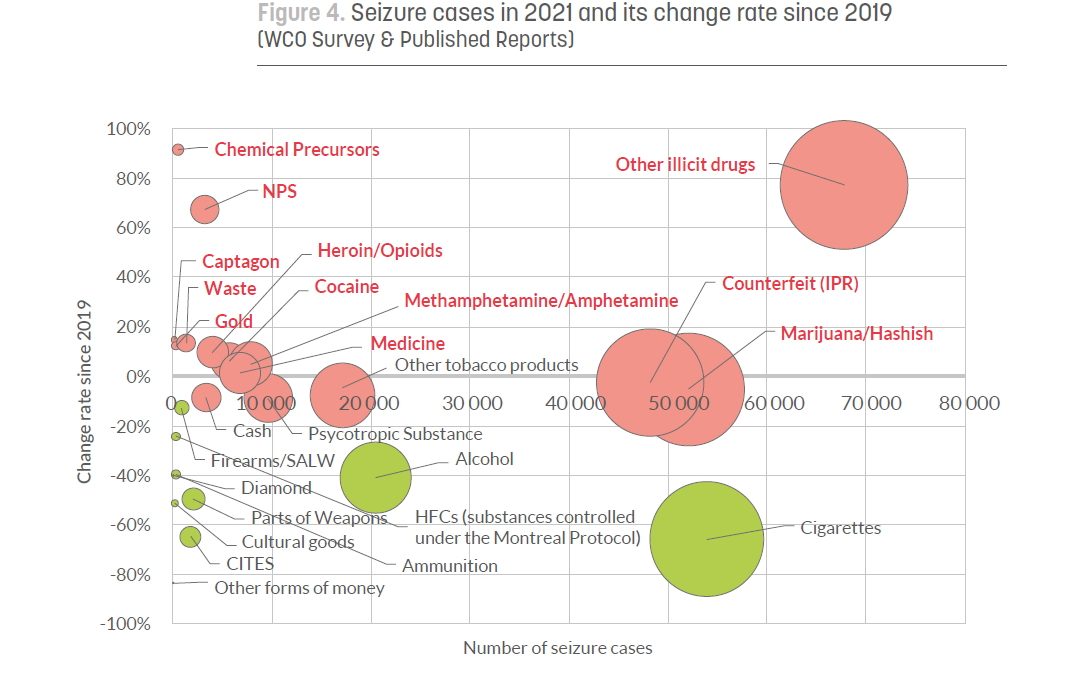
A newly introduced graph (shown here) in the WCO report (Page 17, Fig. 4) reveals precisely what the ADA and its fellow association IADAA have reported over the past years: the illicit trade in cultural heritage is so small that it barely shows in the statistics. Not only is it the smallest category – so small that you have to look carefully in case you miss it – but the graph also shows that seizures have fallen by around 50% between 2019 and 2021.
Let’s not forget, too, that the Cultural Heritage category is not limited to antiquities, as so many mistakenly believe; it covers 13 distinct sub-categories, including: all forms of art, antiques and collectables, household items, flora and fauna, books and manuscripts. In 2019, the top three categories of recovered item sub-categories were: Fauna, Flora, Minerals, Anatomy & Fossils; Other; and Hand-painted or Hand-drawn articles and works of art. No mention of antiquities, which did not even warrant its own sub-category.
All of this begs the question as to why, in its chapter on Cultural Heritage, the WCO has chosen to focus exclusively on photographs of seized antiquities (at least one of which seems to be a fake) alongside fossils and coins. The choice appears politically charged.Consistent reporting of
The WCO has stated in the past and here that there is under-reporting of crime in the culture sector and that it only counts seizures and cases reported via the Customs Enforcement Network (CEN), the implication being that the problem is much larger.
Figures consistently show low rate of illicit trade in cultural property
However, the miniscule share of illicit trade represented in its reports over the years by cultural property has been consistent, only now augmented by media reports not sourced via the CEN.
It further boosts this chapter of the report with a summary of Pandora VI, the latest in a seven-year campaign of international operations involving mass seizures and arrests. What the WCO, Europol or Interpol have never done, however, is to provide data on how many of their seizures and arrests later prove to be justified and how many were shown to be related to terrorism financing. It is not just the trade asking for these figures, academic investigators want them too to see how effective these operations are.
Previously the WCO has attempted to rebut the ADA and IADAA’s analysis of its reports, stating that the figures cannot be relied on. As our analysis always provides transparent sources for the data emanating from the reports, however, the WCO’s case against our analysis simply does not stand up.
Ultimately, its figures must be indicative of the global state of affairs; if they are misleading, why publish them?
by ADA | Jul 6, 2022 | Views
Věra Jourová, vice-president of the European Commission for values and transparency, has decided to target fake news and disinformation. She calls it “potentially even more dangerous” than conventional weaponry.
Russia’s propaganda campaign surrounding its invasion of Ukraine has prompted this action, but it is also an excellent opportunity to address all of the fake news surrounding antiquities. Those guilty of promoting it include the media, governments, NGOs, campaign groups and even law enforcement.
Cultural property has become an important soft power diplomacy tool in recent years. The incentive for interest groups and individuals to spread false evidence and data as propaganda has grown substantially as a result. Equally corrosive has the been the failure to check the validity of claims. Lack of time and resources is at fault, but so is confirmation bias. If the claim fits your narrative, why bother to check whether it is true or not?
How to begin
Ironically, this applied to the European Commission’s own Fact Sheet, Questions and Answers on the illegal import of cultural goods to finance terrorism. Published on July 13, 2017, it set out the evidence on which the EC relied to press ahead with its import licensing proposals for cultural property and the art market. Researching the sources of its data and claims back to their original sources show clearly that they are groundless.
UNESCO’s 50th anniversary campaign, The Real Price of Art, and its bogus $10 million figure as the annual value of cultural property trafficking, have attracted extensive reporting in the media, but both are bogus and easily checked.
Many other questions arise over claims made by public bodies that should know better. The ADA and IADAA have exposed a large number of them for what they are. It is time that the authorities got a grip on this for the benefit of public confidence as well as better policy.
by ADA | Aug 31, 2021 | News, Uncategorized
The June 30 House of Lords debate on the Revocation of the EU import licensing regulations within the UK has summarised neatly the problems with this law.
In his statement to his peers, government whip Lord Parkinson of Whitley Bay said the government hoped to bring clarity to what was required under UK law by the changes.
Some of his fellow peers argued that revoking the law in full meant weakening the UK’s defences against crime. However, Lord Parkinson said the EU legislation would create “complexity and confusion” at borders, and two important reasons persuaded the government to go for full revocation.
The first was that “the provision applies to almost all cultural goods created or discovered in non-EU countries, regardless of their age, value or date of export, and because there is no requirement in the regulation for any person to provide evidence to demonstrate either lawful export or unlawful removal from the country of creation or discovery”.
This meant that in the event of a claim of unlawful export, it was not clear where the burden of proof would lie or what evidence would be required.
“These issues could result in cultural goods being delayed or detained at the border, and might deter people from importing cultural goods to sell in the UK art market or museums from lending objects for exhibitions in this country.”
Success of existing legislation
The second reason for revoking the law was that provisions the UK already has in place are proving successsful.
“The effectiveness of our existing legislation was demonstrated very recently, when we returned to Libya a statue which had been unlawfully removed from that country and which was found and detained by HMRC at Heathrow Airport. This is only the most recent example.”
In the latest round of consultations with the EU over the upcoming 2025 enforcement of the import licensing regulations, the ADA and others have been at pains yet again to demonstrate how unworkable the legislation is.
The objection is not to the protection of borders and fighting crime, but to the impossibility of the compliance demands, the net effect of which would be to destroy much of the art market within Europe. It is this aspect that those objecting to the revocation in the Lords do not seem to grasp.
So far the European Commission has signed serious concerns raised in previous consultations, including earlier this year.
Still not resolved is exactly what documents will be required for legal import. Article 8 (1) d of the draft legislation states that “Other types of documents to submit in support of an import licence application may be, but are not limited to the following” before listing 11 different types of document that must be submitted for approval.
Numerous other problems remain within the draft legislation, from uncertainty over the number or location of customs offices to how property would be marked, as well as very onerous compliance measures that would make a vast number of imports uneconomic.
Recent Comments