Scotland’s Treasure Trove Review Brings Clarity for Legacy Finds
Scotland has published the 2024 review of its treasure trove system. A new scheme that promises a constructive way forward for preservation and record keeping, enthusiasts and the art and antiques industry, is the result.
One of the most important developments for collectors, dealers and auctioneers, concerns the treatment of what are now termed ‘Legacy Finds’.
For the purposes of the new policy, ‘Legacy Finds’ are archaeological objects recovered in Scotland on or before 31 December 1999 that may never have been assessed or recorded under the modern treasure trove system.
Archaeological finds discovered in Scotland are subject to a different system from that operating in England, Wales and Northern Ireland. Under Scots common law, archaeological finds do not automatically belong to either the finder or the landowner. Instead, they fall to the Crown as ownerless property (bona vacantia).
It is essential to remember that under Scottish rules Treasure is not limited to precious metal or stones; it can include a very wide range of artefacts, including wood, glass and textiles, and even worked human and animal bones. Most finds that come under the rules will be over 100 years old, but more modern finds may also qualify.
Ownerless status of finds
In Scotland, finds by metal detectorists and others are not the property of either the finder or the landowner. Instead, they are considered ‘ownerless’ (bona vacantia) pending assessment by the authorities and a possible claim by the Crown.
Responsibility for managing ownerless property in Scotland rests with the King’s and Lord Treasurer’s Remembrancer (KLTR), while archaeological finds are administered specifically through the Treasure Trove Unit (TTU), based at the National Museum of Scotland, which operates on the KLTR’s behalf.
If the Crown does not claim the item, it is disclaimed and returned to the finder with a Certificate of disclaim, which forms part of its provenance.
Where the Crown does claim the find in the public interest, any museum wishing to acquire the object must raise the Finder Reward, from public funds, reserves or private donations.
Where a find is not claimed for a museum collection, it is recorded and returned to the finder together with a disclaim certificate, which confirms that the Crown will not exert its right to claim the find for the nation.
Compensation for finders
The Finder Reward is an ex-gratia compensation payment linked to the market value of the object. That value will be decided by the Treasure Trove Unit (TTU), a panel of experts comprising a team of archaeologists and finds specialists based at the National Museum of Scotland in Edinburgh; it is thought that the panel will include a commercial valuer from the industry. Like the PAS in England, it is thought the value will be based on the hammer price of a similar piece being sold at auction, although this is not expressly stated. Commercial expertise will be of particular importance where similar items have not yet or rarely appeared on the market.
Before the modern reporting regime became widely established, some Scottish archaeological finds entered private collections and the art market without ever being formally assessed or recorded. While there is no statute of limitations on treasure trove in Scotland, the Review has provided a pragmatic way of dealing with these historic finds.
The ‘Legacy Finds’ concept addresses this and covers certain categories of Scottish archaeological finds found before 31 December 1999.
The aim is not simply to determine ownership but also to improve the archaeological record. Collectors, dealers and auctioneers who encounter finds that seem to come under Scottish treasure trove, but are not accompanied by a disclaim certificate, are encouraged to contact the Treasure Trove Unit (TTU) and provide information that will allow the object to be assessed and, where appropriate, recorded.
The TTU will usually require:
- Clear photographs;
- Dimensions and a brief description;
- Known provenance;
- Details of previous ownership, sales or publication history
The Review adopts a pragmatic approach to many older finds. In general, the KLTR will not normally seek to claim finds recovered in Scotland on or before 31 December 1999 where there is evidence that:
- Finds that were bought or sold before 31 December 1999;
- Finds that have demonstrably been outside of Scotland since before 31 December 1999;
- Finds assessed by the Treasure Trove Unit to have been public knowledge before 31 December 1999, whereby the Crown had already had an opportunity to exert its claim.
“Legacy Finds reported to the Treasure Trove Unit are assessed and recorded, with consideration given to their archaeological significance,” the review explains. “In most cases falling within the Legacy Finds policy, the KLTR will not normally seek to claim the object. However, where a find is claimed for a museum collection, the Treasure Trove system provides for the payment of a Finder Reward award, normally reflecting its market value. This helps ensure that significant objects can enter public collections while providing reassurance to collectors, dealers and auctioneers who come forward with previously unassessed material.”
What to do with a Find
Dealers wanting to sell a Legacy Find should first contact the TTU at least a month before the proposed sale to allow for the assessment to be conducted. Having said that, the review also states: “While the treasure trove system is not simply a service for finders, in our judgment the target of 12-month average completion times for straightforward cases, which is referenced as the norm in the Code of Practice, is a reasonable basis for expectation and delivery. It is understood that complex cases require more time.”
Where appropriate, the TTU may issue a Certificate of disclaim confirming the Crown has chosen not to exercise its rights over the finds.
For the trade, this potentially offers a route to obtaining greater certainty regarding provenance while also contributing valuable information to Scotland’s archaeological record.
The Treasure Trove Review, which includes additional investment in the system, hopes that before too long it will be possible to upload all this information via an app.
Currently, the system does not provide a detailed breakdown of reasons either for a claim or a disclaim, but this will be reviewed further.
A balanced system
“While participation in the treasure trove system is not voluntary, the Review recognises that the system benefits from meeting reasonable expectations on the part of those who experience it,” it concludes.
For museums, finders and the trade, the new approach to Legacy Finds seeks to balance protection of Scotland’s archaeological heritage with a practical recognition that many objects have circulated openly for decades. By encouraging their assessment and recording, the reforms should improve the archaeological record while providing greater certainty for collectors, dealers and auctioneers.
“We have come to the clear view that the resources available to the treasure trove system, specifically for operational funding of the Treasure Trove Unit, have not kept pace with the growth of the workload over the last 20 years, and that under-resourcing has had a negative impact on resilience in the system, confidence and participation,” the review explains. “Taken together, all our recommendations for reform rely on, and contribute to, a realistic plan for sustaining the system financially.”
In summary, the proposals are impressive and designed to improve consistency and transparency in rolling out the new regulations, thereby instilling increased confidence in the system among museums, the public and the trade.
More information can be found in the Treasure Trove Scotland: Code of Practice
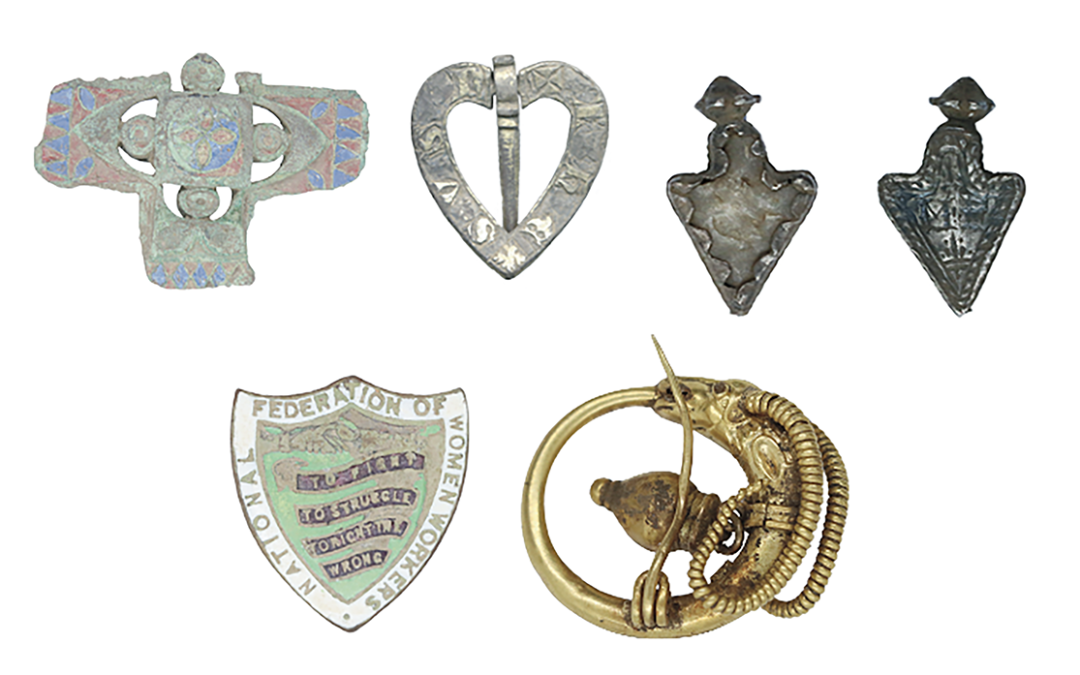
Caption to the image shown above:
Artefacts covered by the new Scottish treasure trove rules can be of any age, from ancient to modern, and almost any material. Here are some examples. Clockwise from top left:
– An enamelled coppery alloy Roman Iron Age harness fitting, 1st or 2nd century AD.
– A late Medieval gilded silver heart-shaped brooch, c.1300-1500 AD.
– A Bronze Age tanged arrowhead of flint, set in a silver bezel, so-called ‘elf shot’ amulet charm, reuse in 17th/18th century.
– A gold zoomorphic annular Castellani brooch in the form a ram’s head, in the archaeological revivalist style, 19th/early 20th century.
– A gilded and enamelled copper alloy National Association of Women Workers badge, early 20th century.
Recent Comments