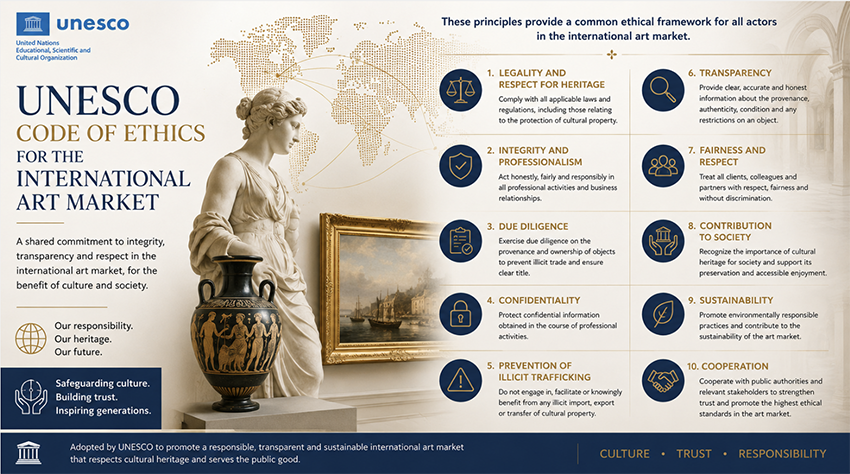
After five years of dialogue, UNESCO has finally published its revised Code of Ethics for the international art market. The idea is that it should set improved standards of conduct that follow the latest ethical guidelines to protect national interests and prevent crimes such as looting and trafficking.
The Code is currently voluntary. Will it work?
The approach, tone and lack of precision leave it facing an uphill struggle to convince market professionals that it will also protect their interests.
The problems start in the first sentence: “Members of the trade in cultural property recognise the key role that trade has traditionally played in the dissemination of culture and in the distribution to museums and private collectors of foreign and domestic cultural property for the education and inspiration of all peoples.”
Yes, the trade does recognise this, but the question is whether UNESCO recognises it. No acknowledgement here.
Sentence two brings its own issues: “They [the trade] acknowledge the worldwide concern over the illicit trafficking of stolen, illegally alienated, clandestinely excavated and illegally exported and imported cultural property, in line with the MONDIACULT 2022 Declaration, and accept the following principles of professional practice intended to safeguard cultural property from criminal activities.”
Risk of undermining human rights
What does ‘illegally alienated’ mean in this context? No explanation appears. And the assumption that the trade falls in line with the Mondiacult 2022 Declaration is misguided. That Declaration makes a commitment to return cultural property to its countries of origin even if it was not removed illegally. The Declaration makes assumptions about ethics in relation to cultural property that are based on questionable current trends in ideology rather than a broader, long-standing moral and common-law principle. For instance, it stresses the importance of human rights but then sets out to undermine those rights when it comes to the private ownership of cultural property, by demanding an end to transactions where provenance documentation is incomplete. It appears to call on UNESCO to act beyond its remit.
The whole approach to how the trade should adopt and commit to the Code is unsettling. Far from being constructive and persuasive, the tone is menacing and manipulative. Traders who voluntary abide by the Code “should be recognised as having committed themselves to a set of professional standards”. This is unnecessary in the case of those who have already done so in becoming members of trade associations that have codes of practice – a stricter commitment than that required by a code of ethics.
Likewise, “Traders who have decided to abide by the principles of the Code will submit a declaration to that effect to UNESCO, as well as to their professional association. Professional associations of traders that support UNESCO in promoting their members’ compliance with the principles of the Code will submit a declaration to that effect to the UNESCO Secretariat.”
None of this sounds voluntary.
What a ‘living document’ might mean
What happens if they follow these directions? How long before UNESCO leverages this position to try to enforce its Code as national and international law by the back door?
The trouble with such declarations made in this way – and mentioning that they have consulted the art market – is that it suggests that the Code enjoys trade endorsement, which it doesn’t. Nor is it workable. The danger is that decision-makers will believe otherwise. And so the bar is raised ever higher, making trade professionals’ daily lives impossible.
Further enhancement along these lines seems likely in the context of Member States emphasizing that the Code should be considered as a ‘living document’, with UNESCO periodically assessing it with ‘relevant stakeholders’ to ensure its continued relevance in light of evolving challenges related to trafficking. This is nothing less than a blank cheque. It is not fair to ask the market to sign up to this.
Principle 1 distinguishes “illegally alienated” cultural property from that which may have been stolen… clandestinely excavated or illegally exported or imported. But what does illegally alienated mean here? As can be seen from the Member States’ caveat above, the goalposts are ever on the move. Goods legally sold and exported years ago are now being deemed national property and illicit in domestic law as nations update their cultural heritage legislation in ever more restrictive ways. Under the Code, this might well render such goods illicit internationally, even when they have been legally traded and owned privately for lengthy periods, and so might be subject to confiscation.
While Principle 2 reasonably commits traders to recording transactional information such as the identity of suppliers, any attempt to use that as a stepping stone to force them to reveal confidential information protected by contractual obligations would cause serious problems. This would be possible under a ‘living document’.
Further lack of clarity over terms
Principle 3 commits traders to conducting ‘proper’ due diligence without fully stipulating what that constitutes. Again it talks of ‘illegally alienated’ items, as well as checking “any other relevant information and documentation which they can reasonably obtain” and scrutinising ICOM Red Lists. What does ‘reasonably obtain’ mean? If due diligence is too burdensome, it would render much of the lower end of the market uneconomic. What measures have been put in place to prevent that?
Principle 4 describes a trader’s ‘reasonable cause’ to believe that an item might be illicit and what their commitment must be under those circumstances but does not define ‘reasonable cause’ in this context.
Principle 4 also states: “A trader who is in possession of the item, where that country seeks its return within a reasonable period of time, will take all legally permissible steps under the trader’s applicable national law to co-operate in view of the return of that item of cultural property to the country of origin.” This appears to commit a trader to return an item simply on the basis of a claim, regardless of whether or not they hold the item lawfully. Long experience has shown that countries of origin claim items whatever their status, so without qualifying that the item must be illicit, the Code would prove unacceptable to the market. Such a catch-all condition would also be inconsistent with pre-existing national or international laws or conventions, such as statutes of limitation endorsed by UNESCO 1970 and UNIDROIT 1995 which are routinely ignored.
Principle 5 repeats the demands of Principle 4, putting the burden on the trader to ensure the item is returned.
No clause addresses the rights of the traders.
An opportunity missed
In recent years, art market stakeholders have been included in discussions about the drafting of the Code, but in the final two meetings earlier this year, CINOA, the global trade federation representing 5,000 dealers – the largest trade group in the world and the vital market stakeholder – was inexplicably not invited to attend. How did that happen?
UNESCO’s new Code of Ethics is an opportunity missed. It appears to blur the line between ethical aspiration and legal requirement. It should have been drafted as a constructive agreement between stakeholders to improve standards and create more clarity; instead its tone and terms appear intimidatory and opaque. It is inconsistent with the laws of numerous countries in relation to property rights and good faith purchases. Market stakeholders approached this initiative in good faith. The result is far from what they could agree to.
Recent Comments