by Antiquities Dealers' Association | Mar 2, 2017 | Uncategorized, Views |
ADA adviser Ivan Macquisten’s article on this subject has finally been published by Homeland Security Today, more than five months after it was commissioned and submitted. This commentary arose from his critique of Homeland Security’s Cash to Chaos report, an assessment of ISIS funding published in early October, that he argued was riddled with inaccuracies, at least in part because it appeared to have taken its information from discredited media sources, as shown in its own footnotes.
by Antiquities Dealers' Association | Jan 31, 2017 | News, Uncategorized |
City law firm K&L Gates will host the second in a series of day-long seminars on February 7 addressing risk in the art and antiquities market. The first of three panels across the day will feature Professor Janet Ulph of Leicester Law School, the University of Leicester, Dr Sophie Vigneron, of Kent Law School at the University of Kent, and art market campaigner and advisor Ivan Macquisten, who also advises the ADA. They will be discussing the Cultural Property [Armed Conflicts] Bill, codes of conduct, ethics, due diligence and compliance for the market and museums, with Ivan adding his perspective on what is happening, why, and what this all means for the trade.
The panel runs between 10 and 11.15am and will be followed by a panel between 11.45 and 12.45 on keeping track of lost and stolen artworks and antiquities, featuring Ariane Moser, COO of Artive Inc, James Ratcliffe, Director of Recoveries & General Counsel at the Art Loss Register, and Sean Kelsey, Senior Associate with K&L Gates.
The final panel, from 2-3.15pm, will focus on risks associated with anti-money laundering and the Proceeds of Crime Act offences, and their mitigation. Speakers include Christine Braamskamp, Partner at K&L Gates, and Richard Abbey, Partner at Ernst & Young Fraud Investigation and Dispute Services.
Further details and tickets are available via this link
by Antiquities Dealers' Association | Nov 22, 2016 | News, Uncategorized |
The ADA is punching well above its weight when it comes to awards at fairs these days. First Costas Paraskevaides of Art Ancient won Best Stand at the LAPADA Fair in Berkeley Square, London in September for the second year running; now ADA deputy chairman Chris Martin and Ancient & Oriental have scooped the LAPADA Best Stand Award at the Winter Art & Antiques Fair at Olympia.
The panel of judges included Caroline de Cabbarus (Principal, Hotspur Design), Noelle McElhatton (Editor, The Antiques Trade Gazette) and Nicholas Somers (Master, The Worshipful Company of Turners), who picked out the stand from more than 70 LAPADA members exhibiting at the fair. Here is what they had to say:
“The judges felt that the exhibitor’s use of curtains was innovative and created intrigue. It framed the stand and made the visitor want to come in closer to have a look. The display inside the stand was elegantly curated with small objects made accessible to view and a simple black backdrop allowed the artefacts to stand out.”
Well done Chris and colleagues!
by Antiquities Dealers' Association | Nov 21, 2016 | News, Uncategorized |
The UK’s leading art trade associations fear well-meaning legislation to protect cultural property in occupied armed conflict zones might damage the wider legitimate market.
The warning came as they tried to persuade ministers to reword a vital clause in the new Cultural Property [Armed Conflicts] Bill that the associations otherwise fully support.
While the Bill aims to protect a very small but very special category of cultural objects, the associations believe its test for criminal liability would expose even honest dealers acting in good faith to possible prosecution, leading them to shun many works that might otherwise be traded legitimately.
On November 15 Victoria Borwick, President of the BADA and MP for Kensington, put the case for the industry as a member of the Bill committee.
Backed by submissions and support from the British Art Market Federation (BAMF), Antiquities Dealers’ Association (ADA), British Antique Dealers’ Association (BADA) and Art and Antique Dealers’ Association (LAPADA), she also argued that the lack of clarity over the definitions of cultural property, due diligence and acceptable codes of conduct under the Bill would leave the art market vulnerable.
The legislation, which is being brought in to protect the cultural heritage and treasures of occupied countries, states that people who deal in unlawfully exported cultural property “knowing or having reason to suspect” that it has been unlawfully exported would commit an offence.
Prior legislation, including The Theft Act (1968) and the Dealing in Cultural Objects (Offences) Act (2003), limits criminal liability to dishonest intent, but the “having reason to suspect” term under this Bill means that someone with no intention of handling illicit items could be guilty even if their own honestly made assessment of information means that they are not actually suspicious.
A matter of dishonest intent
The trade associations understand that the Government has a duty to protect cultural property under the terms of The Hague Convention 1954, which the Bill sets out to ratify, but have reservations about whether the liability clause goes beyond what is strictly necessary for compliance with the convention.
They have argued that the wording should be changed to “knowing or believing”, which includes the element of dishonest intent, but the Government and other campaigners for the Bill disagree that this is necessary.
Ministers have argued that the limited scope of the objects the Bill aims to protect means the art market will not have to change the way in which it operates and that anyone who has carried out proper due diligence is “unlikely” to find themselves at risk.
However, the Government is also refusing to publish a definitive list of countries that it considers to have been occupied since the Convention came into force in August 1956 because of what it refers to as “international sensitivities”, interpreted by some as not wishing to offend allies – would Israel be content to see the West Bank listed, for instance? – so the art market has no yardstick to measure against when it comes to compliance.
The new law would only apply to objects imported to the UK after the Act comes into force, but would cover items that had been exported from their country of origin since August 7, 1956, when the Hague Convention first applied.
Part of the difficulty with this is that while it may be possible to identify where an object has come from, it is not always possible to identify when it was exported and if that export took place illegally when a country was occupied, assuming that it is clear that the country was occupied under the rules.
Technically, if a dispute arises that is pursued, the first time a dealer or auctioneer would know whether or not they were at risk is when the Secretary of State assesses their case and gives a ruling, but by then they would already have broken the law if the ruling went against them.
For this reason, the concern is that an auctioneer or dealer might feel obliged to exercise undue caution because they fear they may break the law if they ignore a “reason to suspect”, which they do not regard as suspicious.
As Sir Edward Garnier MP, a lawyer opposing the clause, has argued, the “reason to suspect” an object may be so weak as to be all but untenable, but still qualify: “The mere making of an unfounded allegation that an item was unlawfully exported from an occupied territory after 1954 may place in the mind of the dealer or auctioneer a reason to suspect that it had been unlawfully exported; and although it may later turn out to be untainted, he will not go near it.”
Reversing the burden of proof to ‘guilty until proven innocent’
The Antiquities Dealers’ Association had argued that embassies and others fairly regularly challenged sales at auction houses, demanding to know the provenance of items and due diligence undertaken, but without offering any evidence to support their challenge. These usually happen within days or even hours of an auction, often, it is suspected, with the express purpose of blighting it.
As BAMF’s submission argued: “How is the auction house or dealer to respond if an assertion is made on social media or a blog that an object is illicit under the terms of the Bill? The allegation may subsequently be proved to have no foundation, but no auction house is likely to run the risk of possible criminal prosecution and if there is no time to investigate its veracity, there will be no choice but to remove it from the sale to the obvious disadvantage of the seller.”
Such a blight would inevitably have an impact on the future saleability and possibly the value of the item, even if there prove to be no grounds for the allegation, said ADA chairman Joanna van der Lande.
Victoria Borwick had success in pressing the case of the ADA over the definition of cultural property under the Bill, which as presently worded can be interpreted as encapsulating all works of art, regardless of their merit.
Statements by the Secretary of State, Karen Bradley, and Parliamentary Under-Secretary of State, Tracey Crouch, during the 2nd Reading in the House of Commons on October 31, left some doubt over how the Government interpreted the definition, but when pressed by Lady Borwick at the Committee hearing, Ms Crouch confirmed that, as far as the Government was concerned, the definition – taken from The Hague Convention 1954 – only referred to works “of great importance to the cultural heritage of every people”.
Victoria Borwick later said: “The art market fully supports the aims of the Bill in protecting cultural property and heritage in occupied countries, and the Government is understandably keen to be the first permanent member of the United Nations Security Council to ratify the Hague Convention and its two protocols. However, it is essential that the Bill is fit for all its intended purposes when passed into law.
“We fear that as things stand honest dealers, auctioneers and collectors would be left with too much uncertainty for the UK art market to continue to operate undamaged. Nonetheless, I am grateful to the Minister for being so clear on the definition of cultural property and for promising to consult further with a view to setting out clear guidance on other parts of the Bill in order to make matters more straightforward for the trade.
“Those representing the industry hope to play a full part in that process.”
The Bill will go for further debate in the chamber of the House of Commons in the next few weeks as it reaches its Report stage, which is the final stage at which the criminal liability clause can be challenged.
Members of the trade or collectors who wish to support the trade in its aims should write to their local MP as soon as possible asking them to make those views known during the Report stage.
by Antiquities Dealers' Association | Sep 20, 2016 | News, Uncategorized |
Congratulations to Costas Paraskevaides of Art Ancient, who has won Best Stand at the LAPADA Fair, Berkeley Square, in London for the second year running.
Competition was stiff among the 113 exhibitors, and the highly decorative and imaginative designs of many LAPADA dealers in presenting their stock made Art Ancient’s victory all the more impressive.
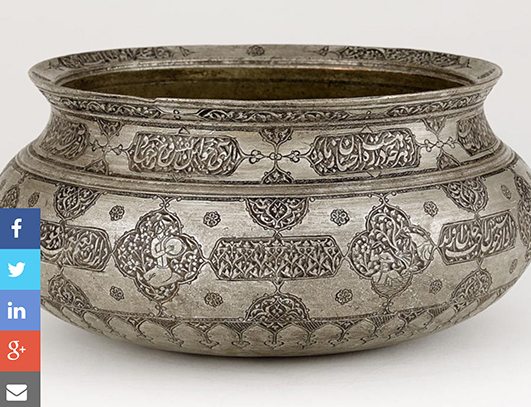
by Antiquities Dealers' Association | Sep 12, 2016 | News, Uncategorized |
 The Global Islamic Economy Gateway (Salaam Gateway) has published an article, titled Ownership, restitution and provenance: The looted Afghan bowl that went around the world and back again, about the restitution of an important Safavid bowl looted from the National Museum of Afghanistan over 20 years ago. Siobhan Forshaw talks to Dr St John Simpson, Assistant Keeper of the Middle East Department at the British Museum, and Christie’s about their part in its recovery. She also airs Dr Simpson’s concerns over the way much of the media have been misreporting data on looted and stolen art linked to the Syrian and Iraqi crisis, the widely promoted but inaccurate view of the art market working on “on a system of nods and winks”, and what should be done to tackle the real issues.
Recent Comments