Anyone who has been involved in the study of the looting and trafficking of antiquities over the past decade knows that no one has any real idea of the figures involved.
The response (or lack of, by some) to the Antiquities Forum’s March 2025 survey on the matter by global authorities involved is a useful snapshot of this state of affairs.
Other sources, such as the 2023 Brodie and Yates report go into more depth on inaccurate claims that have done the rounds for years, and how those claims have embedded themselves in the international debate.
Clues to just how elusive these figures are can be found in the decision by the World Customs Organisation to abandon any attempt to mezasure them after years of trying to do so through their annual Illicit Trade Reports – arguably the source that has given us the most accurate picture so far because of its reach across multiple customs jurisdictions globally.
The single consistent attribute that most claims have shared over the years is that, when traced back to their primary source, they vanish in a puff of smoke.
The Museum of Looted Antiquities (MOLA), launched in 2024, has been striving to do something about it and has certainly come up with some interesting figures in its new report, titled The Great Giveback. The question is: just how accurate and useful are they?
Covering 76 years back to 1950, it has come up with a figure relating to the number of cases (1,870) and objects (1.2 million), and the value of antiquities ($2.15 billion) returned in repatriation cases. “Reported or estimated valuations are available for 58% of the objects and total $2.06 billion in 2024 U.S. dollars,” the report states.
Published data is ‘subject to revision or correction’
Helpfully, it also explains that its data is primarily open-source: “…court records, media reports, academic studies, and other sources available online in a variety of languages, all of which we cite”.
“We’ve collected financial data for over 655,000 looted antiquities – about 45% of the nearly 1.2 million objects we’ve tracked… We drew the values from museum records, auction sales, court records, and law enforcement seizures, and adjusted them for inflation.”
These figures come with the caveat that “many of these records are incomplete and may contain errors or distortions”, so the totals given “are preliminary and subject to revision or correction”.
MOLA notes that “measuring the size of any black market is indeed difficult. As with the trade in illicit drugs, guns, humans and wildlife, most looted antiquities are likely never identified, much less seized and repatriated.”
However, it also argues that because law enforcement extrapolates value estimates for other key areas of risk, such as drugs seizures – and that these are “essential to inform public policy” – it has done the same for antiquities.
“Even with those caveats, the data offer a more complete picture of repatriations – and the antiquities trafficking networks behind these returns – than has been previously available,” MOLA concludes.
Why the claims do not stand up to scrutiny
The data collected on repatriated antiquities allows MOLA to estimate a “lower bound for the size of the illicit antiquities trade”, it argues. “It is at least as big as the number and value of repatriated objects. While far from perfect, such figures are an improvement on what we have now – a collection of anecdotes.”
The problem with these claims is that they don’t stand up to scrutiny. The following analogy explains why.
Consider how much oil has been sold on the world’s markets since 1950. Now consider how much that might be worth. Without being able to name an exact figure, in today’s prices it would be safe to say that it must be at least in the hundreds of trillions of dollars – maybe more.
Now consider what the value of today’s annual global market for oil might be. According to Global Market Research, it is somewhere between $3.5 trillion to $8.4 trillion.
It is clear that these two figures are not related because they measure different things. If quoting the value of today’s global oil market, no one would measure it in terms of the hundreds of trillions of dollars that have been spent in the past 76 years. As with any market, they would quote the annual figures, as given by Global Market research above.
The $2.06 billion dollars quoted by MOLA gives the 76-year total estimated value of trafficked antiquities, not the annual value, and so gives an impression of a vastly inflated current trafficking problem, especially if a significant percentage of what the report terms as ‘trafficked’ is not trafficked, as the following explains.
Thanks to the increasing number of bilateral agreements between (particularly) the USA and third countries, many objects have been repatriated without any evidence being produced at all of them being trafficked.
Concerns over Memoranda of Understanding
The agreements – Memoranda of Understanding (MoUs) – simply give those countries a veto on items being imported to the United States, meaning they can be seized by Customs and sent back to wherever they originally came from. While this is a means of trapping trafficked antiquities, it can also include objects that have been legitimately in circulation for decades and more, but for which documentation demonstrating their original legal export from the source country is no longer available. Lack of complete documentation is the case with almost every antiquity and for perfectly legitimate reasons.
We also know that at least some of these countries operated state-sanctioned antiquities trades for lengthy periods. We know, too, that over the past decade, the New York District Attorney’s Office, through its Antiquities Trafficking Unit, has seized and repatriated thousands of antiquities and artworks, which it estimates to be worth $495 million by September 2026, to source countries or – bizarrely and extraordinarily in the case of Tibet, for instance – to their occupiers/oppressors. Yet, because the ATU’s chief, Assistant District Attorney Matthew Bogdanos, has navigated this operation by exploiting what has been seen as a legal loophole, he has not had to show conclusively that many of these items were trafficked or even illicit. With the recent Intermediate Appeal Court ruling that his actions were themselves not legal, should these hundreds of millions of dollars’ worth of items now be discounted from MOLA’s figures?
It should also be remembered here that the ATU has been extremely opaque over its valuations, refusing to confirm who has been undertaking them, other than to say ‘experts’, while trade estimates of items the ATU valued in the millions have been as low as $7,000. The MOLA report highlights the ATU’s work and the value of repatriations in its Principal Findings, so it is important that its commitment to reviewing all open-source information available about a case before publication be placed in this context.
Transnational operations also raise concerns over accurate reporting
Beyond these considerations are the international enforcement operations masterminded over the past decade and more by Interpol and Europol. From Operations Odysseus to Pandora, they result in the publication of figures showing how many items have been seized and how many arrests made. Photos of seized objects accompany every official report. However, we have never heard how many items later had to be returned as legitimate, nor how many arrests led to convictions. Europol has confirmed that it does not have this data, while Interpol has also never been able to say. Have those figures contributed to MOLA’s data?
Such releases from Interpol and Europol are a small fraction of similar claims that make it into the media unchecked and unquestioned. Antiquities Forum monitors trafficking claims via the media. While increasingly the authorities in places such as Greece and Egypt are proving to be more effective at catching looting gangs red-handed, unverified claims and data reportedly relating to trafficking are legion and should be treated with caution. Seized objects suspected of being illicit are routinely reported as conclusively illicit in media reports and headlines, even when the context does not support that.
What is MOLA’s policy for dealing with such data when using open-source media reports, which it says form part of its research?
Source countries’ change in policy
None of the above accounts for the changing attitudes of source countries that happily parted with items under licensed antiquities trades in the past only to rule now that almost everything they sold off has since become national property and they want it back (without having to pay for it). Are items seized and returned on this basis counted as ‘trafficked’ under MOLA’s figures, as it would seem?
In all this, let’s not forget that vulnerable archaeological sites have been looted as far back as antiquity itself – as evidenced in some of the tomb discoveries in Egypt. Let’s not forget, too, that apart from the less than ethical practices of some authorities, archaeologists and culture tourists of centuries gone by, recent and current conflicts, especially in the Middle and Far East, have created opportunities for criminals to steal.
We all have to be on our guard, which is why the more we can learn about the provenance of objects and the methods of looters and traffickers, the better. The Art Market is only too well aware of this and has been working with UNIDROIT, the European Commission and others on how to solve the issue of what are commonly called ‘orphan objects’. Where MOLA contributes to this accurately, it should be applauded. With all the caveats above, however, it is impossible to tell if that is what it is doing.
The past decade has also taught us that when it comes to regulation and control, evidence is often ignored if it proves inconvenient to the authorities hoping to restrict legitimate trade. It can also be faked, or at least not checked for validity, where a data vacuum lies, as can be seen, for instance, in the ‘evidence’ put forward by the European Commission to justify the 2019/880 Import Licensing Regulation.
Involvement of the Antiquities Coalition
The involvement of the Washington-based Antiquities Coalition (AC), the leading anti-market lobbying organisation, in MOLA’s report, is not reassuring. Not only the funding sponsor, AC members also account for several contributors to the report. Deborah Lehr, Founder and chairman, has written the Foreword, in which she declares that she founded the Antiquities Coalition in 2014 to fill the gap when it comes to data and evidence relating to antiquities trafficking “to change the narrative around cultural racketeering and bring the issue to the attention of the policymakers best positioned to address it”.
She acknowledges the challenges over securing reliable data and declares this new report as “an important step toward addressing that evidence gap”.
The problem is that Lehr herself has been identified as a source of bogus data on the subject – and by the truly independent RAND Report of 2020 (see page 11).
The MOLA report sets out a list of recommendations for international bodies, governments, institutions and the art market. Much of what is recommended (especially for the Art Market) already takes place; other recommendations propose illiberal power grabs or are simply not practical unless all databases recording objects are open to public scrutiny.
What was trafficked and what wasn’t?
In its recommendations, the MOLA report recognises the difference between seizures, forfeitures, negotiated settlements, voluntary returns, and other repatriation mechanisms. Not all of these repatriation solutions relate to trafficking or other crimes. However, as explained above in relation to MoUs, serious concerns over the validity of ATU claims, and other factors, in its analysis of trafficking and the figures given for it, the report appears to ignore this distinction.
All this begs the question as to what MOLA’s objective is here. It argues that extrapolated data used by law enforcement is “essential to inform public policy”, so it is equally essential that policymakers take the full picture into account, including MOLA’s welcome commitment to correcting inaccurate or incomplete data, as well as the concerns set out above.
From the report’s concluding recommendations for the Art Market, it is clear that the $2.06 billion figure is going to be the headline statistic that anti-trade bodies like the Antiquities Coalition use in lobbying Congress, NGOs and others. Remember, that figure has nothing to do with current values for either the legal or illicit markets; it is the estimated/extrapolated figure (in 2024 values) for 58% of the objects MOLA has recorded as trafficked since 1950.
But as a super-inflated picture of current issues it could prove eminently useful in persuading Congressmen and women who don’t have time to check the figures that further regulation and restrictions are required. In her Foreword, Lehr declares that “one of the greatest obstacles to effective action has been the lack of reliable data”. It is difficult to see how this obfuscating report changes that.
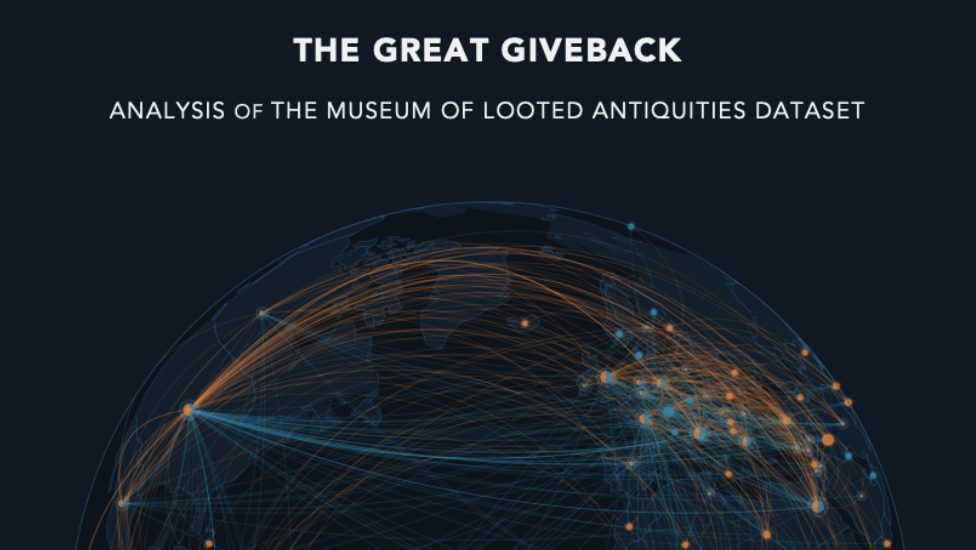
• The image at the top of the article shows a section of the cover page of the new report by the Museum of Looted Antiquities.
Recent Comments